Scientific Name: Strepera versicolor
Population Estimate: Unknown, but Least Concern status
Range / Habitat: Endemic to Australia where found in dry savannah and woodland in the southern part of the country.
Field Notes: Large grey passerine with large, stout bill and yellow eye. White tinged wings and tail and white underneath the tail. There are brown and black forms to this species. The black form is similar to, and in some places overlaps with, Pied Currawong, though lacks the white rump of the latter.
Personal Notes: One of the highlights to an otherwise tiresome trip through the Blue Mountains.
10 July, 2012
07 July, 2012
Australian Golden Whistler
Scientific Name: Pachycephala pectoralis
Population Estimate: Unknown, but Least Concern status
Range / Habitat: Forested and savannah areas in southern and eastern Australia, Indonesia, Fiji, Papua New Guinea, and nearby Islands.
Field Notes: Medium-sized passerine with black cap, extending down to a thick necklace in breeding male. White throat. Bright yellow underparts, extending to a nuchal collar. Wings olive. Females generally drab with olive upper parts, white underneath, and faint yellow under tail. Rufous Whistler similar but with grey cap, not black, and more drab yellow that does not extend to a nuchal collar.
Personal Notes: Photographed at Australian National Botanical Gardens in Canberra, Australia.
Population Estimate: Unknown, but Least Concern status
Range / Habitat: Forested and savannah areas in southern and eastern Australia, Indonesia, Fiji, Papua New Guinea, and nearby Islands.
Field Notes: Medium-sized passerine with black cap, extending down to a thick necklace in breeding male. White throat. Bright yellow underparts, extending to a nuchal collar. Wings olive. Females generally drab with olive upper parts, white underneath, and faint yellow under tail. Rufous Whistler similar but with grey cap, not black, and more drab yellow that does not extend to a nuchal collar.
Personal Notes: Photographed at Australian National Botanical Gardens in Canberra, Australia.
Eastern Spinebill
Scientific Name: Acanthorhynchus tenuirostris
Population Estimate: Unknown, but Least Concern status
Range / Habitat: Endemic to Australia, where found in forested and savannah areas long the east coast and into the southeastern corner of the country.
Field Notes: Fine billed honeyeater with black head and crescent down sides. Red eye. Rufous neck, flanks, and throat patch. Extensive white in outer tail feathers. Non-overlapping with similar Western Spinebill.
Personal Notes: Quite a lucky photo taken at Australian National Botanical Gardens in Canberra.
Population Estimate: Unknown, but Least Concern status
Range / Habitat: Endemic to Australia, where found in forested and savannah areas long the east coast and into the southeastern corner of the country.
Field Notes: Fine billed honeyeater with black head and crescent down sides. Red eye. Rufous neck, flanks, and throat patch. Extensive white in outer tail feathers. Non-overlapping with similar Western Spinebill.
Personal Notes: Quite a lucky photo taken at Australian National Botanical Gardens in Canberra.
Superb Fairywren
Scientific Name: Malurus cyaneus
Population Estimate: Unknown, but Least Concern status
Range / Habitat: Endemic to Australia, where found in forested areas in southeastern part of the country.
Field Notes: Small passerine with long, thin tail almost always cocked up. Female light brown above, white below, with orange patch around the eye (bottom photo). Juveniles and non breeding males similar except tail blue. Breeding males with black upper parts, white underneath, and bright blue cap, cheek patch, and collar around back of neck (top photo). Non-overlapping with similar Splendid Wren.
Personal Notes: Quite common around Canberra, particularly in the Australian National Botanical Gardens. As it was winter, we were surprised to find a male in breeding plumage, which Richard persevered to get an excellent photo of! Later seen in abundance on the coast, where they were jumping straight up into the air to get bugs.
Nankeen Kestrel
Scientific Name: Falco cenchroides
Population Estimate: Unknown, but Least Concern status
Range / Habitat: Open areas throughout Australia, Papua New Guinea, and nearby Islands. Occasionally found in New Zealand.
Field Notes: Small falcon with rufous upper parts and white underparts. Male with grey cap, female with rufous as above.
Personal Notes: Several of these birds seen on a lovely drive between the Blue Mountains and Canberra, Australia.
Population Estimate: Unknown, but Least Concern status
Range / Habitat: Open areas throughout Australia, Papua New Guinea, and nearby Islands. Occasionally found in New Zealand.
Field Notes: Small falcon with rufous upper parts and white underparts. Male with grey cap, female with rufous as above.
Personal Notes: Several of these birds seen on a lovely drive between the Blue Mountains and Canberra, Australia.
06 July, 2012
White-winged Chough
Scientific Name: Corcorax melanoramphos
Population Estimate: Unknown, but Least Concern status
Range / Habitat: Endemic to Australia where found in woodland and scrubland of eastern part of the country.
Field Notes: Large, sociable black bird with hooked bill and red eye. Large white patch in wing, noticeable in flight.
Personal Notes: Seen in Australian National Botanic Gardens in Canberra, Australia.
Diamond Dove
Scientific Name: Geopelia cuneata
Population Estimate: Unknown, but Least Concern status
Range / Habitat: Endemic to Australia where found in arid regions throughout the country.
Field Notes: Small dove with grey head and neck, brown wings with white spots and white underneath. Red ring around eye. Peaceful Dove with extensive barring and blue eye ring.
Personal Notes: Seen at an aviary in Canberra, Australia
Population Estimate: Unknown, but Least Concern status
Range / Habitat: Endemic to Australia where found in arid regions throughout the country.
Field Notes: Small dove with grey head and neck, brown wings with white spots and white underneath. Red ring around eye. Peaceful Dove with extensive barring and blue eye ring.
Personal Notes: Seen at an aviary in Canberra, Australia
Galah
Scientific Name: Eolophus roseicapilla
Population Estimate: Unknown, but Least Concern status
Range / Habitat: Endemic to Australia where found in woodlands, grasslands, and urban areas throughout the country.
Field Notes: Large, loud grey bird with pink head and neck. Unmistakable in range.
Personal Notes: "The pigeon of Canberra."
Population Estimate: Unknown, but Least Concern status
Range / Habitat: Endemic to Australia where found in woodlands, grasslands, and urban areas throughout the country.
Field Notes: Large, loud grey bird with pink head and neck. Unmistakable in range.
Personal Notes: "The pigeon of Canberra."
Spotted Pardalote
Scientific Name: Pardalotus punctatus
Population Estimate: Unknown, but Least Concern status
Range / Habitat: Endemic to Australia where found in forest and savannah in the east and south of the country.
Field Notes: Small passerine with black head and wings with white spots and extensive white eyebrow. Throat and flanks yellow. Unmistakable in range.
Personal Notes: Photographed at the Australian National Botanical Gardens of Canberra, Australia.
Population Estimate: Unknown, but Least Concern status
Range / Habitat: Endemic to Australia where found in forest and savannah in the east and south of the country.
Field Notes: Small passerine with black head and wings with white spots and extensive white eyebrow. Throat and flanks yellow. Unmistakable in range.
Personal Notes: Photographed at the Australian National Botanical Gardens of Canberra, Australia.
Crimson Rosella
Scientific Name: Platycercus elegans
Population Estimate: Unknown, but Least Concern status
Range / Habitat: Forested and artificial habitats throughout Australia. Introduced to New Zealand and Norfolk Island.
Field Notes: Classically a red parrot with blue wings, tail and cheek patch as above. Variants throughout Australia may have yellow, green, or orange bodies. Western Rosella orange body with yellow cheek patch. Eastern Rosella with red head and neck but yellow chest and white cheek patch.
Personal Notes: "Road parrot" common throughout parts of NSW. The taxonomy of the rosellas is still quite a topic for debate.
Population Estimate: Unknown, but Least Concern status
Range / Habitat: Forested and artificial habitats throughout Australia. Introduced to New Zealand and Norfolk Island.
Field Notes: Classically a red parrot with blue wings, tail and cheek patch as above. Variants throughout Australia may have yellow, green, or orange bodies. Western Rosella orange body with yellow cheek patch. Eastern Rosella with red head and neck but yellow chest and white cheek patch.
Personal Notes: "Road parrot" common throughout parts of NSW. The taxonomy of the rosellas is still quite a topic for debate.
Hoary-headed Grebe
Scientific Name: Poliocephalus poliocephalus
Population Estimate: Unknown, but Least Concern status.
Range / Habitat: Found on inland wetlands throughout Australia and in parts of New Zealand.
Field Notes: Small waterfowl with tufted rear, characteristic of grebes. Overall grey but head finely striped black and white. Australasian Grebe has rufous cheek patch and yellow behind bill.
Personal Notes: Photographed in Canberra, Australia.
Population Estimate: Unknown, but Least Concern status.
Range / Habitat: Found on inland wetlands throughout Australia and in parts of New Zealand.
Field Notes: Small waterfowl with tufted rear, characteristic of grebes. Overall grey but head finely striped black and white. Australasian Grebe has rufous cheek patch and yellow behind bill.
Personal Notes: Photographed in Canberra, Australia.
Australasian Grebe
Scientific Name: Tachybaptus novaehollandiae
Population Estimate: Unknown, but Least Concern status
Range / Habitat: Found on inland, freshwater wetlands in most of Australia, New Zealand, Indonesia, Papua New Guinea, and nearby Pacific islands.
Field Notes: Small waterfowl with tufted appearance to the rear, characteristic of grebes. Generally grey-brown overall, with head somewhat darker. Rufous cheek patch and yellow behind bill. Hoary-headed Grebe with thin black and white stripes on head.
Personal Notes: Photographed in Canberra, and then Chiltern, Australia.
Population Estimate: Unknown, but Least Concern status
Range / Habitat: Found on inland, freshwater wetlands in most of Australia, New Zealand, Indonesia, Papua New Guinea, and nearby Pacific islands.
Field Notes: Small waterfowl with tufted appearance to the rear, characteristic of grebes. Generally grey-brown overall, with head somewhat darker. Rufous cheek patch and yellow behind bill. Hoary-headed Grebe with thin black and white stripes on head.
Personal Notes: Photographed in Canberra, and then Chiltern, Australia.
Straw-necked Ibis
Scientific Name: Threskiornis spinicollis
Population Estimate: 1M
Range / Habitat: Wetlands, pasture and grasslands of northern and eastern Australia, parts of Indonesia, and Papua New Guinea.
Field Notes: Black back, wings and head with white neck and underparts. Long yellow plumes on neck. Glossy Ibis with no white and Australian White Ibis with white back and wings.
Personal Notes: Photograph taken in Canberra, Australia.
Population Estimate: 1M
Range / Habitat: Wetlands, pasture and grasslands of northern and eastern Australia, parts of Indonesia, and Papua New Guinea.
Field Notes: Black back, wings and head with white neck and underparts. Long yellow plumes on neck. Glossy Ibis with no white and Australian White Ibis with white back and wings.
Personal Notes: Photograph taken in Canberra, Australia.
04 July, 2012
Grey Butcherbird
Scientific Name: Cracticus torquatus
Population Estimate: Unknown, but Least Concern status
Range / Habitat: Endemic to Australia where found in woodland, scrubland, and urban areas in the southern two-thirds of the continent, exclusive of Tasmania.
Field Notes: Medium-sized passerine with black head, grey back, white breast and neck patch. Bill is large, hooked and blue with black tip. Pied Butcherbird has black back and white collar extending all the way around the neck.
Personal Notes: Our 800th bird!
Population Estimate: Unknown, but Least Concern status
Range / Habitat: Endemic to Australia where found in woodland, scrubland, and urban areas in the southern two-thirds of the continent, exclusive of Tasmania.
Field Notes: Medium-sized passerine with black head, grey back, white breast and neck patch. Bill is large, hooked and blue with black tip. Pied Butcherbird has black back and white collar extending all the way around the neck.
Personal Notes: Our 800th bird!
New Holland Honeyeater
Scientific Name: Phylidonyris novaehollandiae
Population Estimate: Unknown, but Least Concern status
Range / Habitat: Endemic to Australia where found in undergrowth of woodland and open areas where banksia species found, primarily in southwest and southeast Australia, including Tasmania.
Field Notes: Medium-sized passerine with long, slender, decurved bill. Largely black and white, boldly streaked, white eye. Yellow on edges of wings and tail. White-cheeked Honeyeater with black eye and larger white cheek patch. Painted Honeyeater with orange bill, white breast and black eye
Personal Notes: Common bird on hike outside Manly, Australia. Unfortunately, one camera had died and the other had no telephoto lens! We hit the camera store in Sydney later that day...and were rewarded with this photo in Ben Boyd NP.
03 July, 2012
Noisy Miner
Scientific Name: Manorina melanocephala
Population Estimate: Unknown, but Least Concern status
Range / Habitat: Endemic to Australia where commonly found in eucalyptus woodland and urban areas of eastern Australia.
Field Notes: Medium-sized grey passerine with white forehead and black crown. Underparts white. Bill decurved and yellow. Also with yellow patch being eye and in wing. Yellow-throated Miner with yellow patch beside throat. Black-eared Miner with black patch behind eye, not crown.
Personal Notes: Noisy, cheeky birds seen in Sydney Royal Botanical Gardens.
Population Estimate: Unknown, but Least Concern status
Range / Habitat: Endemic to Australia where commonly found in eucalyptus woodland and urban areas of eastern Australia.
Field Notes: Medium-sized grey passerine with white forehead and black crown. Underparts white. Bill decurved and yellow. Also with yellow patch being eye and in wing. Yellow-throated Miner with yellow patch beside throat. Black-eared Miner with black patch behind eye, not crown.
Personal Notes: Noisy, cheeky birds seen in Sydney Royal Botanical Gardens.
Australian Raven
Scientific Name: Corvus coronoides
Population Estimate: Unknown, but Least Concern status
Range / Habitat: Endemic to Australia where found in woodland and open habitats throughout the eastern half of the country, along the southern coast, and into the southwestern corner.
Field Notes: Large, all black corvid with yellow eye and long hackles around neck. Distinguished from other all-black birds within its range (such as Little Raven) by high-pitched, wailing cry.
Personal Notes: Seen on North Head of Manly, near Sydney.
Population Estimate: Unknown, but Least Concern status
Range / Habitat: Endemic to Australia where found in woodland and open habitats throughout the eastern half of the country, along the southern coast, and into the southwestern corner.
Field Notes: Large, all black corvid with yellow eye and long hackles around neck. Distinguished from other all-black birds within its range (such as Little Raven) by high-pitched, wailing cry.
Personal Notes: Seen on North Head of Manly, near Sydney.
02 July, 2012
Pied Currawong
Scientific Name: Strepera graculina
Population Estimate: Unknown, but Least Concern status
Range / Habitat: Endemic to eastern Australia where found in forest, woodlands and urban areas.
Field Notes: Large, black bird with thick bill and yellow eye. White in wing, rump, under tail coverts, and tip of tail. Distinctive voice. Often found in large flocks in winter, but breed in isolation. Non-overlapping with Black Currawong. Grey Currawong overlaps in southeastern Australia. It is most commonly grey, but black (or clinking) form lacks white rump.
Personal Notes: Seen at Sydney Royal Botanical Gardens
Population Estimate: Unknown, but Least Concern status
Range / Habitat: Endemic to eastern Australia where found in forest, woodlands and urban areas.
Field Notes: Large, black bird with thick bill and yellow eye. White in wing, rump, under tail coverts, and tip of tail. Distinctive voice. Often found in large flocks in winter, but breed in isolation. Non-overlapping with Black Currawong. Grey Currawong overlaps in southeastern Australia. It is most commonly grey, but black (or clinking) form lacks white rump.
Personal Notes: Seen at Sydney Royal Botanical Gardens
Australian Ibis
Scientific Name: Threskiornis molucca
Population Estimate: Unknown, but Least Concern status
Range / Habitat: Wetlands and artificial habitats throughout much of Australia, parts of Indonesia, Papua New Guinea, and the Solomon Islands.
Field Notes: Large, white ibis with bare black head and neck, black bill, and black plumed tail feathers. Straw-necked Ibis has black back and wings.
Personal Notes: Ubiquitous at Sydney Royal Botanical Gardens.
14 April, 2012
Plumed Whistling-duck
Population Estimate: 100K - 1M, Least Concern status
Range / Habitat: Found in inland wetlands in New Guinea and Australia.
Field Notes: Slender, brown-coloured duck with a long neck. Characteristic "tiger" patch with elegant white plumes arising from its flanks.
Personal Notes: Seen at the Melbourne Zoo, Australia.
Australian Shelduck
Population Estimate: 340K - 1.2M
Range / Habitat: Found in open wetlands in southern Australia and Tasmania. They occasionally appear in New Zealand.
Field Notes: Large, black-headed duck with white neck ring and chestnut breast. Black back and wings with large chestnut and white patches in wing. Female with white eye ring and white base of bill, as above.
Personal Notes: Seen at the Melbourne Zoo, Australia.
Common Myna
Population Estimate: Unknown, but Least Concern status
Range / Habitat: Found in open woodlands and artificial habitats. Its initial home range spanned from Iran, and southern Asia including Pakistan, India, Nepal, Bhutan, Bangladesh and Sri Lanka, Turkmenistan, Afghanistan, Kazakhstan, Myanmar, Malaysia, peninsular Thailand, Indo-China and China.
An introduced species to Canada, Australia, Israel, New Zealand, New Caledonia, Hawaii, South Africa, and a variety of islands in the Indian, Atlantic and Pacific Oceans.
Field Notes: Medium-sized passerine with black head, brown body, and white "windows" in the wings. Yellow bill, legs, and eye patch.
Personal Notes: Seen at the Royal Botanical Gardens in Melbourne, Australia.
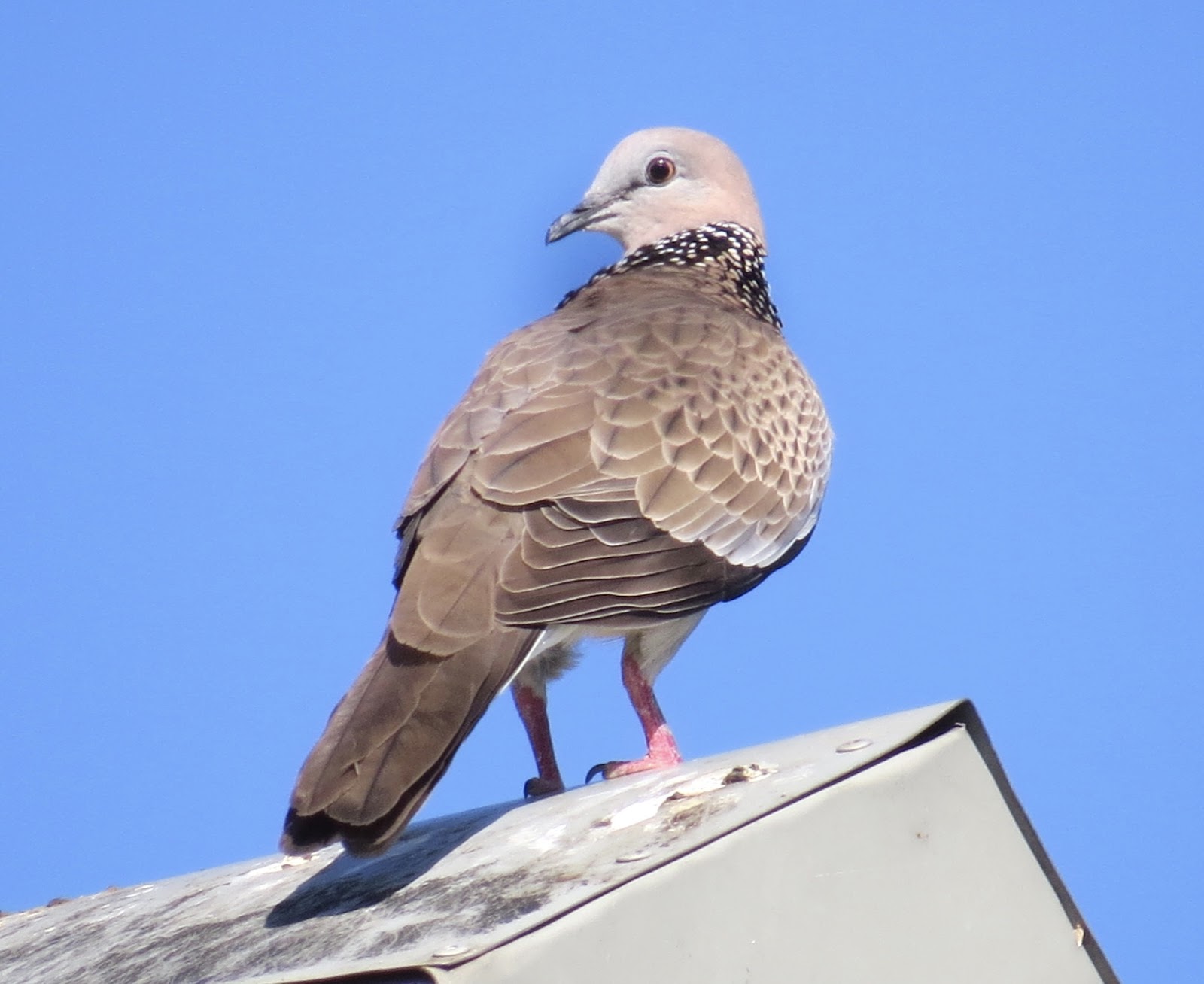
Spotted Dove
Population Estimate: Unknown, but Least Concern status
Range / Habitat: Original range is the Indian Subcontinent including India, Pakistan, Nepal and Sri Lanka east to southern Tibet and Southeast Asia. It has been introduced to Hawaii and Southern California, Singapore, the Philippines, northern Indonesia, Bangladesh, and eastern Australia.
Field Notes: Large dove with dusky rose to grey head, neck, and belly. Wings brown. Distinctive black neck patch with white spots.
Personal Notes: Seen at the Royal Botanical Gardens in Melbourne, Australia.
Nankeen Night Heron
Scientific Name: Nycticorax caledonicus
Population Estimate: 110K - 1.1M
Range / Habitat: Inland wetlands and coastal areas throughout Australia except the arid inland, Indonesia, the Philippines, Papua New Guinea and Melanesia.
Field Notes: Stocky, rufous heron with white underparts and a black cap. As typical with herons, the juvenile form is completely streaked brown and white as in the lower photo. Black-crowned Night Heron (which only overlaps in Indonesia and the Philippines) has dark grey wings and back.
Personal Notes: Seen at the Royal Botanical Gardens in Melbourne, Australia. Also known as Rufous Night Heron.
Dusky Moorhen
Population Estimate: Unknown, but Least Concern status
Range / Habitat: Inland wetlands and artificial habitats in eastern Australia, New Guinea, and Indonesia.
Field Notes: Medium-sized freshwater bird, dusky colored throughout. Red face shield. Bill red with yellow tip. White patches on each side under tail. Eurasian Coot has white face shield. Purple Swamphen larger, bright purple underparts, and all red bill.
Personal Notes: Seen at the Royal Botanical Gardens in Melbourne, Australia.
White-browed Scrubwren
Population Estimate: Unknown, but Least Concern status
Range / Habitat: Endemic to Australia, where found in scrubland, forest, and sheltered artificial habitats throughout the south and east.
Field Notes: Small warbler which spends most of its time on the ground. Variable plumage, but typically white breast and eyebrow, brown upper parts, dark lores. Black spot on wing with white stippling also a helpful field mark.
Personal Notes: Seen at the Royal Botanical Gardens in Melbourne, Australia. Some sources consider this a subspecies.
Willie Wagtail
Population Estimate: Unknown, but Least Concern status
Range / Habitat: Found in most habitats, excluding thick forest, in Australia, New Guinea, Solomon Islands, and eastern Indonesia.
Field Notes: Large, black fantail with white belly and eyebrows. Spends much time on ground, seen less frequently in air compared to Grey Fantail, for example. The latter also with white throat.
Personal Notes: Seen at the Royal Botanical Gardens in Melbourne, Australia.
Bell Miner
Population Estimate: Unknown, but Least Concern status
Range / Habitat: Endemic to Australia, where found in wooded areas in the southeast, exclusive of Tasmania.
Field Notes: Medium-sized, olive-green passerine with yellow bill and legs and orange patch behind the eye. Sociable bird with loud, bell-like call.
Personal Notes: Seen at the Royal Botanical Gardens in Melbourne, Australia.
Silver Gull
Population Estimate: 100K - 1M
Range / Habitat: Found on costal and inland waterways throughout Australia and Tasmania.
Field Notes: Medium-sized white-headed gull with light grey mantle. Adults with striking red bill, eye ring and feet as in top photo. Juveniles with dusky bill and legs as in bottom photo. Similar in appearance to Red-billed Gull in New Zealand, with which some sources consider it conspecific.
Personal Notes: Seen at the Royal Botanical Gardens in Melbourne, Australia.
Subscribe to:
Posts (Atom)