29 November, 2010

Rufous-tailed Hummingbird


Scientific Name: Amazilia tzacatl

Population Estimate: 500K-5M

Range / Habitat: Resident in southeast Mexico through Central America into northern South America. Habitat is subtropical and tropical lowland moist forest.

Field Notes: Rufous tail is a distinguishing feature with great head and back, white belly. Buff-bellied Hummingbird actually rufous on belly. Cinnamon Hummingbird rufous belly to chin.

Personal Notes: Seen at Chaa Creek Reserve, Belize.

26 November, 2010

Red-legged Honeycreeper


Scientific Name: Cyanerpes cyaneus

Population Estimate: 5M-50M

Range / Habitat: Resident in low altitude forest edge and plantations in southern Mexico and Central America.

Field Notes: Small size for a tanager, slight decurved bill, yellow underneath, black eyestripe with white eyebrow. Male striking bright blue and black with bright red legs. Female with dark legs. Compared to other honeycreepers in this area, Green Honeycreeper lacks striping on chest. Similar to Shining Honeycreeper but in the absence of seeing the distinguishing red legs, the lower elevation makes this most likely a Red-legged Honeycreeper.

Personal Notes: Seen on the way to Tikal from Belize. Also seen in Muyil in the Yucatan Peninsula and again in costal CR.

Roadside Hawk


Scientific Name: Buteo magnirostris

Population Estimate: 500K-5M

Range / Habitat: Common resident throughout Mexico, Central America and most of South America. Preferred habitat is lowland moist forest but adapted to urban settings as well.

Field Notes: Medium-sized hawk with relatively long tail and short primaries. Head grey and relatively unmarked in adult. Eye, cere, and legs yellow. Belly barred rufous. Differentiated from Grey Hawk by rufous belly and yellow eye.

Personal Notes:

Crested Guan

Scientific Name: Penelope purpurascens

Range / Habitat: Year-round resident of both slopes of Mexico into Central America. Habitat is tropical lowland moist forest.

Field Notes: Large, fowl-like bird with long tail. Dark brown with white streaking, red eye and wattle, grey-blue mask and bill. Differentiated by Highland Guan primarily by habitat.

Personal Notes: Seen at the Tikal ruins in Guatemala.

Common Ground Dove

Scientific Name: Columbina passerina

Population Estimate: 2M

Range / Habitat: Year-round resident in southern US, Mexico, Central American and into northern South America. Resident on Caribbean islands as well. Prefers tropical lowland dry shrub and savanna.

Field Notes: Small ground dove greyish-brown throughout, scaly chest, violet wing spots. White corners on tail and rufous patch in wing visible in flight. Plain-breasted Ground-dove lacks scaling on chest and orange bill. Ruddy Ground-dove with more rufous in male, though female can be difficult to distinguish. Inca Dove larger with longer tail and more extensive scaling.

Personal Notes:

Plain-breasted Ground Dove

Scientific Name: Columbina minuta

Population Estimate: 5M - 50M

Range / Habitat: Resident of southern Mexico through Central America and into South America, excluding Argentina and Chile. Prefers tropical lowland dry shrub and savanna.

Field Notes: Small ground dove with plain coloring. Lacks orange bill and scaly chest of the Common Ground-dove. Lacks the rufous coloring of the Ruddy Ground-dove.

Personal Notes:

22 November, 2010

Scissor-tailed Flycatcher

Scientific Name: Tyrannus forficatus

Population Estimate: 8M

Range / Habitat: Breeds in the southwestern US and into northeastern Mexico. Forms large premigratory roosts in late summer, with up to 1,000 birds in one flock. Winters in southern Mexico through Central America. Found on dry savanna, grassland, and moist shrubland.

Field Notes: Tyrant flycatcher, grey above and white below with salmon belly. Markedly long forked tail. Winter sympatric with Fork-tailed Flycatcher in Mexico and Central America, which has a black cap and a relatively longer tail.

Personal Notes: Seen on the Mennonite farmland in central Belize.

Fork-tailed Flycatcher

Scientific Name: Tyrannus savana

Population Estimate: 5M-50M

Range / Habitat: Breeds from central Mexico through central Argentina. Known to wander wildly, with sightings in the eastern United States up to Canada. Found on dry savanna and moist shrubland.

Field Notes: Tyrant flycatcher, grey above, white below with black cap and exceptionally long forked tail. Tail longest in males, shorter in females, and shortest in juveniles. Scissor-tailed Flycatcher, with whom it overlaps in southern Mexico and Central America in winter, lacks the black cap and has a relatively shorter tail.

Personal Notes: Seen on Mennonite farmland in central Belize.

Scrub Euphonia


Scientific Name: Euphonia affinis

Population Estimate: 500K-5M

Range / Habitat: Both coasts of southern Mexico, the Yucatan, into Central America. Habitat is lowland forest edge and scrub.

Field Notes: Typical euphonia: short and stubby with a prominent forehead spot. This bird frequently associates with Yellow-throated Euphonia, which has a yellow, not black, throat. The sympatric White-vented Euphonia has the black throat but a white vent.

Personal Notes: Seen at Chaa Creek Resort in Belize

Olive-backed Euphonia

Scientific Name: Euphonia gouldi

Population Estimate: 50K-500K

Range / Habitat: Resident from SE Mexico through Central America. Prefers moist lowland forest.

Field Notes: Small, stubby passerine with characteristic forehead spot of the euphonia (not readily seen in the above photos). Distinctive plumage for euphonias: olive-grey throughout, males with yellow forehead and rust belly and vent (bottom photo). Female with rust forehead and vent only (top photo).

Personal Notes: Seen at Tikal in Guatemala.

White-tipped Dove

Scientific Name: Leptotila verreauxi

Population Estimate: 20M

Range / Habitat: Resident of Mexico, though Central America, into much of South America. Prefers lowland scrub and dry forest.

Field Notes: Typical of the genus, has yellow eyes, black bill, and red legs. Tail feathers are white-tipped, which can typically be seen only in flight (or, as in the photo above, you get a view from underneath).

Personal Notes: Seen at Chaa Creek Resort, Belize, then again in Monteverde, Costa Rica

Great Curassow

Scientific Name: Crax rubra

Range / Habitat: Fragmented distribution in lowland rainforest throughout southern Mexico, Central America, and into northern South America.

Field Notes: Large, fowl-type bird, most commonly seen on the ground. Male all black. Female black and brown. Curly crown feathers in both sexes unmistakable.

Personal Notes: As is evident from the blurry photo above, we caught a fleeting glimpse of a group of these birds while leaving Tikal in Guatemala.

21 November, 2010

Plain Chachalaca

Scientific Name: Ortalis vetula

Range / Habitat: Resident throughout eastern coast of Mexico, Yucatan, and into Central America. Favors lowland shrub and forest. 

Field Notes: Large, noisy fowl-like bird often found in trees. Overall brown with long, broad tail. Face is grey and red gular stripe sometimes apparent. Grey-headed Chachalaca with bright rufous primaries. 

Personal Notes: A surprisingly shy bird for its size and the amount of noise it makes.

Black Catbird

Scientific Name: Melanoptila glabrirostris

Population Estimate: 20K to 50K, Near Threatened status

Range / Habitat: From Yucatan peninsula in Mexico to Belize and Guatemala. Fairly common resident Cozumel Island and Ambergris Caye, Belize. Found in lowland shrub areas.

Field Notes: Secretive bird, all black with blue sheen. Black eye. Smaller bill than other all-black birds in the same distribution. Grey Catbird can overlap in winter but dark grey with black cap, rufous vent and distinctive call.

Personal Notes: The population in Ambergris and Calker Cayes have some white, which we observed on the wing tips of one bird. We subsequently saw this bird on the El Rey ruins in Cancun, Mexico, where it was delightfully common despite its Near Threatened status. 

Common Black Hawk

Scientific Name: Buteogallus anthracinus

Population Estimate: 2M

Range / Habitat: From southwestern US through Mexico and Central America. Some of the Carribean Islands as well. Common coastal bird, found in mangrove swamps, estuaries, and adjacent forests.

Field Notes: Adult all black above and below with one broad white band in tail and yellow cere and lores. Juvenile with streaked white breast, dark back, several thin white bands in tail. Differentiated from Great Black Hawk by habitat, shorter tail, malar stripe (in juvenile).

Personal Notes: We have only ever seen a juvenile hawk, first on Ambergris Caye, Belize and then on the El Rey archeological ruins in Cancun, Mexico. 

Rose-throated Becard

Scientific Name: Pachyramphus aglaiae

Population Estimate: 2M

Range / Habitat: Resident throughout Mexico and Central America in lowland forest.

Field Notes: Small, active passerines. Male (above) and female (below) are distinct from one another and distinctive from other species. Male with black head, back and wings, light grey breast, rose-colored throat. Female with black cap, brown wings and back, yellow breast.

Personal Notes: Identified by our guide in San Blas, Mexico. We had subsequent opportunity to see both male and female at Chaa Creek resort in Belize.

Bright-rumped Attila

Scientific Name: Attila spadiceus

Population Estimate: 500K to 5M

Range / Habitat: Resident species throughout Mexico, Central and northern South America. Prefers lowland forest.

Field Notes: Large, bulky flycatcher with large head, prominent whiskers and hooked bill. Droopy tail while perched with prominent yellow rump.

Personal Notes: Seen at Tikal Mayan ruins in Guatemala.

Collared Aracari

Scientific Name: Pteroglossus torquatus

Population Estimate: 500K to 5M

Range / Habitat: Resident throughout Mexico, Central America, and northern South America, primarily in lowland forest.

Field Notes: Unmistakable in range, as above.

Personal Notes: We were fortunate to see many of these birds at Chaa Creek resort in the jungle of Belize. They were feasting on palm fruits which happened to be ripe the week we were there. We saw them again at Nayara Hotel at Arenal, where they were much more retiring.

Red-throated Ant Tanager

Scientific Name: Habia fuscicauda

Population Estimate: 500K to 5M

Range / Habitat: Resident species in Mexico and Central America. Found in lowland forest and shrub.

Field Notes: Darker lores and wings than male Summer Tanager and Hepatic Tanager. Also differentiated by all black bill. From Red-crowned Ant-tanager by lighter throat and distribution.

Personal Notes: Seen at Chaa Creek resort in Belize.

27 September, 2010

Broad-winged Hawk


Scientific Name: Buteo platypterus

Population Estimate: 1.8M, Least Concern status

Range / Habitat: Summers throughout deciduous forests in the eastern United States. Winters in Central American and northern South America.

Field Notes: Medium-sized, stocky, forest-dwelling hawk. Reddish barred underparts. Pale wings with dark trailing edge white single to multiple white band across dark tail when seen in flight. Forms large kettles in migration. Red-tailed Hawk has pale chest with dark belly band and red tail in flight. Cooper's Hawk and Sharp-shinned Hawk are accipiters and have relatively long tails and short wings. 

Personal Notes: First seen at the Minnesota Landscape Arboretum, later the Fontanelle Forest in Omaha.

07 September, 2010

Burrowing Owl


Scientific Name: Athene cunicularia

Population Estimate: 2M

Range / Habitat: Year-round throughout the American Southwest, and parts of South America. Summers in the American West and winters in Mexico. Builds or inhabits burrows on the ground.

Field Notes: Small owl with no ear tufts. Bars on front, spots on back. Found on open ground as in the photo above.

Personal Notes: Thanks to Birdchick for this photo!

08 August, 2010

Pigeon Guillemot


Scientific Name: Cepphus columba

Population Estimate: 470K

Range / Habitat: Year-round in Pacific coast of North America, from Alaska down to California.

Field Notes: Medium-sized water bird. All black except for white wing patches and bright red feet. Whistling call.

Personal Notes:

Glaucous-winged Gull


Scientific Name: Larus glaucescens

Population Estimate: 570K

Range / Habitat: Northwest coast of North America

Field Notes: Large gull with light grey mantle and wing tips. Note grey underside of wing extending to tip in the upper photo (distinguishes Glaucous-winged Gull from Glaucous Gull, which has all white wing tips).

Personal Notes:

04 August, 2010

Red-throated Diver

Scientific Name: Gavia stellata

Population Estimate: 200K - 600K, Least Concern status

Range / Habitat: Breeds in low tundra wetlands, bogs, and ponds in forests throughout the circumpolar Arctic. Winters on inshore waters along sheltered coasts, occasionally on inland ponds or lakes throughout northern latitudes.

Field Notes: The smallest of the divers. Light grey in breeding plumage with prominent red throat. Pale grey and white in winter. Small bill often turned upwards. 

Personal Notes: A surprise find in Denali National Park. The bus guide (who was supposed to be looking for bears and moose) spotted this bird. We later found this bird on a nest in Iceland, followed by another sighting near the Valagil waterfall in the West Fjords. Also known as Red-throated Loon. 

25 July, 2010

Alder Flycatcher

Scientific Name: Empidonax alnorum

Population Estimate: 50M, Least Concern status

Range / Habitat: Summers in most of Alaska, Canada and New England. Winters in a swath of western South America. Favors moist shrubland habitat.

Field Notes: Medium-sized flycatcher of wet thickets. Drab olive on upper parts with two white wing bars. White underneath. Partial eye ring. Essentially identical to Willow Flycatcher, though with limited overlap in range in the northeastern United States and distinct songs.

Personal Notes:

23 July, 2010

Red-necked Grebe


Scientific Name: Podiceps Grisegena

Population Estimate: 200K - 300K

Range / Habitat: The two subspecies of the red-necked grebe have distinct ranges. The North American and east Asian subspecies, Podiceps grisegena holboelli, is found in western Canada and the northwest USA, as well as eastern Russia, northeast China and northern Japan. In North America, the red-necked grebe breeds in Alaska, Yukon Territory and the Northwest territories, east to southwest Quebec, and south to Oregon, Idaho, Wyoming, Montana, South Dakota, Minnesota, Wisconsin and southern Ontario.

Field Notes: The upperparts are dark brownish-black and the wings are dark, with two prominent white patches. In breeding plumage, the red-necked grebe has a black cap that extends below the eye, with a slight crest and a large, distinctive pale grey check patch that has whitish margins and extends upward to behind the eye. The front of the neck and the upper breast are deep chestnut, becoming paler on the belly, while the sides and flanks are greyish.

Personal Notes:

21 July, 2010

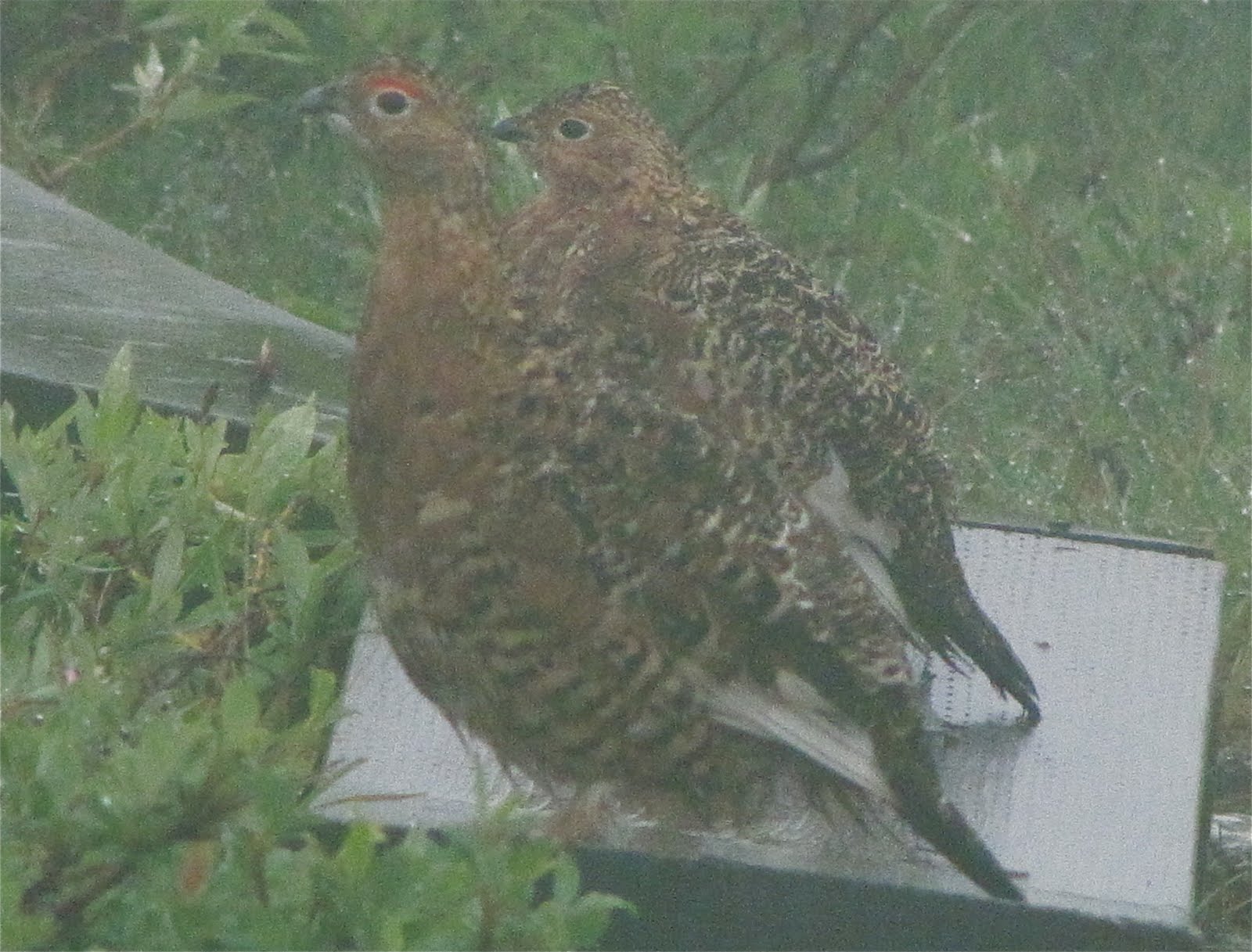
Willow Grouse

Scientific Name: Lagopus lagopus

Population Estimate: 40M

Range / Habitat: Year-round in Arctic regions throughout the world.

Field Notes: Mottled brown and white in the summer, all white in the winter. Males with orange or red markings above the eyes. Rock Ptarmigan is slightly smaller, found at higher altitudes with less lush vegetation, has more grey tones in summer, and may have a black eye stripe in winter.

Personal Notes: The bottom photo was taken on a soggy, foggy day on the Pinnell Mountain Trail outside of Fairbanks, Alaska. Though I got a better photo at Denali, above, I left the bottom one in to show off the orange marking above the eye.

19 July, 2010

Mew Gull


Scientific Name: Larus Canus

Population Estimate: 2.5M - 3.7M

Range / Habitat: The common gull has a wide distribution, breeding throughout temperate and sub-Arctic parts of Eurasia. Two subspecies occur in Europe, the ‘nominate’ race L. c. canus is the subspecies occurring in Britain, extending through north-west Europe and reaching the White Sea in Russia. There is also a subspecies that occurs in North America. In Britain, this species breeds mainly in Scotland

Field Notes: It is generally similar in appearance to the herring gull (Larus argentatus) but is smaller, and has a smaller, thinner bill, a more rounded head and more active flight. The upperwings are pale grey in colour and have black tips featuring white spots known as ‘mirrors’. The white head develops grey streaks in winter and the legs and bill are greenish-yellow. Juveniles are greyish brown with brown upperparts.

Personal Notes:

Yellow-billed Loon

Scientific Name: Gavia adamsii

Population Estimate: 16-32K, Near Threatened

Range / Habitat: Breeds in Russia, Alaska and Canada primarily on inland freshwater lakes and ponds. Winters at sea mainly off the coasts of Norway and western Canada.

Field Notes: Typical loon shape and habits. Distinguishing feature is large, yellow, slightly upturned bill.

Personal Notes: A rare find in Fairbanks in a fairly small pond. This bird is not usually this far inland.

18 July, 2010

Sand Martin

Scientific Name: Riparia riparia

Population Estimate: 50M

Range / Habitat: Summers in the northern US, Canada, Alaska. Winters in the tropics. Also common throughout Europe and Asia. Favors inland wetland areas.

Field Notes: Typical swallow / martin that is brown above and white below with a brown chest band. The Northern Rough-winged Swallow is similar but lacks the chest band.

Personal Notes: Also known as a Bank Swallow. This was a pleasant (but not uncommon) surprise find in Alaska among several Tree and Barn Swallows.

15 July, 2010

Common Yellowthroat

Scientific Name: Geothlypis trichas

Population Estimate: 32M, Least Concern status

Range / Habitat: Summers throughout most of the eastern US and Canada. Winters in Mexico and Central America. Favors inland wetland habitats. 

Field Notes: Olive-backed songbird with yellow throat. Males with prominent black mask and white stripe above (as in the photos), females without. Song a repeated "witch-it-ty."

Personal Notes: We first saw this bird on a trip to Rhode Island, to visit Ted and Jo. 

Northern Mockingbird


Scientific Name: Mimus polyglottos

Range / Habitat: Year-round in shrub land throughout the United States and Mexico.

Field Notes: Medium-sized grey songbird with long tail, dark wings with white wing bars, and a black eye stripe. Similar overall appearance to both the Loggerhead and Great Grey Shrike, but the shrikes have slightly different ranges and wide black mask instead of an eye stripe. Townsend's Solitaire is also similar but has a more restricted range, is the same shade of grey all over, and has a white eye ring instead of a black eye stripe.

Personal Notes: It was remarkable to watch and listen to this bird with a seemingly endless array of different melodies.