Scientific Name: Phalacrocorax aristotelis
Range / Habitat: Marine bird with strong preference for rocky coasts and islands. Year-round on the Atlantic coast of Europe, including western Iceland, and in the Mediterranean.
Field Notes: Medium-sized cormorant, with short tail, glossy back overall. Eye turquoise, base of gape yellow. Crest in non-breeding plumage.
Personal Notes: Seen initially on the rocky coast of Snaefellsjokull National Park, Iceland. The mom and chick later seen in Breidafjordur Bay, Iceland.
Showing posts with label cormorants / shags. Show all posts
24 June, 2014
04 December, 2011
Little Black Cormorant
Scientific Name: Phalacrocorax sulcirostris
Population Estimate: 110K - 1M
Range / Habitat: In lakes, estuaries and harbors in Australia, New Zealand, Indonesia, and Paupa New Guinea.
Field Notes: Small cormorant, all black with sculpted appearance, grey bill, and green eye. Juvenile phase of Little Pied Cormorant has longer tail and yellow bill.
Personal Notes: Known in New Zealand as Little Black Shag.
Spotted Shag
Scientific Name: Phalacrocorax punctatus
Population Estimate: 35K - 150K
Range / Habitat: Endemic to New Zealand, where found in estuaries, harbors, and coastal waters of both islands.
Field Notes: Large, slender cormorant with long brown bill, long tail, and yellow feet. Broad white stripe from above eye and down sides of neck. Light brown wings with darker spots. The white stripe and spotted wings differentiate from Great Cormorant and Australian Pied Cormorant.
Personal Notes: We first saw this bird on the Otago Peninsula, later found it in Wellington Harbour, and finally found a "colony" at Oamaru (top photo). Maori name Parekareka.
09 May, 2011
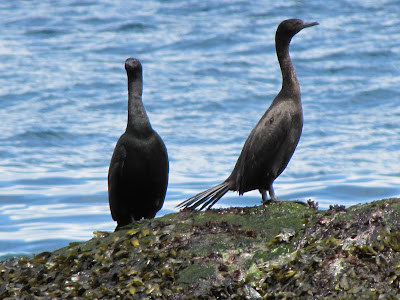
Pelagic Cormorant
Population Estimate: Unknown, but Least Concern status
Range / Habitat: A seabird of the northern Pacific. Found in maritime habitats off California (USA) in the east, round Canada, Alaska, the Aleutian Islands, Russia to the southern tip of Japan. Also found north of the Bering Sea. It's name is misleading, since it prefers inshore areas to open ocean.
Field Notes: Small, slender cormorant with thin / long neck and bill. All black with glossy green sheen. Subtle red patch on gape. Breeding adults have large white flank patch (not shown here). Double-crested Cormorant is larger, with a thicker bill, and conspicuous pale / orange facial skin and blue eye. Brandt's Cormorant larger with heavier bill, buffy throat patch, and thicker neck.
Personal Notes: Seen off the eastern coast of Vancouver Island near the Campbell River. I love my Matee for slopping through the low tide muck to get these photos and rescue the day!
18 January, 2010
Neotropic Cormorant
Scientific Name: Phalacrocorax brasilianus
Population Estimate: 2M
Range: Year-round throughout Mexico, Central and South America.
Field Notes: Like most cormorants, all black bird with hooked bill with a dull yellow on the base and throat. Eye is blue. Only a small overlap in range with the Double-crested Cormorant and in comparison the Neotropic Cormorant is smaller with relatively longer tail.
Personal Notes: We loved the bottom photo of the cormorant scratching his head!
09 November, 2009
Pygmy Cormorant
Scientific Name: Phalacrocorax pygmeus
Population Estimate: 85-180K
Range / Habitat: The largest distribution is in south-east of Europe, Albania, Greece, Bulgaria, Romania, Balkan countries, Turkey, Cyprus, Iran, Iraq, Azerbaijan, Israel, Syria
Field Notes: It has a long tail and short thick bill. Adults have small white feather tufts on the head, neck and underparts in the breeding season. Non-breeding birds have a white throat. The sexes are similar, but juveniles are duller and browner.
Personal Notes
Field Notes: It has a long tail and short thick bill. Adults have small white feather tufts on the head, neck and underparts in the breeding season. Non-breeding birds have a white throat. The sexes are similar, but juveniles are duller and browner.
Personal Notes
Great Cormorant
Scientific Name: Phalacrocorax carbo
Population Estimate: 1.4M - 2.9M
Range / Habitat: Wetlands throughout Europe, Asia, sub-Saharan Africa, Australia, New Zealand and the Atlantic coast of the US.
Field Notes: Large, common all-black cormorant with yellow at base of bill and white check patch sometimes extending to throat. Breeding adults have white thigh patch as in the top photo.
Personal Notes: Known as White-breasted Cormorant in sub-Saharan Africa. Known as Black Shag in New Zealand. Maori name Kawau.
23 October, 2009
Double-crested Cormorant
Scientific Name: Phalacrocorax auritus
Population Estimate: 1.5M, Least Concern status
Range: Winters in the southern US interior, and more extensively on the coasts. In summer it is widespread throughout North America.
Field Notes: Most common cormorant in North America, found along coasts but also inland. All black bird with hooked bill that is yellow at the base. Juveniles more pale, as in top photo. Often found in groups, these are heavy fliers that cruise just above the water. Great Cormorant and Brant's Cormorant have very limited overlap. The Neotropic Cormorant has a shared range along the Gulf Coast in Mexico, but the Double-crested Cormorant is larger with brighter yellow bill base, and relatively shorter tail.
Personal Notes: The drying of feathers is my favorite pose.
13 October, 2009
Australian Pied Cormorant
Scientific Name: Phalacrocorax varius
Population Estimate: 35K - 1M
Range / Habitat: Costal areas of Australia and New Zealand, ranging inland only to coastal lagoons and lakes.
Field Notes: Large cormorant with variable amounts of black above and white below. Long, hooked, pale bill. Blue eye and yellow patch between eye and bill.
Personal Notes: We saw amazing colonies of these birds nesting in the Fiordlands and Gisborne. They land quite awkwardly high in the trees to make their nests, sometimes requiring a few "fly-bys" before they can execute a landing. Known in New Zealand as Pied Shag. Other sources call it Large Pied Cormorant. Maori name Karuhiruhi.
Little Pied Cormorant
Scientific Name: Microcarbo melanoleucos
Population Estimate: 51K - 1.1M
Range / Habitat: Found around the coasts, islands, estuaries, and inland waters of Australia, New Guinea, New Zealand, Malaysia, and Indonesia, and around the islands of the south-western Pacific and the sub-Antarctic
Field Notes: Small cormorant with long tail, stubby yellow bill, and black feet. Usually black above and white below, though plumages vary considerably. Juvenile phase is all black and distinguished from Little Black Cormorant by longer tail and yellow bill.
Personal Notes: Seen at Awaroa Lodge in Abel Tasman first, later in Wellington Harbour on our return and then a variety of places.... Known in New Zealand as Little Shag. Maori name Kawaupaka.
Subscribe to:
Posts (Atom)


