Showing posts with label sandpipers / snipes. Show all posts

24 June, 2014

Red-necked Phalarope

Scientific Name: Phalaropus lobatus

Range / Habitat: Breeds on tundra in the circumpolar Arctic. Winters at sea in a variety of spots near the equator.

Field Notes: Small wader, smallest of the phalaropes. Small, needle-like bill and slender neck. Brown upperparts, with some gold, white breast and chin. Rufous horseshoe-shaped collar.

Personal Notes: A ubiquitous bird in small pools of water in Iceland in the summer, but surprisingly difficult to photograph.

Purple Sandpiper

Scientific Name: Calidris maritima

Range / Habitat: Breeds on tundra and rocky areas from NE Canada through Greenland, Iceland, Scandinavia to NW Siberia. Winters on rocky coasts of E North America and NW Europe.

Field Notes: Plump, medium-sized shorebird. medium-length bill with yellow base and slight droop at end. Short yellow legs. Grey to brown head, neck and back. Underparts lighter and heavily streaked. No purple in breeding plumage and only a faint sheen in winter.

Personal Notes: A surprise find at Snaefellsjoekull National Park in Iceland.

Black-tailed Godwit

Scientific Name: Limosa limosa

Range / Habitat: Breeds in wet grassland throughout Europe and parts of Russia. Fully migratory. Winters in sheltered estuaries and inland wetlands in parts of southern Europe, northern Africa, Asia and Australia.

Field Notes: Large, leggy shorebird with long, straight bill, orange at base and dark at tip. Breeding plumage with rufous head, neck and breast, otherwise mottled brown. Tail with with black tip. Winter plumage is uniform grey-brown above and lighter below.

Personal Notes: Striking bird seen in the marshy grasslands throughout Iceland in summer.

24 May, 2014

Stilt Sandpiper

Scientific Name: Micropalama himantopus

Range / Habitat: Breeds in sedge tundra near water in subarctic North America. Winters in a variety of water habitats in South America and part of Mexico and Central America.

Field Notes: Medium-sized shorebird, heavily barred in breeding plumage as above. Long, greenish legs, long neck. Long bill, drooped at the tip. Rufous patch to cheek. When seen among other sandpipers, tips tail high in the air.

Personal Notes: A record first at Deseret Ranch in Utah where seen in migration with Bill and Billy Fenimore.

12 May, 2014

Solitary Sandpiper

Scientific Name: Tringa solitaria

Range / Habitat: Breeds in taiga throughout Canada and Alaska. In migration and winter found along freshwater, more commonly in wooded areas. Winters in southern Mexico, including the Yucatan, Central American, Cuba and other Caribbean islands, and throughout northern South America.

Field Notes: Medium-sized shorebird with proportionate legs and bill. Brown upperparts, densely speckled white. White underparts and white eyering. Similarly sized non-breeding Spotted Sandpiper without speckling on back and with white eyestripe. Lesser Yellowlegs with prominent yellow legs and more mottling on back.

Personal Notes: Seen in migration at Minnesota NWR in May, 2014.

26 April, 2014

Marbled Godwit

Scientific Name: Limosa fedoa

Range / Habitat: Breeds in the northern prairies of the US and Canada and winters along the coasts of the US and Mexico.

Field Notes: A large shorebird with a long, upturned bill. Unmistakable in summer range.

Personal Notes:  Several seen (and heard calling) in the Ft. Pierre National Grasslands of South Dakota.

03 February, 2014

Least Sandpiper

Scientific Name: Calidris minutilla

Population Estimate: Unknown, but Least Concern status

Range / Habitat: Breed in wet tundra and interrupted boreal forest across much of northern Canada and Alaska. In winter found along muddy shores and estuaries of the southern US, Mexico, and northern South America. They are not common on ocean beaches.

Field Notes: Smallest of the "peeps," not much bigger than a sparrow. They have a brown back and head with white eyestripe. White underneath with subtle neck striping. Black bill droops slightly. Distinctive yellow-green legs and a high-pitched "creep" call. Semipalmated Sandpipers and Western Sandpipers are slightly larger with stouter bills and black legs instead of the Least Sandpiper’s yellowish legs.

Personal Notes: A common sight, but hard to photograph, on the Salton Sea in California. Shown above with a Dunlin in the middle of the photo.

19 March, 2013

Curlew Sandpiper

Scientific Name: Calidris ferruginea

Population Estimate: 1.8M - 1.9M

Range / Habitat: Breeds in the tundra of Siberia. Migrates to Africa, Australasia or India.

Field Notes: Medium-sized waders, breeding adult has patterned dark grey upperparts and brick-red underparts. Winter bird bird is pale grey above and white below, and shows an obvious white supercilium. Legs brown-grey. Similar to Dunlin but with longer down-curved bill, longer neck and legs and a white rump.

Personal Notes: Seen at Donana National Park, Spain.


31 January, 2012

Bar-Tailed Godwit

Scientific Name: Limosa lapponica

Population Estimate: 1.1 - 1.2M

Range / Habitat: Breeds on inland wetlands and boggy Arctic of Scandinavia, northern Asia, and Alaska. Migrates to coastal East Asia, New Zealand, Australia, Africa and northwestern Europe where found in estuaries.

Field Notes: Large wading shorebird with a long, upturned bill. Most common migrant wader in New Zealand in summer, with non-breeding plumage as above. Overall very mottled, less crisp, than other godwits. Tail is a finely barred, not solid.

Personal Notes: Maori name Kuaka. Seen at Paunawea, South Island, New Zealand. This species makes the longest known non-stop flight of any bird and also the longest journey without pausing to feed by any animal = 11,700 kilometers (~7,300 mi) along a route from Alaska to New Zealand. This journey takes nine days.

11 July, 2011

Upland Sandpiper

Scientific Name: Bartramia longicauda

Population Estimate: 350K

Range / Habitat: Grasslands in the upper half of US, excluding far West, up into Canada and interior Alaska in summer. Full migrant to grasslands of southeastern South America in winter.

Field Notes: Medium sized sandpiper with long neck, small head, short yellow bill, yellow legs. Greater Yellowlegs and Lesser Yellowlegs have grey, not brown backs, and longer dark bills.

Personal Notes: Seen en route to Devil's Tower National Monument in Wyoming. From then on he was known by the Spolts as "Pylon Plover." 

09 May, 2011

Long-billed Dowitcher


Scientific Name: Limnodromus scolopaceus

Population Estimate: 400K, Least Concern status

Range / Habitat: Breeds in wet tundra in the far north of North America and eastern Siberia. Winters throughout Mexico and the far southern US. 

Field Notes: Medium-sized wading bird. Long, straight bill, twice as long as head. Long, pale legs. Distinctive "sewing machine" type feeding. Differentiated from Short-billed Dowitcher largely by location and voice. Wilson's Snipe also with similar proportions but in grassy areas and with golden stripes down back. 

Personal Notes: Seen on coast of Vancouver Island and later photographed at Neponset Reservoir on Deseret Ranch in Utah. 

19 December, 2010

Ruddy Turnstone

Scientific Name: Arenaria interpres

Population Estimate: 460K to 800K

Range / Habitat: Circumpolar breeder in the Arctic tundra. Otherwise can be found on shorelines throughout the world, including New Zealand and Pacific islands.

Field Notes: Stocky shorebird with short, black bill, slightly upturned and bright orange legs. A harlequin-like pattern of black and white is characteristic in all plumages. The breeding plumage is even more dramatic with bright, rufous sides. Behaviorally, often seen turning over stones and shells.

Personal Notes: Though quite common throughout the world, always a lovely sight on our travels. 

14 May, 2010

Greater Yellowlegs


Scientific Name: Tringa Melanoleuca

Population Estimate: 100K

Range / Habitat: Breed in bogs and marshland in the boreal forest of Canada and Alaska. Range does not extend as far north as Lesser Yellowlegs. Migrates to the Atlantic and Pacific coasts of United States and south to South America. Rare vagrant to Western Europe.

Field Notes: Medium to large sandpiper with slightly elongated, blunt-tipped, upturned bill. Bright yellow legs are distinguishing feature. Lesser Yellowlegs is smaller and has a straight, sharp bill.

Personal Notes:

Wilson's Phalarope


Scientific Name: Phalaropus tricolor

Population Estimate: 1.5M, Least Concern status

Range / Habitat: Breeds in the prairies of western North America and Canada. Winters in the central Andes in South America. Frequents saline lakes in migration. 

Field Notes: Dainty shorebird. Breeding female is predominantly grey and brown above, with white underparts, a reddish neck and reddish flank patches. Breeding male is a duller version of the female, with a brown back, and the reddish patches reduced or absent. Typical phalarope behaviour of swimming in tight circles while feeding. 

Personal Notes: Seen on Deseret Ranch in Utah.
 

12 May, 2010

Long-billed Curlew


Scientific Name: Numenius Americanus

Population Estimate: 50K - 125K

Range / Habitat: Summer / breeding in the western plains and Great Basin of the US. Winters in the southwestern US and Mexico. Their breeding habitat is grasslands in west-central North America.

Field Notes: Adults have a very long bill curved downwards, a long neck and a small head. The neck and underparts are a light cinnamon, while the crown is streaked with brown. This species exhibits sexual dimorphism, the female having a much longer bill than the male.

Personal Notes:

19 January, 2010

Willet


Scientific Name: Catoptrophorus semipalmatus

Population Estimate: 250K, Least Concern status

Range: Summers in the interior western US. Winters along along the ocean and found from the mid-Atlantic and Pacific Northwest US down through northern South America.

Field Notes: Large, stocky sandpiper. Striking black and white wing pattern in flight. Otherwise nondescript.

Personal Notes: It was a treat seeing theses birds in the tree tops in Rhode Island.

16 January, 2010

Spotted Sandpiper

Scientific Name: Actitis macularia

Population Estimate: 150K, Least Concern status

Range: Summers throughout North America, excepting the southern US. Winters in southern coastal US through Mexico, Central and most of South America. Can be found anywhere near water. 

Field Notes: Medium-sized shore bird with proportionate, orange bill. Bobs tail constantly and teeters when flying. Brown up top and white underneath. White eye ring and eye stripe. Breeding plumage is with prominent dark belly spots as above. Non-breeding with all white breast. Solitary Sandpiper similar to non-breeding form but with dense white speckling on back and no white stripe above eye. Lesser Yellowlegs also similar to non-breeding form but with long, prominent yellow legs and crown speckled grey and white. 

Personal Notes: As stated on the Cornell website: "[a] great ambassador for the notoriously difficult-to-identify shorebirds." Indeed.

30 December, 2009

Sanderling


Scientific Name: Calidris alba

Population Estimate: 620K to 700K

Range / Habitat: Circumpolar arctic breeder in grassland tundra. Otherwise found in marine intertidal areas and wetlands. Complete migrator with worldwide distribution, including Australia and New Zealand.

Field Notes: Larger sandpiper than the peeps. Winter plumage as above with strikingly black legs and bill against white neck, chest, belly. White shoulder patch. Breeding plumage with rufous neck and head. Compared to other shorebirds, lacks hind toe. Characteristic "bicycling" or "clockwork" behavior of chasing the waves out, then running back in front of incoming waves.

Personal Notes: I love my ladee.

13 November, 2009

Common Sandpiper

Scientific Name: Actitis hypoleucos

Population Estimate: 2.6M - 3.2M

Range: Throughout Africa, Europe, Asia and Australia.

Field Notes: Medium-sized shore bird with proportionate bill. Drab back but bright white breast and striking eye-ring. White wedge between neck and wing. Non-breeding Spotted Sandpiper is similar but does not generally overlap in range.

Personal Notes:

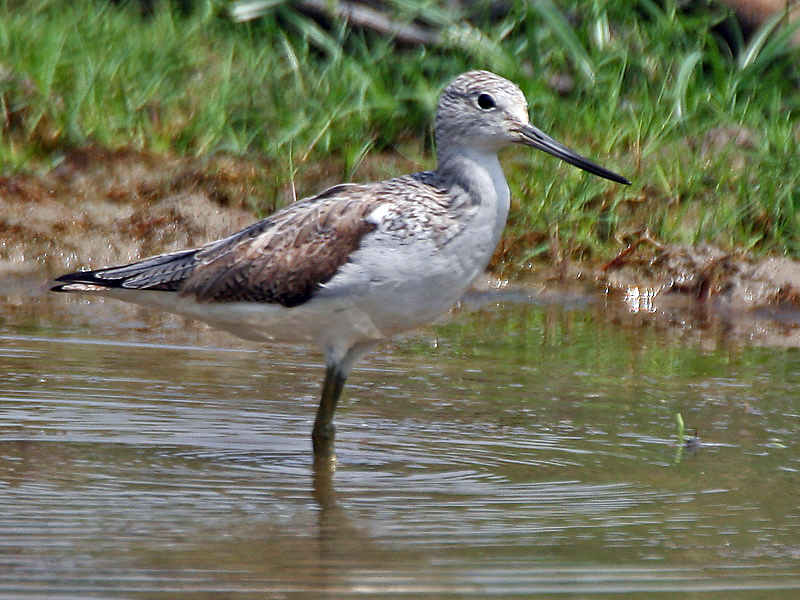
Common Greenshank


 File:Common Greenshank (Tringa nebularia) at Bharatpur I IMG 5523.jpg

Scientific Name: Tringa nebularia

Population Estimate: 440K - 1.5M


Range / Habitat: Migratory species, breeding from northern Scotland eastwards across northern Europe and Asia. Winters in Africa, the Indian Subcontinent, and Australasia, usually on fresh water.

Field Notes: Medium-sized wader with brown-grey upperparts and buff underneath. They have long greenish legs and a long, slightly upturned bill with a grey base.

Personal Notes: Seen at Donana National Park, Spain.