Showing posts with label tanagers and allies. Show all posts

05 July, 2011

Western Tanager


Scientific Name: Piranga ludoviciana

Population Estimate: 8.9M

Range / Habitat: Summers in montane forest of western US and Canada. Winters throughout Mexico exclusive of Yucatan.

Field Notes: Breeding male (top photo) with red head, yellow belly and rump. Otherwise black with two yellow wing bars. Female or juvenile (bottom photo) drab olive yellow on head, rump, belly. Still with black back and two yellow wing bars.

Personal Notes: We first spotted the female outside our friend Patrick's window in Puerto Vallarta. We then spotted a male in classic plumage in the courtyard of the Grand American Hotel in Salt Lake City, UT. The top photo was taken en route to Rainbow Lake in the Absaroka-Beartooth Wilderness in Montana. The light was so bright that morning, the camera had a hard time with the color!

24 May, 2011

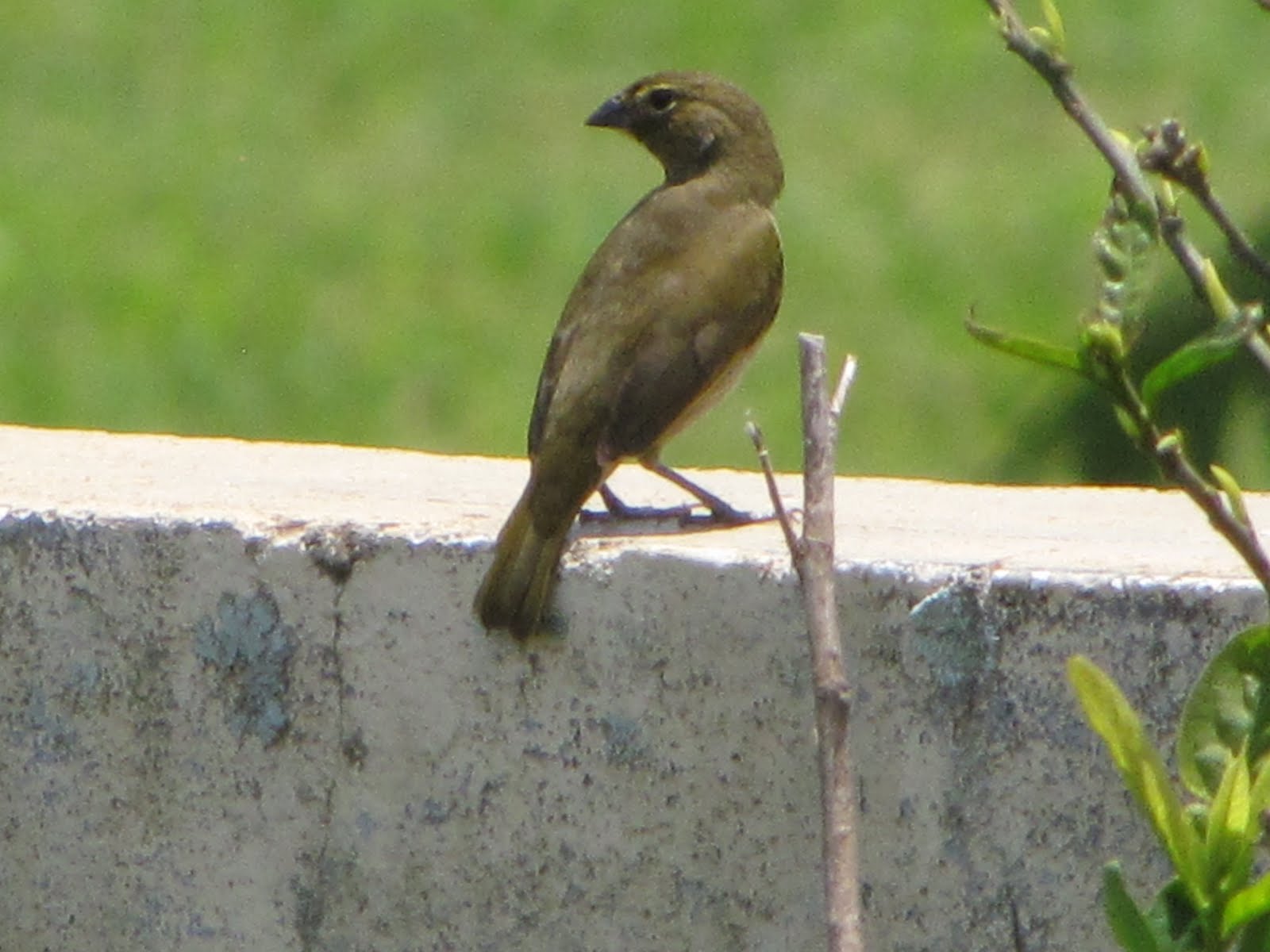
Yellow-faced Grassquit


Scientific Name: Tiaris olivaceus

Population Estimate: 500K to 5M

Range / Habitat: Subtropical / tropical lowland shrub and grass land in Mexico, Central America, northwestern South America and several Caribbean islands.

Field Notes: Small olive green passerine with thick, short bill. Males and females both with yellow throat and superciliary, though much more pronounced in males.

Personal Notes: Seen at Monteverde Lodge, Costa Rica

23 May, 2011

Thick-billed Seed Finch


Scientific Name: Oryzoborus funereus

Population Estimate: 500K to 5M

Range / Habitat: Found in lowland shrubby and grassy areas from southern Mexico, through Central America, and into northwestern South America.

Field Notes: Medium-sized passerine with finch beak. Male all black with white wing patch, nearly identical to Variable Seedeater but with straight culmen. Female warm brown without distinguishing marks, as in photo above. This warm color distinguishes from female of Variable Seedeater.

Personal Notes: Seen at Arenal Nayara Hotel, Costa Rica

Passerini's Tanager


Scientific Name: Ramphocelus passerinii
Population Estimate: 50-500K
Range / Habitat: Lowland moist forest, extending into shrub land and open areas in southern Mexico and Central America.
Field Notes: Medium-sized tanager, both sexes with red eye and light blue bill with dark tip. Males all black with extensive scarlet rump. Females with grey head, darker grey wings and tail. Chest and back are mottled dull yellow and olive. Males indistinguishable from Cherrie's Tanager. Female Cherrie's Tanager has bright orange on breast and rump.
Personal Notes: Seen at Lake Arenal, Costa Rica. Also known as Scarlet-rumped Tanager

Palm Tanager


Scientific Name: Thraupis palmarum

Population Estimate: Unknown, but Least Concern status

Range / Habitat: Lowland, semi-open areas in Central America, northern South America, Trinidad and Tobago.

Field Notes: Medium-sized passerine with overall drab olive-grey plumage but black flight feathers and tail. Conspicuously favors palm trees. Plain-coloured Tanager has grey head, no olive. Sulphur-rumped Tanager has white tufts on side of breast and yellow rump.

Personal Notes: Seen at Manuel Antonio, Costa Rica

Variable Seedeater


Scientific Name: Sporophila corvina

Population Estimate: Unknown, but Least Concern status

Range / Habitat: Subtropical / tropical lowlands and foothills in semi-open areas such as forest edges, roadsides, low scrub and gardens.

Field Notes: Small passerine with finch beak. Male all black with white wing patch, nearly identical to Thick-billed Seed Finch but with curved culmen. Female drab brown, darker on top than underneath. Female of Thick-billed Seed Finch much more warm brown.

Personal Notes: Seen at Arenal Nayara Hotel, Costa Rica

18 May, 2011

Green Honeycreeper


Scientific Name: Chlorophanes spiza

Population Estimate: 500K - 5M

Range / Habitat: Subtropical and tropical lowland moist forest in southern Mexico, Central America, and northern South America.

Field Notes: Medium-sized passerine with yellow, decurved bill. Female is all green. Male is a vibrant turquoise with black half-hood and red eye as above.

Personal Notes: Seen at Arenal Nayara Hotel in Costa Rica.

17 May, 2011

Blue-grey Tanager

Scientific Name: Thraupis episcopus

Population Estimate: 5-50M

Range / Habitat: Lowland tropical moist forest but also shrubland and artificial landscapes throughout Central America and northern South America.

Field Notes: Medium-sized passerine with light blue head, neck, chest, belly. Dark blue wings. Bill and eye are black and face is unmarked. Unmistakable in range.

Personal Notes: Seen at Chaa Creek in Belize and again at Nayara Hotel in Arenal, Costa Rica where we got the above photos.

11 May, 2011

Scarlet Tanager

Scientific Name: Piranga olivacea


Population Estimate: 2.2M


Range / Habitat: Breeds in deciduous and mixed deciduous/coniferous woodlands --though occasionally in suburban areas with large trees -- in eastern US. Winters in montane evergreen forests in western South America.


Field Notes: Small passerine. Breeding male unmistakable -- black wings on all red body -- as above.


Personal Notes:

13 December, 2010

Yellow-winged Tanager

Scientific Name: Thraupis abbas

Population Estimate: 500K to 5M

Range / Habitat: In subtropical to tropical lowland moist forest from southeast Mexico to Nicaragua.

Field Notes: Medium-sized passerine with unmistakable plumage as above.

Personal Notes: Seen at Chaa Creek Resort, Belize

Crimson-collared Tanager

Scientific Name: Ramphocelus sanguinolentus

Population Estimate: 50K to 500K

Range / Habitat: Tropical to subtropical lowand moist forest, particularly at forest edge, from southeastern Mexico to Panama.

Field Notes: Unmistakable in its range, as pictured above.

Personal Notes: Seen fairly routinely at Chaa Creek

26 November, 2010

Red-legged Honeycreeper


Scientific Name: Cyanerpes cyaneus

Population Estimate: 5M-50M

Range / Habitat: Resident in low altitude forest edge and plantations in southern Mexico and Central America.

Field Notes: Small size for a tanager, slight decurved bill, yellow underneath, black eyestripe with white eyebrow. Male striking bright blue and black with bright red legs. Female with dark legs. Compared to other honeycreepers in this area, Green Honeycreeper lacks striping on chest. Similar to Shining Honeycreeper but in the absence of seeing the distinguishing red legs, the lower elevation makes this most likely a Red-legged Honeycreeper.

Personal Notes: Seen on the way to Tikal from Belize. Also seen in Muyil in the Yucatan Peninsula and again in costal CR.

21 November, 2010

Red-throated Ant Tanager

Scientific Name: Habia fuscicauda

Population Estimate: 500K to 5M

Range / Habitat: Resident species in Mexico and Central America. Found in lowland forest and shrub.

Field Notes: Darker lores and wings than male Summer Tanager and Hepatic Tanager. Also differentiated by all black bill. From Red-crowned Ant-tanager by lighter throat and distribution.

Personal Notes: Seen at Chaa Creek resort in Belize.

14 May, 2010

Saffron Finch


Scientific Name: Sicalis Flaveola

Population Estimate: Unknown, but Least Concern status

Range / Habitat: They have a wide distribution in Colombia, northern Venezuela, western Ecuador, western Peru, eastern and southern Brazil, Bolivia, Paraguay, Uruguay, northern Argentina, and Trinidad and Tobago. It has also been introduced to Hawaii, Puerto Rico and elsewhere. Formerly, it was placed in the Emberizidae but it is close to the seedeaters.

Field Notes: The Saffron Finch (Sicalis flaveola) is a tanager from South America that is common in open and semi-open areas in lowlands outside the Amazon Basin. Male is bright yellow with an orange crown which distinguishes it from most other yellow finches (the exception being the Orange-fronted Yellow-finch). The females are more confusing and are usually just a slightly duller version of the male, but in the southern subspecies S. f. pelzelni they are olive-brown with heavy dark streaks.

Personal Notes:

30 December, 2009

Summer Tanager


Scientific Name: Piranga rubra

Population Estimate: 4M

Range / Habitat: Breeds in deciduous woodland, frequently near waterway, in eastern and southwestern US and northern Mexico. Otherwise found in a variety of forest types at mid- to upper-tree levels. Winters in southern Mexico, including the Yucatan, through to northern South America.

Field Notes: Medium-sized passerine with large, pale bill. Males all red as in top photo. Females and juveniles with olive back and wings, yellow underparts with splotches of red. Scarlet Tanager with black or dark wings. Hepatic Tanager with dark bill.

Personal Notes: Original seen in Belize, we found this bird again on the El Rey ruins in Cancun, Mexico. Finally heard one stateside Battle Creek Regional Park in St Paul MN. 

23 December, 2009

Yellow-throated Euphonia

Scientific Name: Euphonia hirundinacea

Population Estimate: 500K to 5M

Range / Habitat: Eastern Mexico through Central America. Frequents forest edges and lowland scrub. Often appears in mixed euphonia flocks.

Field Notes: Typical euphonia: small, stubby tanager and distinctive forehead patch. Dark on top, yellow underneath, yellow forehead patch. Sympatric Scrub Euphonia and White-vented Euphonia have black throats.

Personal Notes: