Showing posts with label buntings / New World sparrows / allies. Show all posts

24 June, 2014

Snow Bunting

Scientific Name: Plectrophenax nivalis

Range / Habitat: Breeds on rocky tundra in circumpolar Arctic. Winters in open weedy and grassy fields and along shores of lakes and oceans in northern latitudes of North America, Europe and Asia.

Field Notes: Small songbird with white head, chest and belly. Back black in males, more brown in females. Can have some brown in the face. Large white patch in wings. Unmistakable in range. 

Personal Notes: A surprise find at Godafoss waterfall in Iceland. We finally saw these birds in Minnesota on a March ride back from Ely to the Puppe's cabin. 


25 May, 2014

Red Fox-sparrow

Scientific Name: Passerella iliaca

Range / Habitat: Preferred habitat is dense thicket near water. Breeds in Alaska, northern Canada, and the American West. Winters primarily in the southeastern US, though can be found near the border of Mexico and on the Pacific Coast.

Field Notes: Though highly variable, generally rust-brown above with a mix of rust and gray on the head, and heavy brownish splotches on the flanks and the center of the chest. The bill can range from yellowish to dark grey. Song Sparrow with more distinct face markings and streaks on chest. Also, does not forage in leaf litter. Savannah Sparrow with yellow lores and found in open habitat.

Personal Notes: Seen at Deseret Ranch, Utah. Also known as Fox Sparrow.

24 May, 2014

Brewer's Sparrow

Scientific Name: Spizella breweri

Range / Habitat: Preferred habitat is sagebrush. Winters in Sonoran and Chihuahuan deserts. Winters in the Great Basin.

Field Notes: Medium-sized sparrow with finely streaked grey-brown upper parts, pale eyering, dark moustache stripe and plain, pale grey underparts. Bill is pink with dark tip.

Field Notes: Seen on Deseret Ranch in Utah.

26 April, 2014

Lincoln's Sparrow

Scientific Name: Melospiza lincolnii

Range / Habitat: Winters in scrubby areas of southwestern US and Mexico, excluding the Yucatan. Breeds in boggy areas of Canada, Alaska, and part of the American West.

Field Notes: Small drab bird with face marking similar to Song Sparrow. Habitat differentiates as does buffy malar stripe and fine, distinct streaks on a buffy chest. Swamp Sparrow with more rufous crown and back, complete grey collar, minimal streaking on grey breast.

Personal Notes: Great picture by Richard at Fontenelle Forest in Omaha, NE.

14 April, 2014

Painted Bunting

Scientific Name: Passerina ciris

Range / Habitat: Wooded areas in otherwise open habitat. Winters in southern Mexico, including Yucatan, Central America, some Caribbean islands, and the southern tip of Florida. Summers in northern Mexico, Texarkana, and the southeastern coast of United States.

Field Notes: Typical bunting size, shape and bill. Males are unmistakable in range with blue head and neck, rufous chest and belly, yellow and green on the back. Females, as above, are distinctly green to the back and head, yellow to the breast, pale eye ring. Other female buntings are clearly grey or brown in colour.

Personal Notes: A new species for us in El Rey ruins of Cancun, Mexico.

08 January, 2014

Canyon Towhee

Scientific Name: Pyrgisoma fuscum

Population Estimate: Unknown, but Least Concern status

Range / Habitat: Year-round in rocky, arid scrubland of the southwestern US and Mexico.

Field Notes: Large, long-tailed sparrow frequently found on ground, particularly in parking lots picking bugs off of cars. All brown with rufous cap and under tail.

Personal Notes: Our last Arizona bird, found just before leaving Sedona after hiking Bear Mountain.

08 October, 2013

Harris's Sparrow

Scientific Name: Zonotrichia querula

Population Estimate: Unknown, stable, Least Concern status

Range / Habitat: Found in woodlands and brushy habitats. Breeds in central Canada and winters in a relatively small area of the Great Plains. 

Field Notes: Large sparrow with white breast, black bib and throat, black crown, pink bill. 

Personal Notes: Seen in autumn in the Minnesota River NWR after a long hiatus. 

20 March, 2013

Corn Bunting

Scientific Name: Emberiza calandra

Population Estimate: 32M - 132M

Range / Habitat: Bird of open country that breeds across southern and central Europe, north Africa and Asia across to Kazahkstan. It is mainly resident, but some birds from colder regions of central Europe and Asia migrate southwards in winter.

Field Notes: Bulky bunting streaked grey-brown above, and streaked white breast, necklace with dark "pendant," and characteristic call.

Personal Notes: Seen around Donana National Park, Spain.

28 August, 2011

Yellowhammer

Scientific Name: Emberiza citrinella

Population Estimate: 70M - 200M

Range / Habitat: Found in a range of open habitats (grassland, shrubland, artificial landscapes) throughout Europe and Asia. Most birds are resident in those areas, though some travel further south in winter. An introduced species in New Zealand

Field Notes: Sparrow-sized bird with yellow head and breast. Dark prominent streaks on head as above. Grey bill. Rufous streaks on chest. Rufous upperparts and rump. White outer tail feathers in flight. Yellowhead has no face or chest markings. European Greenfinch has large, flesh-colored bill, grey cheeks and wings. Cirl Bunting much less yellow and rump greyish-olive. Male Cirl Bunting with black markings on face. 

Personal Notes: Seen on the beach at Gisborne.

27 June, 2011

Sage Sparrow

Scientific Name: Amphispiza belli

Population Estimate: 4.3M

Range / Habitat: Dry shrub land up to 3000m. Year-round along the southern US Pacific coast into Baja. Summers in the American West with winters in the American Southwest and northwestern Mexico.

Field Notes: Medium-sized sparrow, relatively long-tailed. Grey head and brown back. White eye ring and supraloral spots. White and black lateral throat stripes. Breast buffy with central dark spot. Five-striped Sparrow similar but little overlap and grey breast.

Personal Notes: First seen on a beautiful drive along the southwestern edge of the Bighorn National Forest in Wyoming and then again in the Petrified Forest NP.

20 June, 2011

Lark Bunting


Scientific Name: Calamospiza melanocorys

Population Estimate: 27M

Range / Habitat: Tall, dense grassland. Winters in northern Mexico. Summers in Great Plains of the United States.

Field Notes: Medium-sized sparrow with short, thick, bluish bill. Large white patches in wing. Breeding male all back with white wings. Female and nonbreeding male grayish brown and heavily striped.

Personal Notes: Seen at Buffalo Gap National Grasslands, South Dakota.

Grasshopper Sparrow

Scientific Name: Ammodramus savannarum

Population Estimate: 15M

Range / Habitat: Tall, dense grassland winters in southeastern US, Mexico, Central America, and into northwestern South America. Summers throughout eastern US to Rocky Mountains, parts of California and Pacific Northwest.

Field Notes: Found singly. Relatively long-billed and flat-headed sparrow with short tail. Unmarked, buffy breast. Complete eye ring. Some yellow in the face. Dark crown with pale middle stripe.

Personal Notes: Seen in the South Dakota Badlands.

04 June, 2011

Green-tailed Towhee


Scientific Name: Pipilo chlorurus

Population Estimate: 4.1M, Least Concern status

Range / Habitat: Year-round in dry shrub land of montane American West. Winters extending into Mexico.

Field Notes: Small towhee but large and long-tailed for an American sparrow. Overall grey bird with striking rufous crown, white throat, and olive-green patches on wing. Ascending cat-like mew call, reminiscent of a Grey Catbird.

Personal Notes: Seen at Vedawoo outside of Laramie, then again in the Bighorn Mountains. Once again seen on Deseret Ranch in Utah.

23 May, 2011

White-eared Ground Sparrow


Scientific Name: Melozone leucotis

Population Estimate: 20-50K

Range / Habitat: Tropical montane moist forest edges in Central America.

Field Notes: Large sparrow with black head and bib, olive / brown back and white belly. White spots in front and back of eyes along with yellow patches on the sides of the neck are diagnostic.

Personal Notes: Seen at Monteverde Lodge, Costa Rica

Chestnut-capped Brush Finch


Scientific Name: Arremon brunneinucha

Population Estimate: 500K to 5M

Range / Habitat: Subtropical / tropical montane moist forest from southern Mexico, through Central America, to northwestern South America.

Field Notes: Medium-sized finch. Adults have a chestnut crown and bright white throat which aid identification. Black mask and necklace, olive-green back, white chest and belly. The above is a juvenile of the species.

Personal Notes: Seen at Monteverde Cloud Forest Reserve, Costa Rica

18 May, 2011

Rufous-collared Sparrow


Scientific Name: Zonotrichia capensis

Population Estimate: 5-50M

Range / Habitat: Lowland grassland, savannah, shrubland, artificial landscapes, and urban areas throughout Central and South America.

Field Notes: Male at top with distinctive black and grey striped head with white throat and rufous nape. Female (center) less colorful and with crest. Young male at bottom has slight stature and central breast spot not yet fully filled in.

Personal Notes: Ubiquitous at Arenal Nayara Hotel in Costa Rica.

09 May, 2011

Golden-crowned Sparrow

Scientific Name: Zonotrichia atricapilla

Population Estimate: 5M

Range / Habitat: Breeds in the tundra and shrubland of western Canada and Alaska. Winters along the Pacific coast of the US where common in urban areas.

Field Notes: Stocky sparrow with unmistakable head plumage, as above.

Personal Notes: Seen in Victoria, British Columbia.

27 February, 2011

Yellow-eyed Junco

Scientific Name: Junco phaeonotus

Population Estimate: 20M

Range / Habitat: Year-round through the southwestern US and throughout Mexico. Preferred habitat is high altitude grassland, shrubland, and forest.

Field Notes: Distinctive plumage as above. Typical Junco behavior: found in groups foraging on the ground then will make a hasty retreat to higher perches. Distinctive fan-like tail in flight with white-flashes on the sides. There are similar-colored variations of Dark-eyed Junco, but the eye color is determinant. Also, per Sibley, the dark-eyed varieties hop on the ground whereas the yellow-eyed birds walk.

Personal Notes: We were more than happy to take a break from summiting Xinantecatl in central Mexico to observe these birds.

Clay-colored Sparrow

Scientific Name: Spizella pallida
Population Estimate: 23M

Range / Habitat: Summers in upper midwestern US and central Canada. Winters throughout Mexico. Found in a variety of habitats including grassland and shrubland, inland water areas.

Field Notes: Above bird in nonbreeding plumage. Sparrow with clear breast and distinct facial markings, particularly the "mustache" and lateral throat stripe. Chipping Sparrow in nonbreeding plumage has duskier chest, more prominent supercilium, darker lores.

Personal Notes: A "random sparrow on a cactus" photo Richard took on our walk out of Teotihuacan.

01 June, 2010

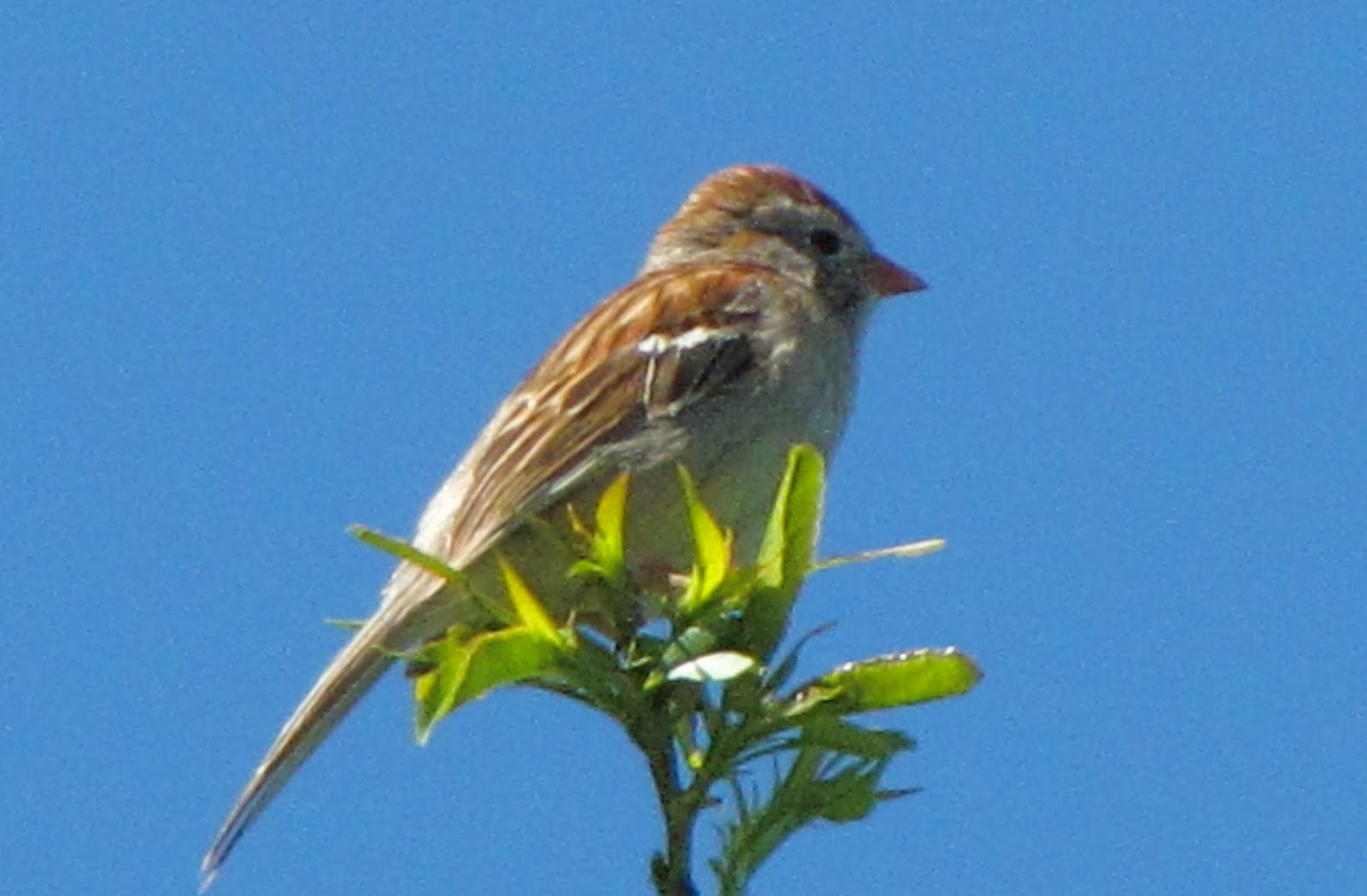
Field Sparrow


Scientific Name: Spizella pusilla

Population Estimate: 8M, Least Concern status

Range / Habitat: "Old-field" sparrows, found year-round in the southeastern US. In winters extending a bit south, and in summers up to the Canadian border.

Field Notes: Clear-breasted sparrow with rusty cap parted by a grey strip, white eye ring, pale pink bill, and rufous strip behind the eye. Face is otherwise bland grey. Call a distinctive, accelerating trill.

Personal Notes: