Showing posts with label Wisconsin. Show all posts

11 May, 2011

Black-and-white Warbler


Scientific Name: Mniotilta varia

Population Estimate: 14M, Least Concern status

Range / Habitat: Breeds in deciduous and mixed forest in eastern US and most of Canada. One of the earliest migrants, found in any forest or woodlot. Winter in forests and forest edges from Florida to Colombia, including Caribbean islands. 

Field Notes: Dramatic black and white plumage as above. Somewhat unique in warbler behavior, this bird forages for insects while creeping along tree limbs, similar to a nuthatch. Blackpoll Warbler is similar but has all black cap with white cheek and does not creep along limbs.

Personal Notes: We observed the nuthatch-like behavior described above. These buggers are hard to photograph!

02 May, 2011

Grey Crowned Crane

Scientific Name: Balearica regulorum

Population Estimate: 47-59K, Vulnerable status

Range / Habitat: Year-round in parts of eastern and southern Africa, preferring grassland adjacent to wetlands.

Field Notes: Distinctive crane, as above. Black Crowned-crane similar but neck is black, not light grey.

Personal Notes: Seen at International Crane Foundation and at Disney's Animal Kingdom Lodge.

27 April, 2011

Wattled Crane

Scientific Name: Grus carunculatus

Population Estimate: 6-8K, Vulnerable status

Range / Habitat: Year-round in wetlands of southern Africa and Ethiopia.

Field Notes: Large black crane with white head and neck, black cap, and distinctive red wattle over face and bill. Unmistakable in range.

Personal Notes: Seen at the International Crane Foundation in Wisconsin.

Whooping Crane

Scientific Name: Grus americana

Population Estimate: 50-250, Endangered status

Range / Habitat: Found in fields near water. Summers on reserves in Canada and Wisconsin. Winters on reserves in Texas and Florida.

Field Notes: Tallest bird in North America. All-white crane with black wing-tips and red forehead and cheek. Call is a single, bugle-like note. Sandhill Crane is overall grey / brown with a distinctive rattling call.

Personal Notes: Seen in captivity at the International Crane Foundation near Necedah NWR. Only 15 adults of this species remained in 1938, but it has been increased to current levels through active breeding programs and guided migration via ultralight planes.

Greater Prairie Chicken

Scientific Name: Tympanuchus cupido

Population Estimate: 460K, Vulnerable status

Range / Habitat: Year-round in open grasslands of the Dakotas, Nebraska, Wisconsin, Oklahoma.

Field Notes: Unmistakable in range. Chicken-sized bird known for its mating ritual on communal leks.

Personal Notes: Despite cold, rainy, windy weather, had a great time viewing these birds on Carl Flaig's farm.

01 June, 2010

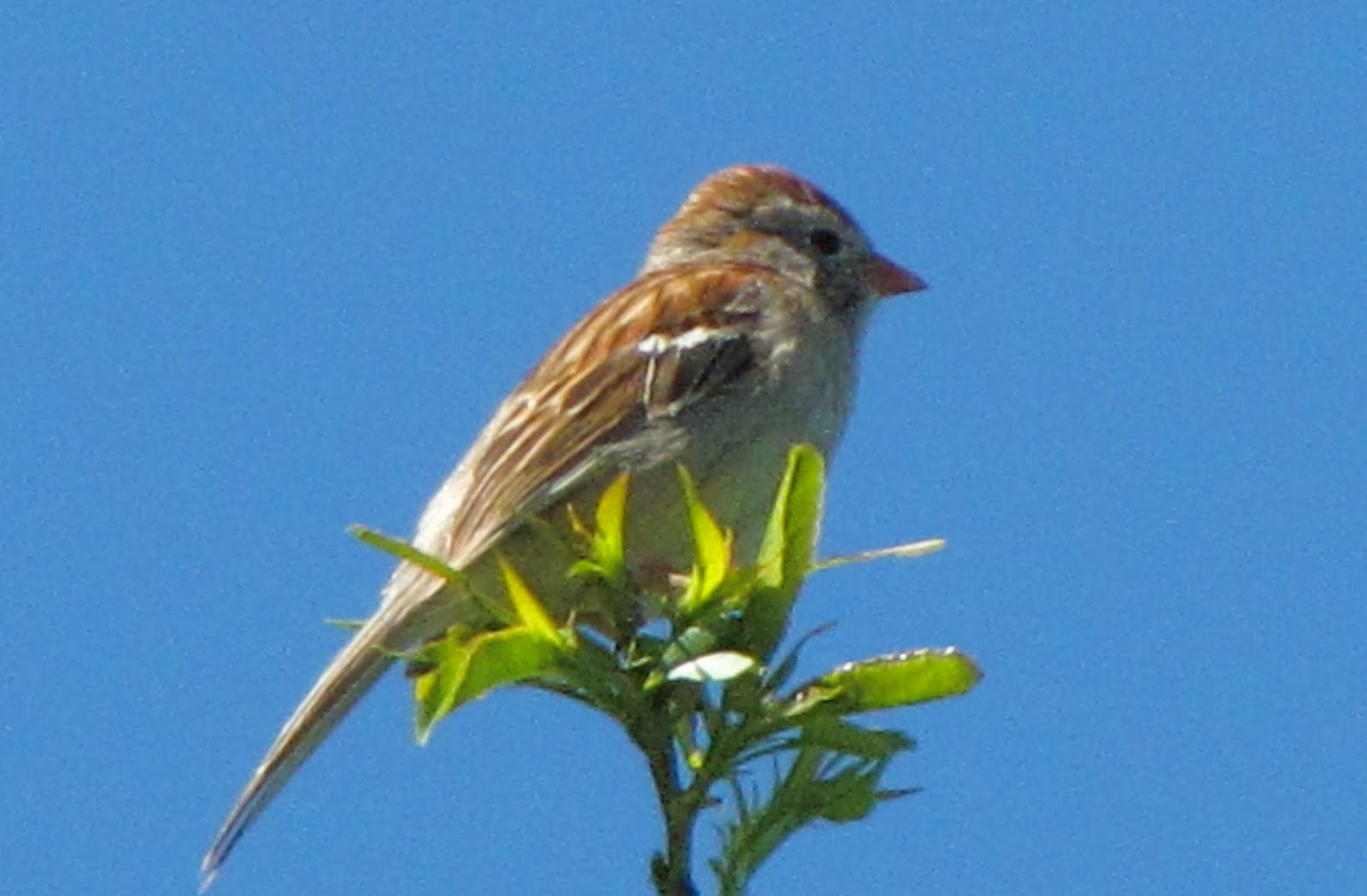
Field Sparrow


Scientific Name: Spizella pusilla

Population Estimate: 8M, Least Concern status

Range / Habitat: "Old-field" sparrows, found year-round in the southeastern US. In winters extending a bit south, and in summers up to the Canadian border.

Field Notes: Clear-breasted sparrow with rusty cap parted by a grey strip, white eye ring, pale pink bill, and rufous strip behind the eye. Face is otherwise bland grey. Call a distinctive, accelerating trill.

Personal Notes:

14 May, 2010

Savannah Sparrow

Scientific Name: Passerculus sandwichensis

Population Estimate: 80M, Least Concern status

Range / Habitat: Summers in northern US up through Canada and all of Alaska. Winters in southern US down through Mexico. Found in a variety of open habitats such as meadows, marshland, coastline, and tundra. 

Field Notes: Highly variable sparrow with lightly streaked breast and yellow lords. Song Sparrow has central dark chest spot and dark mustache. Vesper Sparrow has bold eye ring. Both lack the yellow lores.

Personal Notes: A pleasant surprise visitor while in a Greater Prairie Chicken blind in Wisconsin. Later seen and photographed in various places throughout the western US before finally seeing him at home in Minnesota in the spring of 2014. Ironically, seen outside Savannah, Georgia en masse in the winter of 2014, not the elusive Seaside, Saltmarsh, or Nelson's Sparrows we were hoping for. 

12 May, 2010

Yellow-rumped Warbler


Scientific Name: Dendroica coronata

Population Estimate: 130M, Least Concern status

Range / Habitat: Summers in western US, most of Canada, and Alaska. Winters in southern US, Mexico and Central America. Preferred habitat is temperate forest.

Field Notes: Full-bodied black, white, and grey warbler. Characteristic yellow forehead, chin, armpits and rump (the latter seen only in flight). There are plenty of other similarly colored warblers but none with this particular distribution of yellow.

Personal Notes: This species has distinct regional morphs: the Myrtle (top) is predominantly Eastern U.S., while the Audobon's (bottom) is overwhelmingly Western

20 April, 2010

Chipping Sparrow


Scientific Name: Spizella passerina

Population Estimate: 100M, Least Concern status

Range / Habitat: Throughout most of North America in summer only, found in areas with grassland interspersed by trees. Year-round in southern California. Winters in Mexico, Florida, Cuba, parts of Central America.

Field Notes: Small for a sparrow, always smaller than we think. Bill seems a little too small for a sparrow, too, classic Spizella species. Bright rufous cap, white eyebrow, black eye stripe and clear white breast distinguish this bird. Call is a persistent, rapid "chip".

Personal Notes:

American Mourning Dove


Scientific Name: Zenaida macroura

Population Estimate:
130M, Least Concern status

Range / Habitat: Found anywhere except deep woods in North America, Central America and the Caribbean. Year-round in most of the US and into Mexico, but extends north into Canada in the summer and south into Central America in the winter.

Field Notes:
A medium-sized graceful dove with soft greyish-brown upperparts and more buffy underparts, with a greyish crown and hindneck, sometimes with a metallic purple or bronze gloss. Small head and slender tail. The eye is surrounded by a narrow ring of bare blue or greenish-blue skin, and there is a small black streak on the cheek. The sorrowful call is distinctive.

Personal Notes: I'm slightly embarrassed to say that when we first started birding we followed one of these birds at dusk, thinking we were hearing an owl call.

Brown-headed Cowbird


Scientific Name: Molothrus ater

Population Estimate: 56M

Range / Habitat: Year-round in southern and eastern US in grasslands and other cleared habitats. Summer visitor to the western US and north into Canada. Winters into Mexico.

Field Notes: Stocky blackbirds, often seen in small flocks often foraging on the ground. Male is glossy black with brown head. Female dull brown. Juvenile light black with extensive breast streaking. Eye is black, as opposed to red eye of Bronzed Cowbird or yellow eye of Brewer's Blackbird.

Personal Notes: These birds lay eggs in other nests then leave the host birds to raise their young. 

Western Osprey


Scientific Name: Pandion haliaetus

Population Estimate: 500K, Least Concern status

Range / Habitat: Migrant throughout much of the US. It winters primarily in South America and breeds in the northern US and Canada. Found around nearly any type of body of water.

Field Notes: Large raptor with black back and white chest. Wings a distinctive "M" shape in flight. Feathers cover the legs. Dark eye stripe on white head. Stick nests place conspicuously in open areas.

Personal Notes: Above photo taken in Amery, Wisconsin on a job interview. 

Eastern Towhee


Scientific Name: Pipilo Erythrophthalmus

Population Estimate: 11M

Range / Habitat: Restricted to eastern US where found year-round in the south, push up nearly to Canada in the summer. In contrast to the photos above, usually found in scrub and undergrowth.

Field Notes:
A large, bulky sparrow with long tail. Males are strikingly marked, as above, with black head and neck, white belly, rufous flanks, red eye. There is a flash of white on the back in flight. Similar to Spotted Towhee, though less white marking on the back and wings, and minimal overlap in the Great Plains.

Personal Notes: Richard went on quite an excursion for this photo. We kept getting glimpses of this bird in the brush, but patience was finally rewarded.

11 April, 2010

Tree Swallow


Scientific Name: Tachycineta bicolor

Population Estimate: 20M, Least Concern status

Range / Habitat: Breed in open habitats such as fields and wetlands, usually adjacent to water across northern US, Canada and Alaska. Winters in Baja, the Gulf coast of the US, Florida and into Mexico.

Field Notes: Medium-sized swallow with glossy, blue-green upperparts and contrasting white underparts. The wings are long and the tail only shallowly forked.

Personal Notes:

American Crow


Scientific Name: Corvus brachyrhynchos

Population Estimate:
31M, Least Concern status

Range / Habitat:
 Year-round in fields, open woodlands, and forests -- as well as areas inhabited by people -- throughout the US. In summer they extend up into Canada. 

Field Notes: L
arge, all-black birds with harsh, cawing voices. Nearly identical to Northwestern Crow and Fish Crow. Common Ravens are larger with longer wings, heavier bills, and shaggy neck feathers. 

Personal Notes:

05 January, 2010

Common Goldeneye


Population Estimate: 2.5M to 4.6M, Least Concern status

Range / Habitat: Breeds in lakes and rivers surrounded by coniferous forest throughout the subarctic. Winters mostly in coastal areas throughout the northern hemisphere, except in the US where it is found on inland waters.

Field Notes: Medium-sized diving ducks. Male white with black back and head, and circular white spot on face. Female with chocolate brown head and back, flanks and belly brown to white. Among the last birds to migrate south in the fall. Barrow's Goldeneye similar but with crescent-shaped cheek patch.

Personal Notes:

13 October, 2009

Mallard


Scientific Name: Anas platyrhynchos

Range / Habitat: Common on almost any wetland in the northern hemisphere. Also found in southern Australia and New Zealand.

Field Notes: Male unmistakable as above. Female similar to many other dabbling ducks. Hybrids also common.

Personal Notes: I know they're ubiquitous in the US, but isn't that the most charming photo?

27 September, 2009

Sandhill Crane


Scientific Name: Grus canadensis

Population Estimate: 520K

Range / Habitat: Found in open grasslands, meadows, wetlands. Summers in Alaska, Canada, parts of upper midwestern and western US. Winters in parts of Texas, California, northern Mexico.

Field Notes: Large grey and brown bird with striking red crown. Frequently feeding on ground. Call is a loud, resonant, wooden rattle.

Personal Notes:

29 August, 2009

Goosander

Scientific Name: Mergus merganser

Population Estimate: 2M, Least Concern status

Range: Winters throughout much of US, excluding the Southeast. Summers throughout Canada. There is a year-round population in the western US, extending up the coast to Alaska.

Field Notes: A large, diving duck with a long, thin bill. Male breeding plumage is distinct with iridescent green / black head, white neck and sides, and black back. Females have rust-colored head and crest, white chest and brown / grey back. The white chin of the female Common Merganser can be used to differentiated it from the female Hooded Merganser or female Red-breasted Merganser. Juveniles look like females. Adult females will end up raising other broods so they form large groups in the summer.

Personal Notes: Formerly known as Common Merganser.