Scientific Name: Icterus parisorum
Population Estimate: Unknown, but Least Concern status
Range / Habitat: Found in arid and semi-arid foothills and canyons with open woodland. Summers up to southwestern US, year-round in central Mexico and Baja.
Field Notes: Medium-sized songbird, male brilliant yellow and black, unmistakable in range. Female with light grey head and back, overall duller.
Personal Notes: Chance finding on our first drive-through of Joshua Tree National Park.
Showing posts with label oropendolas / orioles / blackbirds. Show all posts
01 February, 2014
18 July, 2011
Bobolink
Population Estimate: 11M
Range / Habitat: Full migrant found almost exclusively in grasslands. Summers / breeding in upper US and into Canada, excluding the far west. Winters in the middle of South America.
Field Notes: Typical blackbird size / shape. Male in breeding plumage has black face, bill, and underparts, white on back and wings, yellow half-hood. Female and non-breeding male with yellow underparts, brown tail and wings, black eyestripe and streak on top of head, yellow superciliary, pale bill.
Personal Notes: We finally got to see this species (with the help of the Wyoming bird list serve) on a gravel road between Fort Phil Kearney and Story, Wyoming. We were quite excited to find him later in St. Paul MN at Kaposia Landing, a former superfund site.
11 July, 2011
Bullock's Oriole
Population Estimate: 3.8M
Range / Habitat: Open woodlands, summers in the American West, winters in Mexico not including Yucatan.
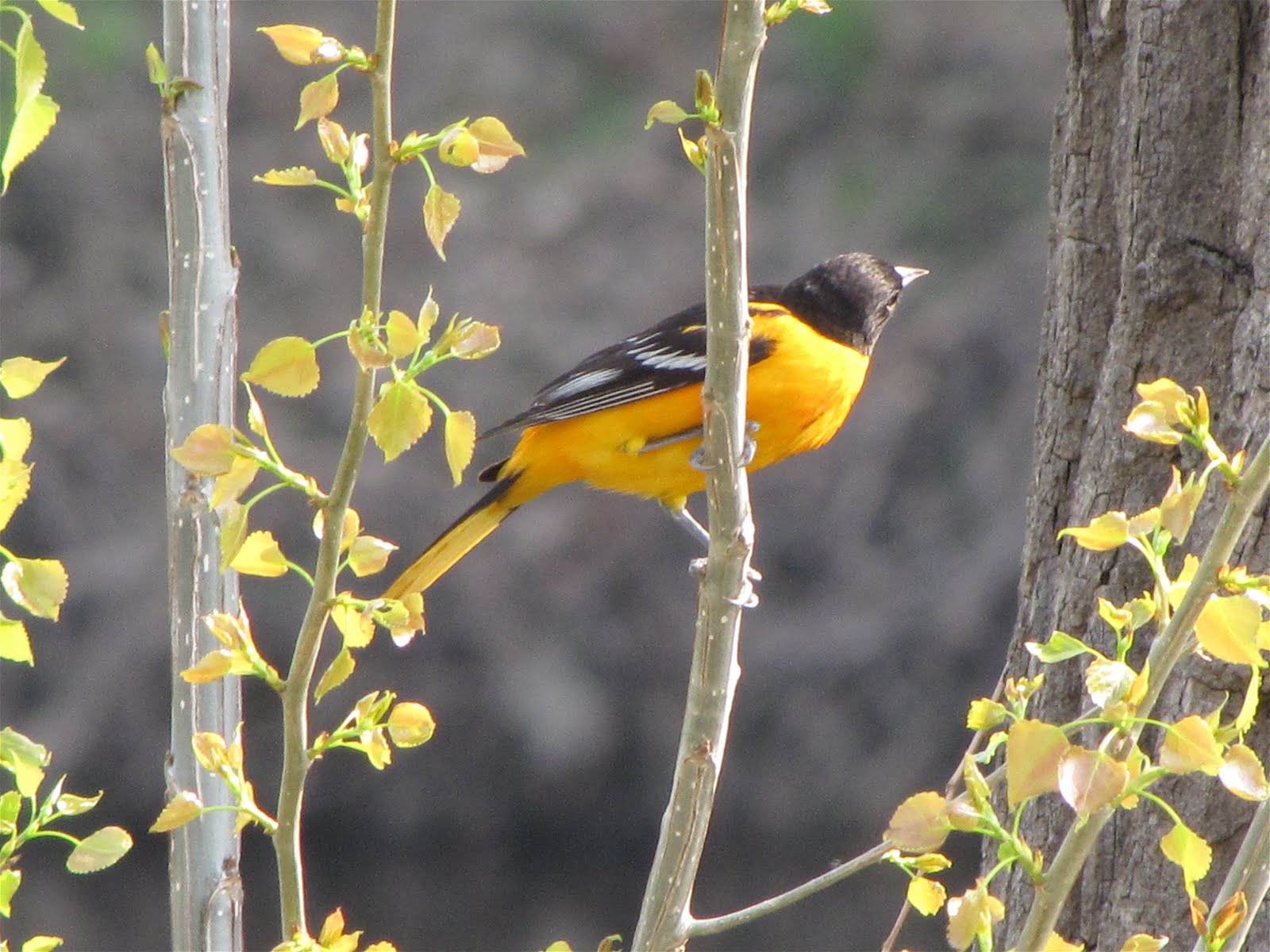
Field Notes: Male unmistakable in range with black cap and eye stripe on yellow / orange head and chest. Large white wing bar. Black back and throat. Female more drab without black markings on head / chest.
Personal Notes: The bloke in the photo above and his mate were seen while hiking just above the prairie dog 'town' at Devil's Tower National Monument. We saw him (and an eastern kingbird) get chased off a big dead Ponderosa pine by a red-headed woodpecker.
12 December, 2010
Montezuma Oropendola
Scientific Name: Psarocolius montezuma
Population Estimate: 50K to 500K
Range / Habitat: Subtropical lowland moist forest from southeastern Mexico through to Panama.
Field Notes: Large icterid. Unmistakable with orange tip to bill. Tail yellow underneath. Shape and flight may suggest Brown Jay. Chestnut-headed Oropendola smaller with all pale bill.
Personal Notes: Seen at Tikal Mayan ruins. We saw the related Chestnut-headed Oropendula while driving in the mountains between Arenal Lake and Monteverde in Costa Rica.
01 December, 2010
Yellow-tailed Oriole
Population Estimate: 500K-5M
Range / Habitat: Ranges from the Yucatan and SE Mexico through Central America into northern South America. Preferred habitat is subtropical and tropical lowland moist forest, often swamp or mangrove forests.
Field Notes: Adult (top photo) is distinctive with yellow head, belly, rump, and outer rectrices. Mask, back, wings and tail black but with prominent yellow wing bar. Juvenile (bottom photo) distinguished by mottled olive and black back with yellow wing bar.
Personal Notes: Both seen at the Chaa Creek Resort.
14 May, 2010
Brewer's Blackbird
Scientific Name: Euphagus cyanocephalus
Population Estimate: 35M
Range / Habitat: Year-round in the American West. Winters in the southern US and into Mexico. Summers extending through the US up into Canada, excluding northeastern US. They favor open and semi-open areas, often near water.
Field Notes: Males iridescent with black head and dark green elsewhere. Yellow eye, black bill, black legs. Common Crackle is larger, with reversed color pattern (green head, darker body), large bill, longer and wedge-shaped tail. Common Starling with black eye, yellow bill and pink legs. Rusty Blackbird is less iridescent with rufous pattern on black body.
Personal Notes:
12 May, 2010
Western Meadowlark
Scientific Name: Sturnella neglecta
Population Estimate: 32M, Least Concern status
Range / Habitat: Songbird of open country. Found year-round throughout the western US, west of the Mississippi River. Summers extending north into Canada. Winters extending south into Mexico.
Field Notes: Stocky songbird with yellow throat, chest and belly. Black "V" on chest. Back streaked brown and black. Overall duller in winter. Distinctive in flight with a large "keel" and white lateral rectrices. Song melodic and flute-like with gurgles. Eastern Meadowlark with generally different distribution but in areas of overlap best distinguished by voice.
Personal Notes: Ubiquitous (but much enjoyed) during our time in Wyoming.
10 May, 2010
Baltimore Oriole
Scientific Name: Icterus Galbula
Population Estimate: 6M
Range / Habitat: Winters in Florida, southern Mexico, Central America, and northern South America. Summers across most of eastern NA. Preferred habitat high in leafy deciduous trees of open woodlands, forest edge, orchards, parks.
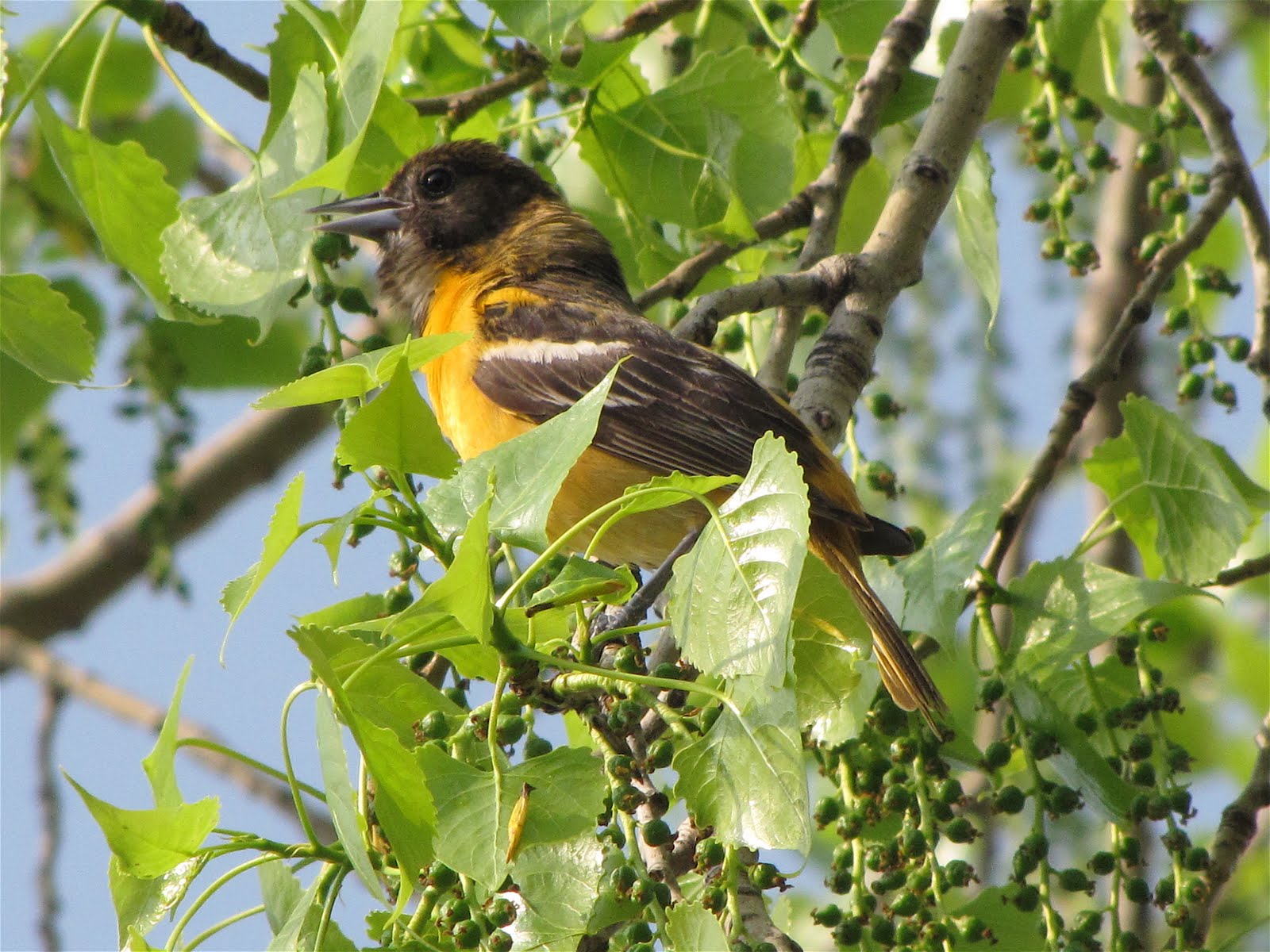
Field Notes: Slender songbird, breeding male (top photo) with brilliant orange chest, shoulder, rump. Central chest may be more reddish. Black head, tail and wings, with a single white wing bar. Female (bottom photo) with dark grey head, paler chest, and two white wing bars. Male Black-headed Grosbeak has little range overlap, is stockier and with much larger bill.
Personal Notes: Female in bottom photo was perched just above her nest on St Anthony Main in Minneapolis.
20 April, 2010
Brown-headed Cowbird
Scientific Name: Molothrus ater
Population Estimate: 56M
Range / Habitat: Year-round in southern and eastern US in grasslands and other cleared habitats. Summer visitor to the western US and north into Canada. Winters into Mexico.
Field Notes: Stocky blackbirds, often seen in small flocks often foraging on the ground. Male is glossy black with brown head. Female dull brown. Juvenile light black with extensive breast streaking. Eye is black, as opposed to red eye of Bronzed Cowbird or yellow eye of Brewer's Blackbird.
Personal Notes: These birds lay eggs in other nests then leave the host birds to raise their young.
05 April, 2010
Eastern Meadowlark
Scientific Name: Sturnella Magna
Population Estimate: 10M
Range / Habitat: The eastern meadowlark is one of the most widely distributed species of songbird. It is native to North and Central America, with its range extending into South America. It is present throughout the year in much of eastern North America, Central America and the north of South America, breeding from New Brunswick and Nova Scotia, south to the north-east of Brazil.
Field Notes: Distinctive, medium-sized songbird often found on perches. Dappled brown and black upperparts with bright yellow neck, chest, belly and forehead. Black bib. Characteristic song with slurred, flute-like whistles. Can overlap with Western Meadowlark in places, where best differentiated by voice. The feathers on its back are a mixture of browns and blacks, with an overlaid pattern of darker streaks and bars. Its underparts are bright yellow and there is a black ‘V’ across the chest.
Personal Notes:
04 April, 2010
Rusty Blackbird
Scientific Name: Euphagus Carolinus
Population Estimate: 200K to 2M
Range / Habitat: The rusty blackbird has the most northerly breeding range of all North American blackbirds, occurring in Alaska, Canada and the north-eastern United States. It is a migratory species, spending the winter in the south-eastern and mid-western United States.
Field Notes: Medium-sized black bird with slender bill and yellow eye. All black in breeding plumage, wings tinged rust in winter. Does not have a sheen to head as common in other black birds. Common Grackle with larger bill, longer tail, and wings tinged blue or purple. Brewer's Blackbird with blue and green iridescence. No other blackbird in range with yellow eye.During the winter, the male rusty blackbird is characterised by the rusty edges to the tertials, and by its rusty brown crown, nape and back. The rest of the upperparts are black, while the cheeks, throat, breast and sides are lighter brown or buff. The male also has a tawny-coloured stripe above the eye. The female rusty blackbird is similar to the male, but with a conspicuous paler buff line above the eye.
Personal Notes:
01 April, 2010
Common Grackle
Scientific Name: Quiscalus quiscula
Population Estimate: 100M, Least Concern status
Range / Habitat: The breeding habitat is open and semi-open areas across North America east of the Rocky Mountains. In the summer extends range north through Canada and west to the Rockies. Found in open habitats, lawns, city parks, agricultural areas.
Field Notes: Adult has a long dark bill, pale yellowish eyes and a long tail; its feathers appear black with purple, green or blue iridescence on the head, and primarily bronze sheen in the body plumage. The adult female, beyond being smaller, is usually less iridescent; her tail in particular is shorter, and unlike the males, does not keel in flight and is brown with no purple or blue gloss. The juvenile is brown with dark brown eyes.
Personal Notes:
21 March, 2010
Red-winged Blackbird
Scientific Name: Agelaius phoeniceus
Population Estimate: 210M, Least Concern status
Range / Habitat: Year-round on fresh and saltwater marshes through most of the US and Mexico. In summer extending into Canada.
Field Notes: Medium-sized passerine. Males glossy black with red and yellow shoulder patches. Females are a subdued, streaky brown, almost like a large, dark sparrow with a dramatic eyebrow.
Personal Notes: One of the most welcome sounds of spring in Minnesota!
18 January, 2010
Orchard Oriole
Scientific Name: Icterus spurius
Population Estimate: 4.3M
Location of Sighting: Puerto Vallarta, Mexico
Date of Sighting: January, 2010
Notes: Male is unmistakable as in the middle photo. Top photo shows male with either female or juvenile. The bottom photo is one of our favorites (though I'm not sure the bottom bird is an oriole) because of the composition.
Mexican Cacique
Scientific Name: Cacicus melanicterus
Population Estimate: 50K to 500K
Location of Sighting: Puerto Vallarta, Mexico
Date of Sighting: January, 2010
Notes: Unmistakable, boisterous, birds that travel in flocks. Endemic to Pacific coast of Mexico. Males are darker, have more yellow on their wings, and have a floppy black crest.
23 December, 2009
Melodious Blackbird
Scientific Name: Dives dives
Order: Passeriformes
Population Estimate: 500K to 5M
Location of Sighting: Yucatan Peninsula, Mexico
Date of Sighting: December, 2009
Notes: Aptly named, these blackbirds have a slightly longer tail than those in North America, but the most notable difference is the voice. They have quite a range of calls with much resonance. Before vocalizing, the birds will puff up their chest, as shown in the bird on the right.
22 December, 2009
Great-tailed Grackle
Scientific Name: Quiscalus mexicanus
Population Estimate: 30M, Least Concern status
Range / Habitat: Year-round in rural and developed areas of the western US, Mexico, and Central America.
Field Notes: Large, sociable, loud black bird with long tail. Differentiated from other black birds of similar size by long tail and yellow eyes. There is a significant amount of sexual dimorphism: males are much larger and black / iridescent (top photo) while females are smaller and dark brown / black (bottom photo).
Population Notes: Though they can be a bit brash in vocalization, they are always entertaining.
Subscribe to:
Posts (Atom)