27 September, 2010

Broad-winged Hawk


Scientific Name: Buteo platypterus

Population Estimate: 1.8M, Least Concern status

Range / Habitat: Summers throughout deciduous forests in the eastern United States. Winters in Central American and northern South America.

Field Notes: Medium-sized, stocky, forest-dwelling hawk. Reddish barred underparts. Pale wings with dark trailing edge white single to multiple white band across dark tail when seen in flight. Forms large kettles in migration. Red-tailed Hawk has pale chest with dark belly band and red tail in flight. Cooper's Hawk and Sharp-shinned Hawk are accipiters and have relatively long tails and short wings. 

Personal Notes: First seen at the Minnesota Landscape Arboretum, later the Fontanelle Forest in Omaha.

07 September, 2010

Burrowing Owl


Scientific Name: Athene cunicularia

Population Estimate: 2M

Range / Habitat: Year-round throughout the American Southwest, and parts of South America. Summers in the American West and winters in Mexico. Builds or inhabits burrows on the ground.

Field Notes: Small owl with no ear tufts. Bars on front, spots on back. Found on open ground as in the photo above.

Personal Notes: Thanks to Birdchick for this photo!

08 August, 2010

Pigeon Guillemot


Scientific Name: Cepphus columba

Population Estimate: 470K

Range / Habitat: Year-round in Pacific coast of North America, from Alaska down to California.

Field Notes: Medium-sized water bird. All black except for white wing patches and bright red feet. Whistling call.

Personal Notes:

Glaucous-winged Gull


Scientific Name: Larus glaucescens

Population Estimate: 570K

Range / Habitat: Northwest coast of North America

Field Notes: Large gull with light grey mantle and wing tips. Note grey underside of wing extending to tip in the upper photo (distinguishes Glaucous-winged Gull from Glaucous Gull, which has all white wing tips).

Personal Notes:

04 August, 2010

Red-throated Diver

Scientific Name: Gavia stellata

Population Estimate: 200K - 600K, Least Concern status

Range / Habitat: Breeds in low tundra wetlands, bogs, and ponds in forests throughout the circumpolar Arctic. Winters on inshore waters along sheltered coasts, occasionally on inland ponds or lakes throughout northern latitudes.

Field Notes: The smallest of the divers. Light grey in breeding plumage with prominent red throat. Pale grey and white in winter. Small bill often turned upwards. 

Personal Notes: A surprise find in Denali National Park. The bus guide (who was supposed to be looking for bears and moose) spotted this bird. We later found this bird on a nest in Iceland, followed by another sighting near the Valagil waterfall in the West Fjords. Also known as Red-throated Loon. 

25 July, 2010

Alder Flycatcher

Scientific Name: Empidonax alnorum

Population Estimate: 50M, Least Concern status

Range / Habitat: Summers in most of Alaska, Canada and New England. Winters in a swath of western South America. Favors moist shrubland habitat.

Field Notes: Medium-sized flycatcher of wet thickets. Drab olive on upper parts with two white wing bars. White underneath. Partial eye ring. Essentially identical to Willow Flycatcher, though with limited overlap in range in the northeastern United States and distinct songs.

Personal Notes:

23 July, 2010

Red-necked Grebe


Scientific Name: Podiceps Grisegena

Population Estimate: 200K - 300K

Range / Habitat: The two subspecies of the red-necked grebe have distinct ranges. The North American and east Asian subspecies, Podiceps grisegena holboelli, is found in western Canada and the northwest USA, as well as eastern Russia, northeast China and northern Japan. In North America, the red-necked grebe breeds in Alaska, Yukon Territory and the Northwest territories, east to southwest Quebec, and south to Oregon, Idaho, Wyoming, Montana, South Dakota, Minnesota, Wisconsin and southern Ontario.

Field Notes: The upperparts are dark brownish-black and the wings are dark, with two prominent white patches. In breeding plumage, the red-necked grebe has a black cap that extends below the eye, with a slight crest and a large, distinctive pale grey check patch that has whitish margins and extends upward to behind the eye. The front of the neck and the upper breast are deep chestnut, becoming paler on the belly, while the sides and flanks are greyish.

Personal Notes:

21 July, 2010

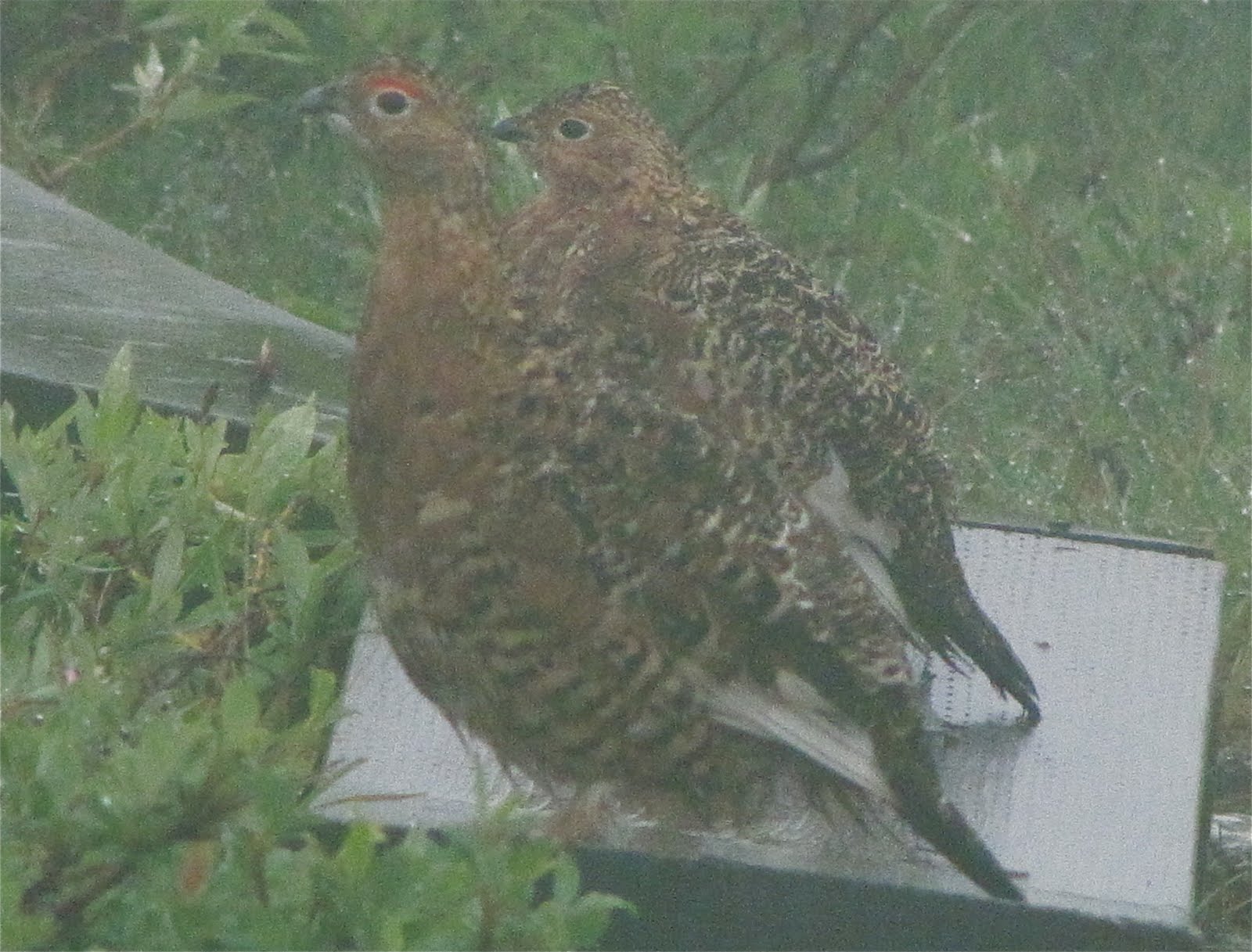
Willow Grouse

Scientific Name: Lagopus lagopus

Population Estimate: 40M

Range / Habitat: Year-round in Arctic regions throughout the world.

Field Notes: Mottled brown and white in the summer, all white in the winter. Males with orange or red markings above the eyes. Rock Ptarmigan is slightly smaller, found at higher altitudes with less lush vegetation, has more grey tones in summer, and may have a black eye stripe in winter.

Personal Notes: The bottom photo was taken on a soggy, foggy day on the Pinnell Mountain Trail outside of Fairbanks, Alaska. Though I got a better photo at Denali, above, I left the bottom one in to show off the orange marking above the eye.

19 July, 2010

Mew Gull


Scientific Name: Larus Canus

Population Estimate: 2.5M - 3.7M

Range / Habitat: The common gull has a wide distribution, breeding throughout temperate and sub-Arctic parts of Eurasia. Two subspecies occur in Europe, the ‘nominate’ race L. c. canus is the subspecies occurring in Britain, extending through north-west Europe and reaching the White Sea in Russia. There is also a subspecies that occurs in North America. In Britain, this species breeds mainly in Scotland

Field Notes: It is generally similar in appearance to the herring gull (Larus argentatus) but is smaller, and has a smaller, thinner bill, a more rounded head and more active flight. The upperwings are pale grey in colour and have black tips featuring white spots known as ‘mirrors’. The white head develops grey streaks in winter and the legs and bill are greenish-yellow. Juveniles are greyish brown with brown upperparts.

Personal Notes:

Yellow-billed Loon

Scientific Name: Gavia adamsii

Population Estimate: 16-32K, Near Threatened

Range / Habitat: Breeds in Russia, Alaska and Canada primarily on inland freshwater lakes and ponds. Winters at sea mainly off the coasts of Norway and western Canada.

Field Notes: Typical loon shape and habits. Distinguishing feature is large, yellow, slightly upturned bill.

Personal Notes: A rare find in Fairbanks in a fairly small pond. This bird is not usually this far inland.

18 July, 2010

Sand Martin

Scientific Name: Riparia riparia

Population Estimate: 50M

Range / Habitat: Summers in the northern US, Canada, Alaska. Winters in the tropics. Also common throughout Europe and Asia. Favors inland wetland areas.

Field Notes: Typical swallow / martin that is brown above and white below with a brown chest band. The Northern Rough-winged Swallow is similar but lacks the chest band.

Personal Notes: Also known as a Bank Swallow. This was a pleasant (but not uncommon) surprise find in Alaska among several Tree and Barn Swallows.

15 July, 2010

Common Yellowthroat

Scientific Name: Geothlypis trichas

Population Estimate: 32M, Least Concern status

Range / Habitat: Summers throughout most of the eastern US and Canada. Winters in Mexico and Central America. Favors inland wetland habitats. 

Field Notes: Olive-backed songbird with yellow throat. Males with prominent black mask and white stripe above (as in the photos), females without. Song a repeated "witch-it-ty."

Personal Notes: We first saw this bird on a trip to Rhode Island, to visit Ted and Jo. 

Northern Mockingbird


Scientific Name: Mimus polyglottos

Range / Habitat: Year-round in shrub land throughout the United States and Mexico.

Field Notes: Medium-sized grey songbird with long tail, dark wings with white wing bars, and a black eye stripe. Similar overall appearance to both the Loggerhead and Great Grey Shrike, but the shrikes have slightly different ranges and wide black mask instead of an eye stripe. Townsend's Solitaire is also similar but has a more restricted range, is the same shade of grey all over, and has a white eye ring instead of a black eye stripe.

Personal Notes: It was remarkable to watch and listen to this bird with a seemingly endless array of different melodies.

14 July, 2010

Common Eider

Scientific Name: Somateria mollissima

Population Estimate: 3.5M, Least Concern status

Range / Habitat: Marine bird breeding in circumpolar Arctic costal areas. Winters extending only slightly south of breeding grounds. 

Field Notes: Large duck with prominent wedge-shaped bill in both sexes. Breeding male unmistakable as above. Female dark brown with heavy black barring. 

Personal Notes: Our first view of an eider duck was while walking around Sachuest Point NWR, Rhode Island with Ted and Joanna Rolfes. Later seen at Acadia National Park. Finally, seen in huge rafts of birds in Iceland during breeding season. 

02 June, 2010

Northern Rough-winged Swallow


Scientific Name: Stelgidopteryx serripennis

Population Estimate: 15M

Range / Habitat: Summers in the entire US. Can winter in parts along the Gulf Coast but primarily found in the Yucatan and Central America. Favors inland wetlands including rivers and streams. 

Field Notes: Somewhat dull plumage for a swallow -- brown above and white below. It is similar to a Sand Martin but without the brown band across the chest.

Personal Notes: As our birding skills have increased we have been able to identify this bird on our own. We required a guide the first few times in San Blas, Mexico and Salt Lake City. By the time we saw this bird in Minnesota, it was an old friend.

01 June, 2010

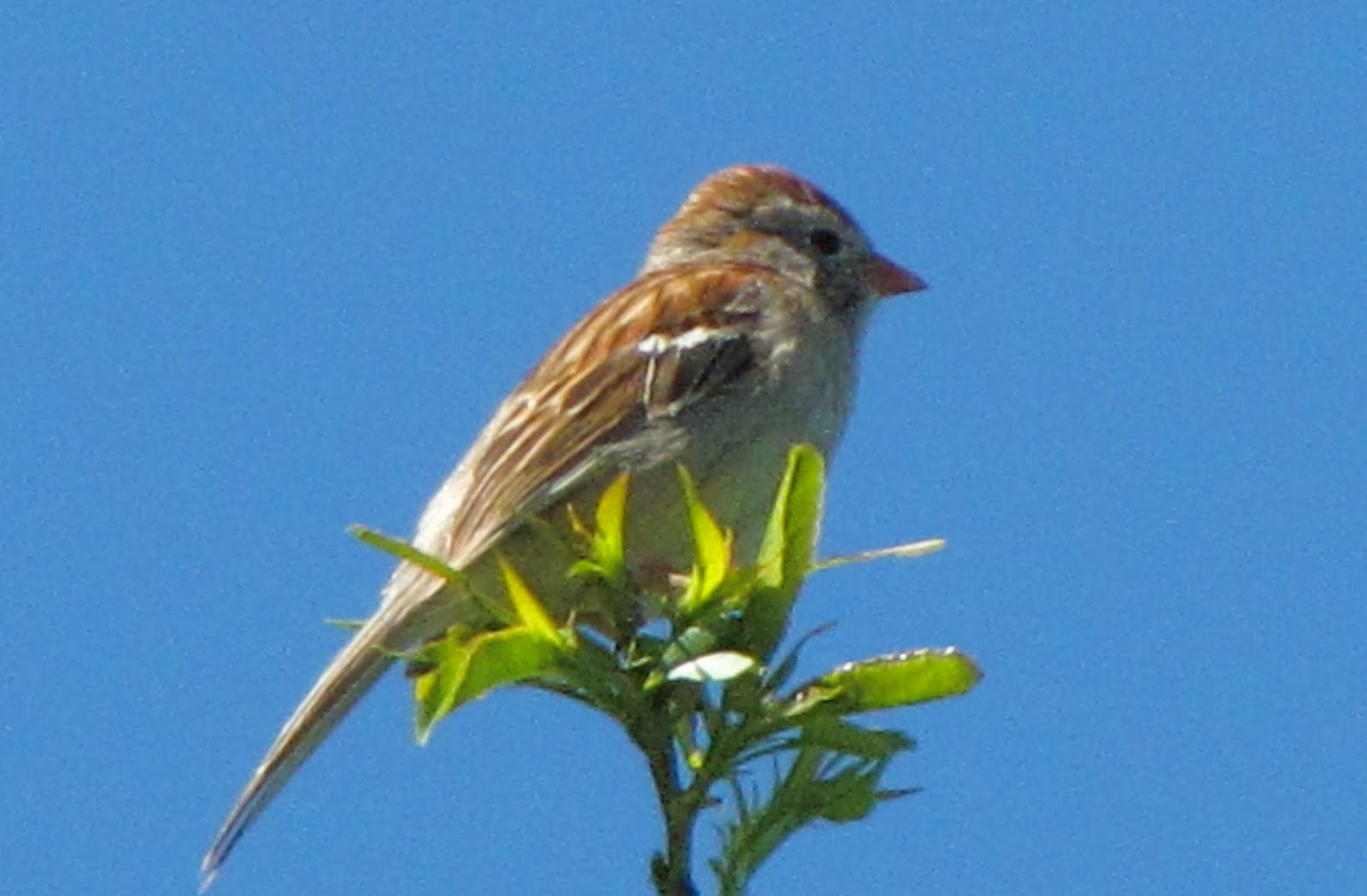
Field Sparrow


Scientific Name: Spizella pusilla

Population Estimate: 8M, Least Concern status

Range / Habitat: "Old-field" sparrows, found year-round in the southeastern US. In winters extending a bit south, and in summers up to the Canadian border.

Field Notes: Clear-breasted sparrow with rusty cap parted by a grey strip, white eye ring, pale pink bill, and rufous strip behind the eye. Face is otherwise bland grey. Call a distinctive, accelerating trill.

Personal Notes:

31 May, 2010

Ruby-throated Hummingbird


Scientific Estimate: Archilochus Colubris

Population Estimate: 7M

Range / Habitat: Eastern America’s sole breeding hummingbird, the ruby-throated hummingbird is a migratory species that breeds in eastern North America, as far north as the southern limit of dense boreal forests, and winters in Central America, from south Sinaloa and south Veracruz, Mexico, to Belize, Honduras, Guatemala, El Salvador, Nicaragua and, sometimes, extreme western Panama. It is also a regular winter visitor to central and southern Florida and the Gulf coast of Louisiana and Texas.

Field Notes: Iridescent green back, males with red throat which can appear dark depending on the light. This is the only hummingbird in the eastern US. The male is recognised by its iridescent, ruby red gorget, which covers the entire throat, and by its black face and chin and entirely dark, deeply-forked tail. The larger female and the immature bird lack the gorget, instead possessing a white chin and throat with variable amounts of thin, dark streaking, and have a dark, slightly-forked tail with white edging. All ruby-throated hummingbirds have a bright, metallic-green back and crown, which often appears darker on the males, and white underparts with greenish flanks. The plumage of the ruby-throated hummingbird, however, varies with the intensity of the light and, consequently, often appears almost black.

Personal Notes: Identification is easy in Minnesota, however, the above bird was in Costa Rica in early May, which complicated our ID at bit.

24 May, 2010

Great Crested Flycatcher


Scientific Name: Myiarchus crinitus

Population Estimate: 7.5M, Least Concern status

Range / Habitat: Temperate forests in eastern North America in summer, from Yucatan Peninsula to northern South America in winter.Their breeding habitat is deciduous or mixed forests across eastern North America and is found over most of the eastern and mid-western portions of the continent

Field Notes: Large flycatcher with grey head, prominent crest and yellow belly. Rufous patches in wings. All adults are brownish-olive on the upperparts with yellow underparts; they have a long rusty brown tail and a bushy crest. Their throat and breast are grey.

Personal Notes: A very welcome sight in Minnesota in the spring of 2014. 

Eastern Kingbird


Scientific Name: Tyrannus tyrannus

Population Estimate: 13M

Range / Habitat: Found in generally open areas throughout most of North America in the summer, excluding the southwest portion. Winters in the interior of South America.

Field Notes: Widespread, large flycatcher with dark head, back and tail. White belly and white tip to tail.

Personal Notes: This fellow actually thrives pretty far west, and overlaps range with the Western Kingbird, though they look nothing alike.

16 May, 2010

Clark's Nutcracker

Scientific Name: Nucifraga columbiana

Population Estimate: 1M, Least Concern status

Range / Habitat: Year-round in montane pine forests of the American West. Outside breeding season this species may wander down from its traditional altitude of 3000 - 13,000 feet (500 - 3000 meters).

Field Notes: Large grey bird with prominent black wings and tail. Its call belies its inclusion in the crow and jay family. The only similar bird in its range is the Grey Jay, whose appearance is spotty throughout the Clark's range, and who is much more demure in appearance with small bill, fuzzy black cap, and no starkly contrasting black or white on the wings or tail.

Personal Notes: We originally found this bird in the High Uintas of Utah (although the photo above was taken later in the Beartooth Mountains), outside Salt Lake City. It was the call, size, and flashes of black on grey that solidified our attention. We didn't see it crack any nuts. Later we were in Lost Creek Canyon on Deseret Ranch and came across perhaps as many as one hundred of these birds flocking together. It was an unusual sight as they are usually quite solitary birds. 

Red-naped Sapsucker


Scientific Name: Sphyrapicus nuchalis

Population Estimate: 2.2M

Range / Habitat: Moves throughout the lower elevations of mixed forest in western mountains of North America. Summer up to western Canadian Rockies, winter down to mountain regions in southern Mexico.

Field Notes: Woodpecker stance, but known to be sapsucker by white stripe down length of body. Very similar appearance to Yellow-bellied Sapsucker (red cap and throat, yellow belly), but little overlap in distribution. Per Sibley, Red-naped Sapsucker with two distinct columns of barring on the back, as in the top photos.

Personal Notes: Wonderful patience on Richard's part to get these photos. As so frequently happens, this bird was found in the wilds of a campground parking lot.

15 May, 2010

Spotted Towhee

Scientific Name: Pipilo Maculatus

Population Estimate: 14M

Range / Habitat: Year-round in forested regions in western US. In summers the range extends slightly north and east, winters slightly south and east.

Field Notes: Large, striking sparrow with long tail. Black head with red eye. White breast and rufous flanks. Compared to Eastern Towhee, with whom it actually shares little geographic area, the Spotted Towhee has white spots across its back and wings.

Personal Notes:

Black-chinned Hummingbird


Scientific Name: Archilochus Alexandri

Population Estimate: 2M

Range / Habitat: Winters along the west coast of Mexico in lowland moist forest. Summers in the western US. Their breeding habitat is open semi-arid areas near water in the western United States, northern Mexico and southern British Columbia.

Field Notes: Males (top photo) with black chin and just a flash of iridescent purple when seen from the right angle. Range overlaps with Broad-tailed Hummingbird (which has a stocky body with conspicuously large tail, males with rosy throat, and distinct loud hum), Calliope Hummingbird (very small hummingbird, males with unmistakable streaked rosy gorget), and Rufous Hummingbird (later migrant, males with rufous coloring). Females (bottom photo) are more difficult to distinguish but posture, size and lack of spotted checks are suggestive of a Black-chinned. A better look at the tail would be definitive.

Personal Notes: Though these photos where taken at feeders we also saw this delicate bird on a separate occasion, perched high on a bare branch

Broad-tailed Hummingbird


Scientific Name: Selasphorus Platycercus

Population Estimate: 4M

Range / Habitat: A bird of subalpine areas found year-round in the mountainous regions of central Mexico and summers in the Rockies.

Field Notes: Unfortunately, the above photo does not show the most distinctive features of this bird. In the right light the male has a rosy red chin with broad tail. The hum of the wings is also unique, quite loud. The photo does show the white line running from the chin to eye to neck. They also have which outer rectrices seen in flight. The Broad-tailed's range overlaps with the Black-chinned Hummingbird (which looks all black-headed), Calliope Hummingbird (very small hummingbird, males with unmistakable streaked rosy gorget), and Rufous Hummingbird (later migrant, males with rufous coloring).

Personal Notes: As with many hummingbirds, we have encountered the Broad-tailed away from feeders as well. They were just much harder to photograph in the "wild"!

Plumbeous Vireo


Scientific Name: Vireo plumbeus

Population Estimate: 2.7M, Least Concern status

Range / Habitat: Winters in western Mexico in montane moist forest. Summers in the southern Rockies and the Great Basin. it is a small North American songbird, ranging from far southeastern Montana and western South Dakota south to the Pacific coast of Mexico, including the extreme southern regions of Baja California Sur.

Field Notes: All grey head, back and tail with two weak, white wing bars. White spectacles are pronounced. White underneath, completely lacking yellow coloring of most other vireos. The Grey Vireo overlaps in range, but has a complete, thin eye ring and only one weak wing bar. At first glance may also be confused with a Blue-grey Gnatcatcher, who is smaller with longer tail, thinner bill, complete and narrow eye ring, and no wing bars.

Personal Notes: Formerly lumped as a "Solitary Vireo" with the more eastern Blue-headed Vireo and more northwestern Cassin's Vireo.

Blue-grey Gnatcatcher


Scientific Name: Polioptila caerulea

Population Estimate: 57M, Least Concern status

Range / Habitat: Their breeding habitat includes open deciduous woods and shrublands in southern Ontario, the eastern and southwestern United States, and Mexico. Among gnatcatcher species, this is in the only one to breed in eastern North America.

Field Notes: Tiny, long-tailed all grey bird, with belly lighter than back. May overlap with Black-tailed Gnatcatcher. May also be confused with Plumbeous Vireo, who has incomplete and thick eye ring, stouter bill, shorter tail, and white wing bars. The Grey Vireo is much less common with limited range, and typical vireo size, stance, weak wing bar, and faint "spectacle" spot in front of eye.

Personal Notes: When we first saw this bird in San Blas, Mexico we thought it looked like a "mini mockingbird." I still think it does.

Snow Goose


Scientific Name: Chen Caerulescens

Population Estimate: 7.6M

Range / Habitat: Winters in discrete areas throughout the US and Mexico, including a large swath of states along the Mississippi River. Occasional vagrant to Europe. Breeds in Arctic tundra of North America and Siberia.

Field Notes: Medium-sized white goose (though there is a blue morph) with black tail. Nearly identical to smaller Ross's Goose except Snow Goose has green base to bill with a black edge or "smile" to bill. Blue morph similar to Emperor Goose, though the latter has dark neck and white nape.

Personal Notes: We originally saw this bird in captivity at Tracy Aviary, Salt Lake City, Utah (bottom photo). We were later rewarded by seeing one in migration in early April at the Minnesota Zoo (top photo). And, we likely spotted a blue morph in migration with Canadian geese in November along with Mississippi.

Emperor Goose


Scientific Name: Chen Canagica

Population Estimate: 85K

Range / Habitat: The range of the emperor goose centres on the Bering Sea in the North Pacific Ocean. It breeds in Arctic and sub-Arctic Alaska and along the north-eastern coast of Russia. The majority of the population spends winter along the coasts of the Aleutian Islands, but it may also winter in Canada and the Alaskan Peninsula. Occasionally, individuals have been recorded as far south as California and Japan.

Field Notes: The emperor goose (Chen canagica) is a small, stocky goose that has dark bluish-grey plumage with black barring on the upperparts. The legs and feet of the emperor goose are yellow-orange in colour and the bill is pink. The head and hindneck are striking white, but are often stained an orange-red colour from feeding in tidal ponds where iron oxide is present in sufficient concentration. Juvenile emperor geese have a slightly duller appearance than the adults, with brown barring on the upperparts, grey mottling on the head and foreneck, a black bill and olive-brown legs.

Personal Notes: This bird seen in Tracy Aviary, Salt Lake City, Utah.
 

Golden Eagle


Scientific Name: Aquila Chrysaetos

Population Estimate: 170K

Range / Habitat: The golden eagle has probably never been particularly common in Britain, as pairs require enormous territories. The British population is thought to number around 400 pairs at present. Most of these pairs are found in the Scottish Highlands, although more recently a few birds have returned to the Lake District, Cumbria (6). The species is extinct in Ireland, following persecution. The golden eagle's world range spreads through the Palaearctic region including mountainous parts of Europe as far south as northern Africa and south-east Asia. It also occurs in North America.

Field Notes: This huge bird of prey can be identified by its very long wings and long tail. When gliding or soaring it typically holds its wings in a shallow ‘V’. The plumage is dark brown rather than golden and the massive talons are bright yellow. The feathers of the head and nape of the neck are typically light yellowish or reddish-brown, giving the appearance of a ‘shawl’. Males and females are similar in appearance, but juveniles can be distinguished by the presence of white patches on the undersides of the wings and on both surfaces of the tail.

Personal Notes:

Southern Lapwing


Scientific Name: Vanellus Chilensis

Population Estimate: 2M

Range / Habitat: It is a common and widespread resident throughout South America, except in densely forested regions (e.g. most of the Amazon), the higher parts of the Andes and the arid coast of a large part of western South America. This bird is particularly common in the basin of the River Plate. It has also been spreading through Central America in recent years.

Field Notes: The Southern Lapwing (Vanellus chilensis) is a wader in the family Charadriiformes.The upperparts are mainly brownish grey, with a bronze glossing on the shoulders. The head is particularly striking; mainly grey with a black forehead and throat patch extending onto the black breast. A white border separates the black of the face from the grey of the head and crest. The rest of the underparts are white, and the eye ring, legs and most of the bill are pink.

Personal Notes: Seen at Tracy Aviary in Salt Lake City, Utah.

Elegant Crested Tinamou

Scientific Name: Eudromia elegans

Range / Habitat: Year-round in arid, open areas in Argentina and Chile.

Field Notes: Medium-sized, plump terrestrial bird with small head and essentially no tail. Overall brownish / grey with extensive spotting. Buffy facial stripes and crest.

Personal Notes: Seen in captivity at Tracy Aviary, Salt Lake City, Utah. This bird was constantly moving and bobbing, making it almost impossible to photograph even in an enclosed setting.

Helmeted Guineafowl

Scientific Name: Numida meleagris

Range / Habitat: Year-round in open areas throughout sub-Saharan Africa. Has been introduced into West Indies, Brazil, Australia and southern France.

Field Notes: Plump, fowl-like bird with very short tail. Body black with white speckling. Head and neck featherless, with bare skin blue to bluish white. Characteristic horn-colored bony casque and variety of red facial appendages.

Personal Notes: First seen in captivity in Tracy Aviary in Salt Lake City, later photographed at Disney's Animal Kingdom in Florida. Still waiting to see these birds in the wild....

14 May, 2010

Saffron Finch


Scientific Name: Sicalis Flaveola

Population Estimate: Unknown, but Least Concern status

Range / Habitat: They have a wide distribution in Colombia, northern Venezuela, western Ecuador, western Peru, eastern and southern Brazil, Bolivia, Paraguay, Uruguay, northern Argentina, and Trinidad and Tobago. It has also been introduced to Hawaii, Puerto Rico and elsewhere. Formerly, it was placed in the Emberizidae but it is close to the seedeaters.

Field Notes: The Saffron Finch (Sicalis flaveola) is a tanager from South America that is common in open and semi-open areas in lowlands outside the Amazon Basin. Male is bright yellow with an orange crown which distinguishes it from most other yellow finches (the exception being the Orange-fronted Yellow-finch). The females are more confusing and are usually just a slightly duller version of the male, but in the southern subspecies S. f. pelzelni they are olive-brown with heavy dark streaks.

Personal Notes: