Showing posts with label Galliformes. Show all posts

18 August, 2014

Franklin's Grouse

Scientific Name: Falcipennis canadensis

Range / Habitat: Year-round in boreal forests and taiga throughout Canada and Alaska.

Field Notes: Medium-sized fowl with heavily barred back and breast. Breeding males nearly black, as above, females lighter brown, as below. Males with white-boardered black throat and red eye combs. Ruffed Grouse larger with a crest and no red eye comb.

Personal Notes: First seen in Jasper National Park, Alberta, Canada. These birds were not shy, often found right on the side of the road, not moving even when we stopped to photograph them. We later found the male on route to Wapta Falls in Yoho National Park, British Columbia, Canada.

31 December, 2013

Gambel's Quail

Scientific Name: Callipepla gambelii

Range / Habitat: Year-round in the Sonoran, Mohave, and Chihuahuan deserts of the southwestern US and Mexico, below about 5,500 feet elevation.

Field Notes: Similar in appearance to the California Quail, though Gambel's has white breast with black belly and ranges do not overlap.

Personal Notes: A surprise find near the Clifton mines at the southern edge of Apache-Sitgreaves National Forests in Arizona.

20 March, 2013

Red-legged Partridge

Scientific Name: Alectoris rufa

Population Estimate: 6M - 13.5M

Range / Habitat: Breeds on farmland and open stony areas in southwestern Europe, in France and Iberia. It has been introduced in parts of England and Wales.

Field Notes: Sandy-brown above, pinkish-buff on the belly, and pale grey on the breast, with a prominent gorget of black streaking, bold rufous and black flank-bars, a cream throat, pink legs, and a red bill and eye ring.

Personal Notes: Seen near Donana National Park, Spain.

23 May, 2011

Grey-headed Chachalaca

Scientific Name: Ortalis cinereiceps

Range / Habitat: Tropical wet forest and forest edge lowlands and middle elevations throughout Central America.

Field Notes: Large, skulking bird with long, wide tail. Grey head with red gular area, brown body with rufous primaries. Often arboreal. Plain Chachalaca lacks rufous primaries.

Personal Notes: Seen at Arenal Nayara Hotel, Costa Rica.

18 May, 2011

Black Guan

Scientific Name: Chamaepetes unicolor

Range / Habitat: Found in tropical montane moist forest of Costa Rica and Panama.

Field Notes: Large, all-black bird with blue facial skin, red eye, and red legs.

Personal Notes: Seen at Monteverde Cloud Forest Reserve in Costa Rica. We would never have seen this bird hidden right above us without our excellent guide, Carlos.

07 May, 2011

Golden Pheasant

Scientific Name: Chrysolophus pictus

Population Estimate: Unknown, but Least Concern status

Range / Habitat: Endemic to forest and shrubland in western China.

Field Notes: Unmistakable in range.

Personal Notes: Seen first at Disney's Animal Kingdom then later at Kew Royal Botanical Gardens, London. 

04 May, 2011

Crested Partridge

Scientific Name: Rollulus rouloul

Population Estimate: Unknown, Near Threatened status

Range / Habitat: Lowland moist forest of Myanmar, Thailand, Malaysia, Brunei and Indonesia.

Field Notes: Ground foragers which are unmistakable in range. Male has dramatic red crest as in top photo. Female in bottom photo.

Personal Notes: Seen at Disney's Animal Kingdom.

03 May, 2011

Vulturine Guineafowl

Scientific Name: Acryllium vulturinum

Range / Habitat: Year-round in dry savannah and shrubland of east Africa.

Field Notes: Unmistakable in range as above. The largest of all guineafowl.

Personal Notes: Seen at Disney's Animal Kingdom Lodge.

27 April, 2011

Greater Prairie Chicken

Scientific Name: Tympanuchus cupido

Population Estimate: 460K, Vulnerable status

Range / Habitat: Year-round in open grasslands of the Dakotas, Nebraska, Wisconsin, Oklahoma.

Field Notes: Unmistakable in range. Chicken-sized bird known for its mating ritual on communal leks.

Personal Notes: Despite cold, rainy, windy weather, had a great time viewing these birds on Carl Flaig's farm.

03 April, 2011

Great Argus

Scientific Name: Argusianus argus

Population Estimate: 100K

Range / Habitat: Subtropical / tropical lowland moist forest in Malaysia, Thailand, Indonesia, Myanmar

Field Notes: Unmistakable in range.

Personal Notes: Seen at Minnesota Zoo. Also known as Malay Great Argus Pheasant.

19 December, 2010

Ocellated Turkey

Scientific Name: Meleagris ocellata

Population Estimate: 20K to 50K, Near Threatened status

Range / Habitat: Found in lowland moist forest of Yucatan, northern Belize, northeastern Guatemala.

Field Notes: Unmistakable. Named for the orange spots on the head. Very similar to Wild Turkey, though they do not overlap in range.

Personal Notes: Seen all over the place at Tikal, one of the few areas this near-threatened species is protected. Kristen couldn't get enough pics of these blokes!

26 November, 2010

Crested Guan

Scientific Name: Penelope purpurascens

Range / Habitat: Year-round resident of both slopes of Mexico into Central America. Habitat is tropical lowland moist forest.

Field Notes: Large, fowl-like bird with long tail. Dark brown with white streaking, red eye and wattle, grey-blue mask and bill. Differentiated by Highland Guan primarily by habitat.

Personal Notes: Seen at the Tikal ruins in Guatemala.

22 November, 2010

Great Curassow

Scientific Name: Crax rubra

Range / Habitat: Fragmented distribution in lowland rainforest throughout southern Mexico, Central America, and into northern South America.

Field Notes: Large, fowl-type bird, most commonly seen on the ground. Male all black. Female black and brown. Curly crown feathers in both sexes unmistakable.

Personal Notes: As is evident from the blurry photo above, we caught a fleeting glimpse of a group of these birds while leaving Tikal in Guatemala.

21 November, 2010

Plain Chachalaca

Scientific Name: Ortalis vetula

Range / Habitat: Resident throughout eastern coast of Mexico, Yucatan, and into Central America. Favors lowland shrub and forest. 

Field Notes: Large, noisy fowl-like bird often found in trees. Overall brown with long, broad tail. Face is grey and red gular stripe sometimes apparent. Grey-headed Chachalaca with bright rufous primaries. 

Personal Notes: A surprisingly shy bird for its size and the amount of noise it makes.

21 July, 2010

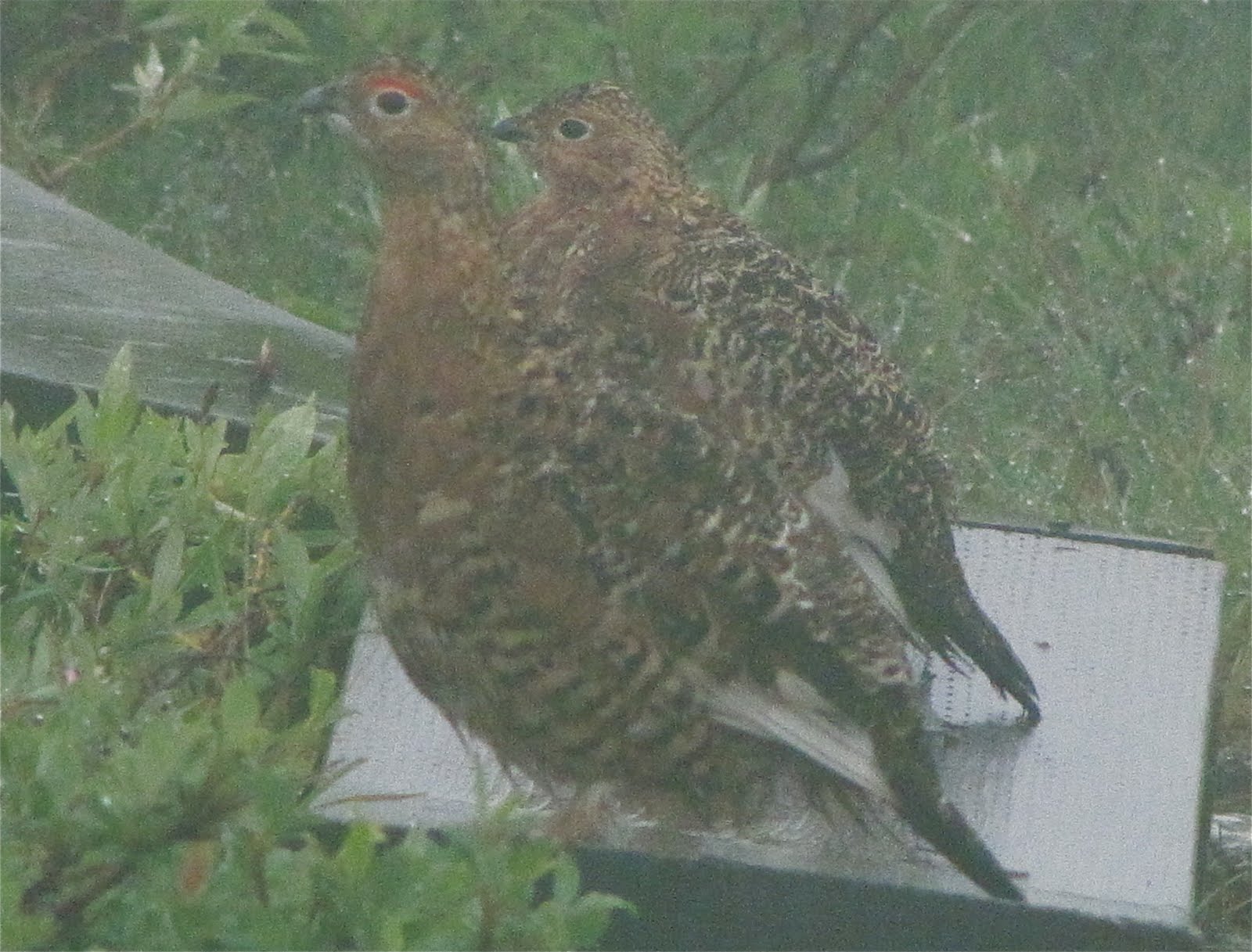
Willow Grouse

Scientific Name: Lagopus lagopus

Population Estimate: 40M

Range / Habitat: Year-round in Arctic regions throughout the world.

Field Notes: Mottled brown and white in the summer, all white in the winter. Males with orange or red markings above the eyes. Rock Ptarmigan is slightly smaller, found at higher altitudes with less lush vegetation, has more grey tones in summer, and may have a black eye stripe in winter.

Personal Notes: The bottom photo was taken on a soggy, foggy day on the Pinnell Mountain Trail outside of Fairbanks, Alaska. Though I got a better photo at Denali, above, I left the bottom one in to show off the orange marking above the eye.

15 May, 2010

Helmeted Guineafowl

Scientific Name: Numida meleagris

Range / Habitat: Year-round in open areas throughout sub-Saharan Africa. Has been introduced into West Indies, Brazil, Australia and southern France.

Field Notes: Plump, fowl-like bird with very short tail. Body black with white speckling. Head and neck featherless, with bare skin blue to bluish white. Characteristic horn-colored bony casque and variety of red facial appendages.

Personal Notes: First seen in captivity in Tracy Aviary in Salt Lake City, later photographed at Disney's Animal Kingdom in Florida. Still waiting to see these birds in the wild....

14 May, 2010

Sage Grouse


Scientific Name: Centrocercus Urophasianus

Population Estimate: 150k

Range / Habitat: The Sage Grouse (Centrocercus urophasianus) is the largest grouse in North America, where it is known as the Greater Sage-Grouse. Its range is sagebrush country in the western United States and southern Alberta and Saskatchewan, Canada.

Field Notes: Birds in known lake areas. Adults have a long, pointed tail and legs with feathers to the toes. Adult males have a yellow patch over the eye, are grayish on top with a white breast, a dark brown throat and a black belly; two yellowish sacs on the neck are inflated during courtship display. Adult females are mottled gray-brown with a light brown throat and dark belly.

Personal Notes: We especially like the bottom three "mug shot" photos!

12 May, 2010

Chukar Partridge


Scientific Name: Alectoris Chukar

Population Estimate: 2M - 10M

Range / Habitat: The chukar has an extremely large native range, spanning countries from Eastern Europe to China, Russia and Africa. Furthermore, it has been introduced to many other areas, including the United States, Canada, New Zealand and elsewhere within Europe. The species is currently regionally extinct from Kuwait.

Field Notes: The Chukar is a rotund ong partridge, with a light brown back, grey breast, and buff belly. The shades vary across the various populations. The face is white with a black gorget. It has rufous-streaked flanks, red legs and coral red bill. Sexes are similar, the female slightly smaller in size and lacking the spur. The tail has 14 feathers, the third primary is the longest while the first is level with the fifth and sixth primaries.

Personal Notes:

30 December, 2009

Indian Peafowl


Scientific Name: Pavo Cristatus

Population Estimate: Unknown but Least Concern status


Range / Habitat: The native range of the Indian peafowl encompasses India, Sri Lanka, Pakistan, Bhutan, Bangladesh and Nepal. Captive specimens are found throughout the world, and introduced, feral populations now occur in Australia, New Zealand, the Bahamas, and the USA.


Field Notes: The national bird of India, the spectacular appearance of the male Indian peafowl, or ‘peacock’, is well-known throughout the world. The male’s head, neck and breast are a glossy, iridescent blue, with white patches above and below the eyes, along with a crest of upright, blue-tipped feathers on the crown of the head. By contrast, the back and wings are greyish-brown with brown barring.

10 November, 2009

Ring-necked Pheasant


Scientific Name: Phasianus colchicus

Population Estimate: 34M - 47M, Least Concern status

Range / Habitat: Common Pheasants are native to Asia, their original range extending from between the Black and Caspian Seas to Manchuria, Siberia, Korea, Mainland China and Taiwan. Through introduction they are now found in open fields and roadsides through the middle of US and Europe. 

Field Notes: Unmistakable, as above. 

Personal Notes: Also known as Common Pheasant.