Scientific Name: Uria aalge
Range / Habitat: Exclusively marine, breeding along sea coasts on rocky cliffs and offshore islands throughout the subarctics. In winter, generally pelagic in the same waters.
Field Notes: Medium-sized waterbird with black to dark-brown head, neck and back. White underparts with some dark streaking on the flanks. Bridled or ringed morph, restricted to the Atlantic, has white eye-ring and post-ocular stripe. Non-breeding adults have white on face and throat. Thick-billed Murre has a white line on the gape, is blacker on the back, and lacks streaked flanks. Razorbill more stocky, with stouter bill lined in white.
Personal Notes: Seen huddled in large clusters against the wind on the Latrabjarg cliffs in western Iceland.
Showing posts with label Alaska. Show all posts
24 June, 2014
09 August, 2011
Steller's Jay
Scientific Name: Cyanocitta stelleri
Population Estimate: 4.4M
Range / Habitat: Year-round in montane evergreen forests of western North America, Canada and Mexico.
Field Notes: Noisy, inquisitive and conspicuous like most jays. Coloration is quite dark -- black head and neck with crest and bright blue body. No white markings.
Personal Notes: Richard had been trying to get a photo of this bird for some time. We were finally rewarded at Barr Camp on Pike's Peak. A fitting end to the summer in Wyoming (bottom photo). The top photo was from a group of more subdued jays in Apache-Sitgreaves Forests in Arizona and better demonstrates the plumage and crest.
Labels:
Alaska,
Arizona,
Colorado,
crows / jays,
DONE,
Montana,
Passeriformes,
Utah,
Wyoming
11 May, 2011
Canada Goose
Scientific Name: Branta canadensis
Range / Habitat: Wet environments year-round in the middle latitudes of US. Summers up through Canada and Alaska, winters extending down to souther US and parts of Mexico. Introduced in parts of Europe and New Zealand.
Field Notes: Large, noisy waterfowl with long neck and high rump profile in water. Head, neck are black with white cheek patch. Back brown, belly and rump white. Brent Goose has shorter neck and white neck ring, not cheek patch.
Personal Notes: These birds are ubiquitous in Minnesota, so much so that we never photographed them until we were about to leave. We were startled to find them in New Zealand, where introduced and much more wary than in the States.
08 August, 2010
Pigeon Guillemot
Glaucous-winged Gull
Scientific Name: Larus glaucescens
Population Estimate: 570K
Range / Habitat: Northwest coast of North America
Field Notes: Large gull with light grey mantle and wing tips. Note grey underside of wing extending to tip in the upper photo (distinguishes Glaucous-winged Gull from Glaucous Gull, which has all white wing tips).
Personal Notes:
04 August, 2010
Red-throated Diver
Scientific Name: Gavia stellata
Population Estimate: 200K - 600K, Least Concern status
Range / Habitat: Breeds in low tundra wetlands, bogs, and ponds in forests throughout the circumpolar Arctic. Winters on inshore waters along sheltered coasts, occasionally on inland ponds or lakes throughout northern latitudes.
Field Notes: The smallest of the divers. Light grey in breeding plumage with prominent red throat. Pale grey and white in winter. Small bill often turned upwards.
Personal Notes: A surprise find in Denali National Park. The bus guide (who was supposed to be looking for bears and moose) spotted this bird. We later found this bird on a nest in Iceland, followed by another sighting near the Valagil waterfall in the West Fjords. Also known as Red-throated Loon.
25 July, 2010
Alder Flycatcher
Population Estimate: 50M, Least Concern status
Range / Habitat: Summers in most of Alaska, Canada and New England. Winters in a swath of western South America. Favors moist shrubland habitat.
Field Notes: Medium-sized flycatcher of wet thickets. Drab olive on upper parts with two white wing bars. White underneath. Partial eye ring. Essentially identical to Willow Flycatcher, though with limited overlap in range in the northeastern United States and distinct songs.
Personal Notes:
23 July, 2010
Red-necked Grebe
Scientific Name: Podiceps Grisegena
Population Estimate: 200K - 300K
Range / Habitat: The two subspecies of the red-necked grebe have distinct ranges. The North American and east Asian subspecies, Podiceps grisegena holboelli, is found in western Canada and the northwest USA, as well as eastern Russia, northeast China and northern Japan. In North America, the red-necked grebe breeds in Alaska, Yukon Territory and the Northwest territories, east to southwest Quebec, and south to Oregon, Idaho, Wyoming, Montana, South Dakota, Minnesota, Wisconsin and southern Ontario.
Field Notes: The upperparts are dark brownish-black and the wings are dark, with two prominent white patches. In breeding plumage, the red-necked grebe has a black cap that extends below the eye, with a slight crest and a large, distinctive pale grey check patch that has whitish margins and extends upward to behind the eye. The front of the neck and the upper breast are deep chestnut, becoming paler on the belly, while the sides and flanks are greyish.
Personal Notes:
21 July, 2010
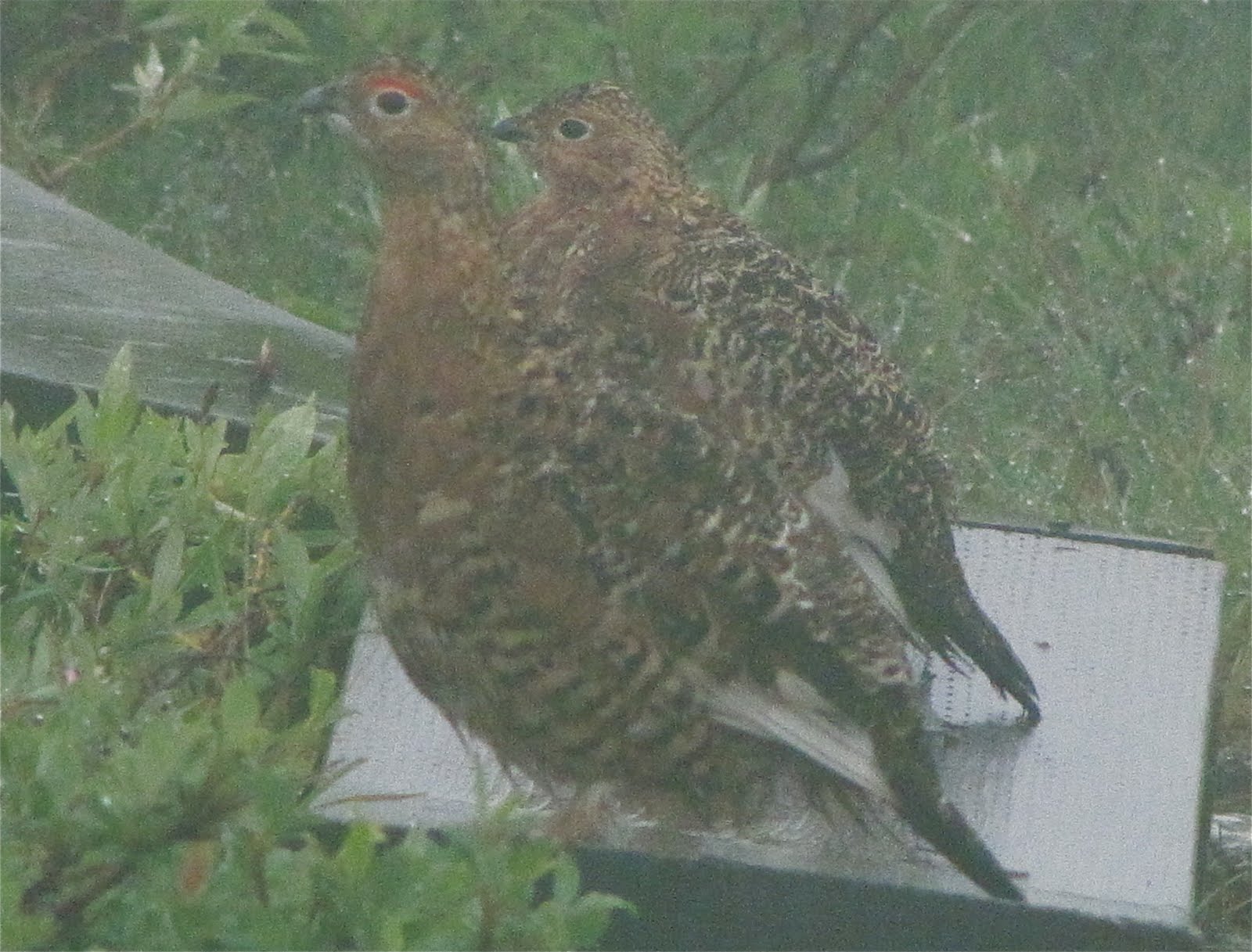
Willow Grouse
Population Estimate: 40M
Range / Habitat: Year-round in Arctic regions throughout the world.
Field Notes: Mottled brown and white in the summer, all white in the winter. Males with orange or red markings above the eyes. Rock Ptarmigan is slightly smaller, found at higher altitudes with less lush vegetation, has more grey tones in summer, and may have a black eye stripe in winter.
Personal Notes: The bottom photo was taken on a soggy, foggy day on the Pinnell Mountain Trail outside of Fairbanks, Alaska. Though I got a better photo at Denali, above, I left the bottom one in to show off the orange marking above the eye.
19 July, 2010
Mew Gull
Scientific Name: Larus Canus
Population Estimate: 2.5M - 3.7M
Range / Habitat: The common gull has a wide distribution, breeding throughout temperate and sub-Arctic parts of Eurasia. Two subspecies occur in Europe, the ‘nominate’ race L. c. canus is the subspecies occurring in Britain, extending through north-west Europe and reaching the White Sea in Russia. There is also a subspecies that occurs in North America. In Britain, this species breeds mainly in Scotland
Field Notes: It is generally similar in appearance to the herring gull (Larus argentatus) but is smaller, and has a smaller, thinner bill, a more rounded head and more active flight. The upperwings are pale grey in colour and have black tips featuring white spots known as ‘mirrors’. The white head develops grey streaks in winter and the legs and bill are greenish-yellow. Juveniles are greyish brown with brown upperparts.
Personal Notes:
Yellow-billed Loon
Population Estimate: 16-32K, Near Threatened
Range / Habitat: Breeds in Russia, Alaska and Canada primarily on inland freshwater lakes and ponds. Winters at sea mainly off the coasts of Norway and western Canada.
Field Notes: Typical loon shape and habits. Distinguishing feature is large, yellow, slightly upturned bill.
Personal Notes: A rare find in Fairbanks in a fairly small pond. This bird is not usually this far inland.
18 July, 2010
Sand Martin
Population Estimate: 50M
Range / Habitat: Summers in the northern US, Canada, Alaska. Winters in the tropics. Also common throughout Europe and Asia. Favors inland wetland areas.
Field Notes: Typical swallow / martin that is brown above and white below with a brown chest band. The Northern Rough-winged Swallow is similar but lacks the chest band.
Personal Notes: Also known as a Bank Swallow. This was a pleasant (but not uncommon) surprise find in Alaska among several Tree and Barn Swallows.
13 May, 2010
Black-billed Magpie
Scientific Name: Pica hudsonia
Population Estimate: 30M - 100M, including both Pica pica and Pica hudsonia
Range / Habitat: Year-round in a variety of habitats throughout the American West, northwest Canada and up into Alaska.
Field Notes: Large songbird with long tail. Shiny black head, tail, and back. White belly and wing patches. Deep blue on the wings as well.
Personal Notes: Striking, if common, bird of the American West. Some sources consider this bird the same species as Pica pica, which is found throughout Europe, much of Asia, and northwest Africa
Labels:
Alaska,
Alberta,
crows / jays,
DONE,
Minnesota,
Montana,
Passeriformes,
Utah,
Wyoming
Northern Pintail
Scientific Name: Anas acuta
Population Estimate: 5.3M, Least Concern status
Range / Habitat: Found throughout the northern hemisphere, southern latitudes in winter, northern latitudes in summer. Preferred habitat is shallow wetland with dense vegetation.
Field Notes: Large dabbling duck with thin, graceful neck and elongated central tail feathers. Male breeding plumage unmistakable as above.
Personal Notes: One of our favorite finds on the Salton Sea and then in the prairie potholes of South Dakota.
Barrow's Goldeneye
Scientific Name: Bucephala islandica
Population Estimate: 250K, Least Concern status
Range / Habitat: Breeds on freshwater lakes, ponds and fast-flowing rivers primarily in northwestern North America but also in scattered locations in eastern Canada and Iceland. Winters along rocky coasts near breeding grounds. Rare visitor to Lake Superior.
Field Notes: Medium-sized diving duck, female and breeding male as above. Common Goldeneye has circular cheek patch.
Personal Notes: First seen in Duluth as a rare, winter visitor. Later the above photograph taken from Tracy Aviary in Salt Lake City, Utah. Finally, seen in their eponymous setting -- Iceland.
Labels:
Alaska,
Anseriformes,
DONE,
ducks / geese / swans,
Iceland,
Least Concern,
Minnesota,
Montana
12 May, 2010
Yellow-rumped Warbler
Scientific Name: Dendroica coronata
Population Estimate: 130M, Least Concern status
Range / Habitat: Summers in western US, most of Canada, and Alaska. Winters in southern US, Mexico and Central America. Preferred habitat is temperate forest.
Field Notes: Full-bodied black, white, and grey warbler. Characteristic yellow forehead, chin, armpits and rump (the latter seen only in flight). There are plenty of other similarly colored warblers but none with this particular distribution of yellow.
Personal Notes: This species has distinct regional morphs: the Myrtle (top) is predominantly Eastern U.S., while the Audobon's (bottom) is overwhelmingly Western
Barn Swallow
Scientific Name: Hirundo rustica
Population Estimate: 190M, Least Concern status
Range / Habitat: Most common swallow world wide, throughout the Americas, Europe, Asia, Africa, and into northern Australia. Breeding is in the Northern Hemisphere summer with winters in the Southern Hemisphere. Nests in barns and other man-made structures.
Field Notes: Iridescent blue on top, rufous chin, and light brown underneath with a long, forked tail. The Cliff Swallow can look similar but lacks the long forked tail, is generally white on the breast, and has a white forehead mark. Easily distinguished from other swallows in flight by its long forked tail.
Personal Notes: One of our best bird pictures to date!
11 April, 2010
Tree Swallow
Scientific Name: Tachycineta bicolor
Population Estimate: 20M, Least Concern status
Range / Habitat: Breed in open habitats such as fields and wetlands, usually adjacent to water across northern US, Canada and Alaska. Winters in Baja, the Gulf coast of the US, Florida and into Mexico.
Field Notes: Medium-sized swallow with glossy, blue-green upperparts and contrasting white underparts. The wings are long and the tail only shallowly forked.
Personal Notes:
Labels:
Alaska,
DONE,
Least Concern,
Minnesota,
Passeriformes,
South Dakota,
swallows / martins,
Utah,
Wisconsin
01 February, 2010
Common Raven
Scientific Name: Corvus corax
Population Estimate: 16M, Least Concern status
Range / Habitat: Extreme habitat generalist, found throughout the Northern Hemisphere.
Field Notes: Large, all-black passerine with shaggy throat feathers. In flight, ravens have long, wedge-shaped tails.
Personal Notes: It's easy to see why this is such a bird of lore.
Population Estimate: 16M, Least Concern status
Range / Habitat: Extreme habitat generalist, found throughout the Northern Hemisphere.
Field Notes: Large, all-black passerine with shaggy throat feathers. In flight, ravens have long, wedge-shaped tails.
Personal Notes: It's easy to see why this is such a bird of lore.
Labels:
Alaska,
Alberta,
Arizona,
BCS,
California,
crows / jays,
DONE,
Iceland,
Minnesota,
Montana,
Passeriformes,
Utah
31 January, 2010
Boreal Chickadee
Scientific Name: Parus Hudsonicus
Population Estimate: 8M
Range / Habitat: The boreal chickadee inhabits the northern coniferous forests of North America, breeding throughout Alaska, Canada and the northernmost states of the U.S.
Field Notes: A small songbird, the boreal chickadee (Parus hudsonica) is, as its name suggests, almost entirely restricted to the boreal forests of North America. The top of the head and the back of the neck often have a greyish tinge, which extends down the sides of the head to below the eye. A white stripe runs from the base of the bill to below the eye, while the chin and throat are black. The back, wings, rump and uppertail-coverts of the boreal chickadee are generally pale grey-brown, and the breast and abdomen are white.
Personal Notes:
Population Estimate: 8M
Range / Habitat: The boreal chickadee inhabits the northern coniferous forests of North America, breeding throughout Alaska, Canada and the northernmost states of the U.S.
Field Notes: A small songbird, the boreal chickadee (Parus hudsonica) is, as its name suggests, almost entirely restricted to the boreal forests of North America. The top of the head and the back of the neck often have a greyish tinge, which extends down the sides of the head to below the eye. A white stripe runs from the base of the bill to below the eye, while the chin and throat are black. The back, wings, rump and uppertail-coverts of the boreal chickadee are generally pale grey-brown, and the breast and abdomen are white.
Personal Notes:
Subscribe to:
Posts (Atom)