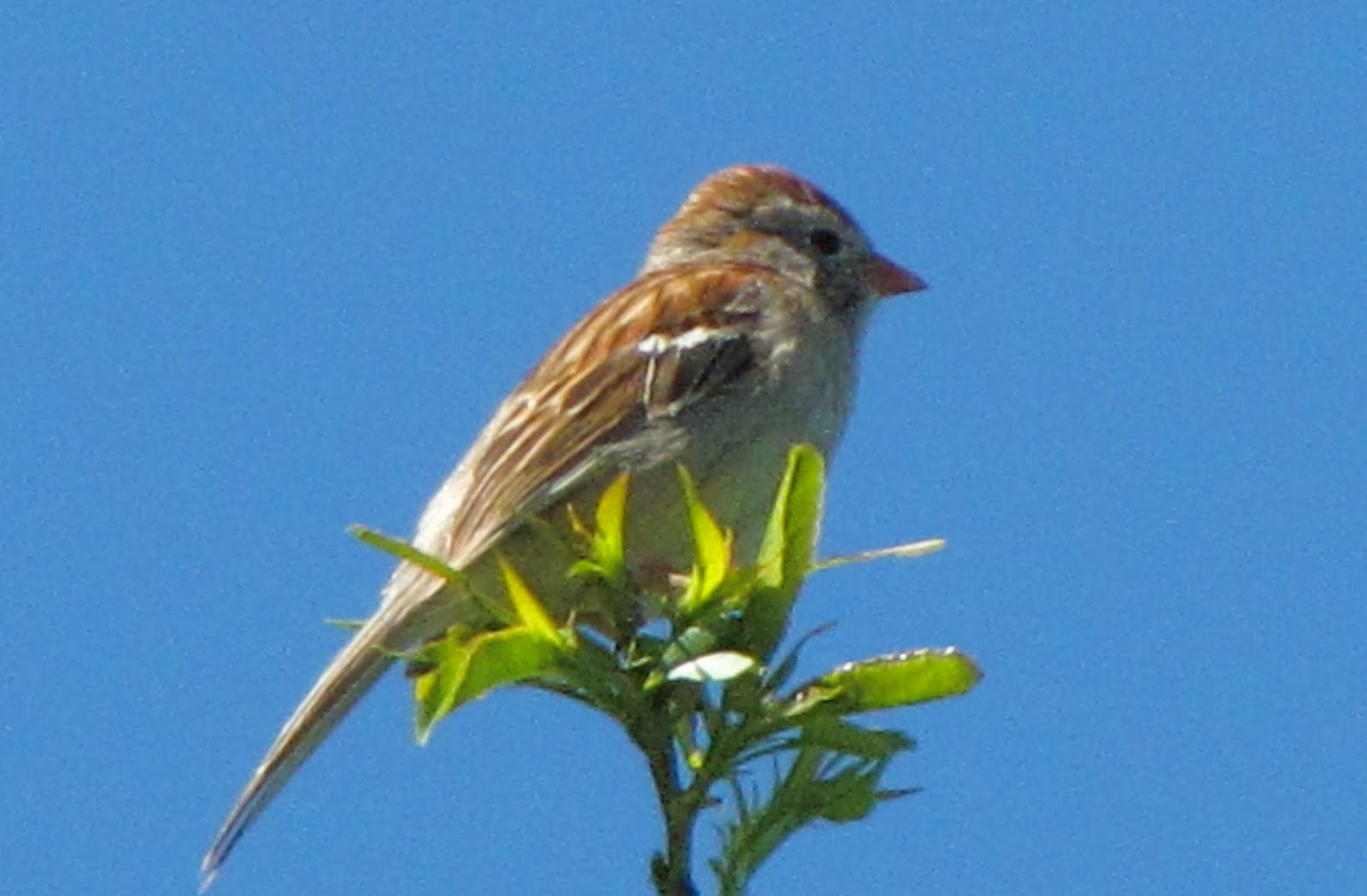
Scientific Name: Melospiza lincolnii
Range / Habitat: Winters in scrubby areas of southwestern US and Mexico, excluding the Yucatan. Breeds in boggy areas of Canada, Alaska, and part of the American West.
Field Notes: Small drab bird with face marking similar to Song Sparrow. Habitat differentiates as does buffy malar stripe and fine, distinct streaks on a buffy chest. Swamp Sparrow with more rufous crown and back, complete grey collar, minimal streaking on grey breast.
Personal Notes: Great picture by Richard at Fontenelle Forest in Omaha, NE.
Showing posts with label Nebraska. Show all posts
26 April, 2014
11 December, 2013
Tufted Titmouse
Scientific Name: Baeolophus bicolor
Range / Habitat: Year-round in lowland, mature deciduous and mixed woods of the eastern United States.
Field Notes: Large, short-crested and long-tailed tit. Grey upperparts, white underparts including check. Rufous flanks. Large, black, beady eye.
Personal Notes: A wonderful find on a wonderful day with friends in New Hampshire. We had a picture for years from Minnesota that we debated about being a Tufted Titmouse. This time we were sure! We then found this bird at the far western edge of his range, in Fontenelle Forest in Omaha, Nebraska.
Range / Habitat: Year-round in lowland, mature deciduous and mixed woods of the eastern United States.
Field Notes: Large, short-crested and long-tailed tit. Grey upperparts, white underparts including check. Rufous flanks. Large, black, beady eye.
Personal Notes: A wonderful find on a wonderful day with friends in New Hampshire. We had a picture for years from Minnesota that we debated about being a Tufted Titmouse. This time we were sure! We then found this bird at the far western edge of his range, in Fontenelle Forest in Omaha, Nebraska.
25 July, 2011
Common Starling
Population Estimate: 310M, Least Concern status
Range / Habitat: Year-round in urban areas throughout the US and all but northernmost Canada, introduced from Europe. Similar habitat throughout Europe, Asia and northern Africa. Also introduced to Australia and New Zealand.
Field Notes: Stocky, medium-sized songbird with short tail. Overall glossy black, with iridescent purple and green. Pale spots on back and brownish wings.
Personal Notes: These birds are EVERYWHERE in the US and yet we waited until 3 weeks before our departure for New Zealand to get a photo for the blog.... Also known as European Starling.
11 May, 2011
Canada Goose
Scientific Name: Branta canadensis
Range / Habitat: Wet environments year-round in the middle latitudes of US. Summers up through Canada and Alaska, winters extending down to souther US and parts of Mexico. Introduced in parts of Europe and New Zealand.
Field Notes: Large, noisy waterfowl with long neck and high rump profile in water. Head, neck are black with white cheek patch. Back brown, belly and rump white. Brent Goose has shorter neck and white neck ring, not cheek patch.
Personal Notes: These birds are ubiquitous in Minnesota, so much so that we never photographed them until we were about to leave. We were startled to find them in New Zealand, where introduced and much more wary than in the States.
27 September, 2010
Broad-winged Hawk
Scientific Name: Buteo platypterus
Population Estimate: 1.8M, Least Concern status
Range / Habitat: Summers throughout deciduous forests in the eastern United States. Winters in Central American and northern South America.
Field Notes: Medium-sized, stocky, forest-dwelling hawk. Reddish barred underparts. Pale wings with dark trailing edge white single to multiple white band across dark tail when seen in flight. Forms large kettles in migration. Red-tailed Hawk has pale chest with dark belly band and red tail in flight. Cooper's Hawk and Sharp-shinned Hawk are accipiters and have relatively long tails and short wings.
Personal Notes: First seen at the Minnesota Landscape Arboretum, later the Fontanelle Forest in Omaha.
01 June, 2010
Field Sparrow
Scientific Name: Spizella pusilla
Population Estimate: 8M, Least Concern status
Range / Habitat: "Old-field" sparrows, found year-round in the southeastern US. In winters extending a bit south, and in summers up to the Canadian border.
Field Notes: Clear-breasted sparrow with rusty cap parted by a grey strip, white eye ring, pale pink bill, and rufous strip behind the eye. Face is otherwise bland grey. Call a distinctive, accelerating trill.
Personal Notes:
15 May, 2010
Blue-grey Gnatcatcher
Scientific Name: Polioptila caerulea
Population Estimate: 57M, Least Concern status
Range / Habitat: Their breeding habitat includes open deciduous woods and shrublands in southern Ontario, the eastern and southwestern United States, and Mexico. Among gnatcatcher species, this is in the only one to breed in eastern North America.
Field Notes: Tiny, long-tailed all grey bird, with belly lighter than back. May overlap with Black-tailed Gnatcatcher. May also be confused with Plumbeous Vireo, who has incomplete and thick eye ring, stouter bill, shorter tail, and white wing bars. The Grey Vireo is much less common with limited range, and typical vireo size, stance, weak wing bar, and faint "spectacle" spot in front of eye.
Personal Notes: When we first saw this bird in San Blas, Mexico we thought it looked like a "mini mockingbird." I still think it does.
12 May, 2010
Yellow-rumped Warbler
Scientific Name: Dendroica coronata
Population Estimate: 130M, Least Concern status
Range / Habitat: Summers in western US, most of Canada, and Alaska. Winters in southern US, Mexico and Central America. Preferred habitat is temperate forest.
Field Notes: Full-bodied black, white, and grey warbler. Characteristic yellow forehead, chin, armpits and rump (the latter seen only in flight). There are plenty of other similarly colored warblers but none with this particular distribution of yellow.
Personal Notes: This species has distinct regional morphs: the Myrtle (top) is predominantly Eastern U.S., while the Audobon's (bottom) is overwhelmingly Western
09 May, 2010
White-throated Sparrow
Scientific Name: Zonotrichia albicollis
Population Estimate: 140M, Least Concern status
Range / Habitat: Winters in the eastern portion of the US, though extends through Texas in the south. Summers throughout Canada. Preferred habitat is forest and bog edges.
Field Notes: Black and white striped head with yellow lores and white throat. There is also a less striking form whose head is tan-on-black (top photo). This bird shares part of its distribution with the similar White-crowned Sparrow, which lacks the yellow lores and white throat patch.
Personal Notes: Richard discovered this bird on the grounds of a fancy Washington DC hotel. We also saw dozens of this bird in migration at the MN Landscape Arboretum in late September.
02 May, 2010
House Wren
Scientific Name: Troglodytes aedon
Population Estimate: 10M, Least Concern status
Range / Habitat: Summer resident of much of the continental United States and some of Canada, winter resident of Mexico and the southern US coasts. There is also a year-round population in Central and South America. Preferred habitat is open shrubland, usually around human habitats.
Field Notes: Small brown songbird with long thin bill and relatively long tail. Buffy breast but the rest of the bird is brown with some barring on the wings more so on the tail. Distinctive features of this particular wren include lack of distinct eyebrow and bill that is yellow at the base but dark at the tip.
Personal Notes: Always a welcome sight, or sound.
Labels:
Costa Rica,
DONE,
Least Concern,
Minnesota,
Nebraska,
Passeriformes,
Utah,
wrens
20 April, 2010
Chipping Sparrow
Scientific Name: Spizella passerina
Population Estimate: 100M, Least Concern status
Range / Habitat: Throughout most of North America in summer only, found in areas with grassland interspersed by trees. Year-round in southern California. Winters in Mexico, Florida, Cuba, parts of Central America.
Field Notes: Small for a sparrow, always smaller than we think. Bill seems a little too small for a sparrow, too, classic Spizella species. Bright rufous cap, white eyebrow, black eye stripe and clear white breast distinguish this bird. Call is a persistent, rapid "chip".
Personal Notes:
Personal Notes:
American Mourning Dove
Scientific Name: Zenaida macroura
Population Estimate: 130M, Least Concern status
Range / Habitat: Found anywhere except deep woods in North America, Central America and the Caribbean. Year-round in most of the US and into Mexico, but extends north into Canada in the summer and south into Central America in the winter.
Field Notes: A medium-sized graceful dove with soft greyish-brown upperparts and more buffy underparts, with a greyish crown and hindneck, sometimes with a metallic purple or bronze gloss. Small head and slender tail. The eye is surrounded by a narrow ring of bare blue or greenish-blue skin, and there is a small black streak on the cheek. The sorrowful call is distinctive.
Personal Notes: I'm slightly embarrassed to say that when we first started birding we followed one of these birds at dusk, thinking we were hearing an owl call.
Population Estimate: 130M, Least Concern status
Range / Habitat: Found anywhere except deep woods in North America, Central America and the Caribbean. Year-round in most of the US and into Mexico, but extends north into Canada in the summer and south into Central America in the winter.
Field Notes: A medium-sized graceful dove with soft greyish-brown upperparts and more buffy underparts, with a greyish crown and hindneck, sometimes with a metallic purple or bronze gloss. Small head and slender tail. The eye is surrounded by a narrow ring of bare blue or greenish-blue skin, and there is a small black streak on the cheek. The sorrowful call is distinctive.
Personal Notes: I'm slightly embarrassed to say that when we first started birding we followed one of these birds at dusk, thinking we were hearing an owl call.
04 April, 2010
Blue-winged Teal
Scientific Name: Anas discors
Population Estimate: 4.6M, Least Concern status
Range / Habitat: Breeds across central North America and throughout Canada, favouring small, shallow freshwater such as the prairie-pothole region. Migrates early to the southern US, Mexico, Central America and northern South America.
Field Notes: Small dabbling duck, much smaller than a Mallard. Breeding male with slate blue head and white crescent behind the bill. Female and eclipse male similar to other dabbling ducks. Both sexes with powder-blue patch on wings in flight.
Personal Notes: Frequently seen alongside the Northern Shoveler on a spring trip through South Dakota.
Labels:
Anseriformes,
Arkansas,
BCS,
Belize,
DONE,
ducks / geese / swans,
Florida,
Least Concern,
Minnesota,
Nebraska,
South Dakota,
Utah
Song Sparrow
Population Estimate: 54M, Least Concern status
Range / Habitat: Found in open habitats in the southern United States in winter and northern United States throughout Canada in summer.
Field Notes: Sparrow with a streaky breast, and often with a central breast spot, that favors open, shrubby, wet areas. Will commonly sing from prominent perch. Face markings can vary considerably by region, but in general there is a russet cap and eye stripe on a grey head along with white and russet stripes along the jaw. Compared to other sparrows with streaky breasts, the Song Sparrow has more distinct facial markings and lacks the white eye ring of the Vesper Sparrow, whose range is nearly identical. The Song Sparrow has a slightly more restricted range than the Savannah Sparrow, and lacks its yellow eyebrow. Also similar to the American Tree Sparrow, the Song Sparrow's range is more southern and the streaky breast and jaw stripes are distinguishing.
Personal Notes: One of the first birds of spring in Minnesota, and most welcome!
21 March, 2010
Red-winged Blackbird
Scientific Name: Agelaius phoeniceus
Population Estimate: 210M, Least Concern status
Range / Habitat: Year-round on fresh and saltwater marshes through most of the US and Mexico. In summer extending into Canada.
Field Notes: Medium-sized passerine. Males glossy black with red and yellow shoulder patches. Females are a subdued, streaky brown, almost like a large, dark sparrow with a dramatic eyebrow.
Personal Notes: One of the most welcome sounds of spring in Minnesota!
19 January, 2010
Turkey Vulture
Scientific Name: Cathartes aura
Population Estimate: 5M
Range / Habitat: Year-round throughout southeastern and southern US, Mexico, Central America and nearly all of South America. In summers will push up into the rest of the US.
Field Notes: Large black bird with small, red head. Vultures characterized by large size, wheeling glides, finger-like wing tips. Viewed when in flight, Turkey Vulture has silver from their wingtips all along the trailing wing edge, small head, and rarely flap wings. Black Vulture has silver on underside of wingtips only, obvious head, and with frequently flap wings.
Labels:
Accipitriformes,
Alabama,
California,
Florida,
Georgia,
Indiana,
Mexico,
Minnesota,
Nebraska,
New World vultures,
South Carolina,
Utah,
Wyoming
04 January, 2010
Blue Jay
Scientific Name: Cyanocitta cristata
Population Estimate: 22M, Least Concern status
Range / Habitat: Year-round in the eastern US and up into Canada in forest edges. They favor acorns and are frequently found near oaks.
Field Notes: Part of the crow family, this is a dramatic and conspicuous bird that is smaller than a crow but larger than a robin. Dramatic crest. The blue coloration is both unmistakable and even electric. Characteristic, high-pitched and far-traveling "jay" sound.
Personal Notes: One of our favorites, especially in winter.
01 January, 2010
American Robin
Scientific Name: Turdus migratorius
Population Estimate: 320M, Least Concern status
Range / Habitat: Year-round throughout most of the US in both woodlands and more populated areas. Winters extending into Mexico. Summers extending throughout Canada and Alaska.
Field Notes: Common, yes, but still quite striking. Robins have a white patch under their tail that can be conspicuous in flight. Juveniles has spotted breast as in the top photo.
Personal Notes:
Labels:
Alaska,
Alberta,
DONE,
Least Concern,
Minnesota,
Montana,
Nebraska,
North Dakota,
Passeriformes,
South Dakota,
thrushes,
Utah,
Washington
Black-capped Chickadee
Scientific Name: Poecile atricapillus
Population Estimate: 34M, Least Concern status
Range / Habitat: Year-round in northern US, Canada and into Alaska. Found in any habitat that has trees or woody shrubs.
Field Notes: Small bird with tiny bill, oversized head, and no neck, giving it an overall round shape. Unmistakable and sharply-demarcated plumage as above. Characteristic "chicka-dee-dee-de" and "cheese-bur-ger" sounds.
Personal Notes: Richard can finally appreciate these handsome birds after winning the battle for a photo. We also appreciate their resilience in a Minnesota winter.
Northern Cardinal
Scientific Name: Cardinalis cardinalis
Population Estimate: 100M, Least Concern status
Range / Habitat: Year-round in inhabited areas such as backyards, parks, woodlots, and shrubby forest edges throughout eastern US and eastern Mexico, including the Yucatan.
Field Notes: Unmistakable in range, even the duller female.
Personal Notes: We were waiting for winter to get our dramatic Northern Cardinal photo, and here it is. We were fortunate to come across a lot of different birds at the MN Arboretum feeder.
Subscribe to:
Posts (Atom)