Showing posts with label North Dakota. Show all posts

25 July, 2011

Common Starling

Scientific Name: Sturnus vulgaris

Population Estimate: 310M, Least Concern status

Range / Habitat: Year-round in urban areas throughout the US and all but northernmost Canada, introduced from Europe. Similar habitat throughout Europe, Asia and northern Africa. Also introduced to Australia and New Zealand.

Field Notes: Stocky, medium-sized songbird with short tail. Overall glossy black, with iridescent purple and green. Pale spots on back and brownish wings.

Personal Notes: These birds are EVERYWHERE in the US and yet we waited until 3 weeks before our departure for New Zealand to get a photo for the blog.... Also known as European Starling.

27 June, 2011

Ruby-crowned Kinglet


Scientific Name: Regulus calendula

Population Estimate: 70M

Range / Habitat: Temperate forest dweller. Summers throughout parts of the American West, Canada, and the interior of Alaska. Winters throughout the southern half of the US and throughout much of Mexico excluding the Yucatan.

Field Notes: Tiny, dull olive-green bird with light wing-bars and eye ring. Short tail and pin beak. Constantly in motion and continually flicking wings. Small ruby crown of the male is rarely seen. Golden-crowned Kinglet has yellow crown, white eyebrow and black eye-stripe.

Personal Notes: One of our favorite birds; we delight in seeing the crown and were fortunate to actually capture on the above photos.

11 May, 2011

Canada Goose


Scientific Name: Branta canadensis

Range / Habitat: Wet environments year-round in the middle latitudes of US. Summers up through Canada and Alaska, winters extending down to souther US and parts of Mexico. Introduced in parts of Europe and New Zealand.

Field Notes: Large, noisy waterfowl with long neck and high rump profile in water. Head, neck are black with white cheek patch. Back brown, belly and rump white. Brent Goose has shorter neck and white neck ring, not cheek patch.

Personal Notes: These birds are ubiquitous in Minnesota, so much so that we never photographed them until we were about to leave. We were startled to find them in New Zealand, where introduced and much more wary than in the States.

01 June, 2010

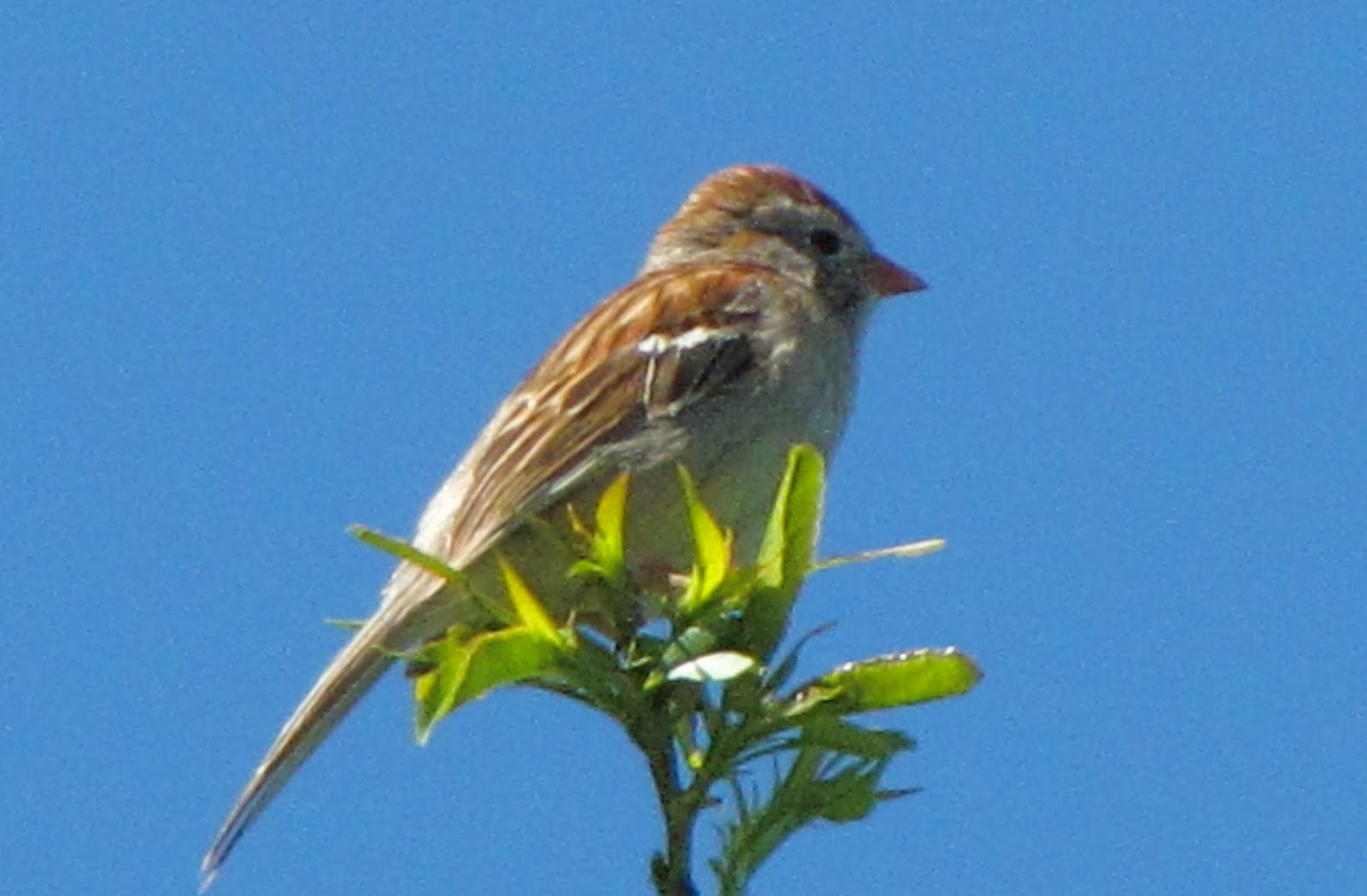
Field Sparrow


Scientific Name: Spizella pusilla

Population Estimate: 8M, Least Concern status

Range / Habitat: "Old-field" sparrows, found year-round in the southeastern US. In winters extending a bit south, and in summers up to the Canadian border.

Field Notes: Clear-breasted sparrow with rusty cap parted by a grey strip, white eye ring, pale pink bill, and rufous strip behind the eye. Face is otherwise bland grey. Call a distinctive, accelerating trill.

Personal Notes:

13 May, 2010

Hen Harrier


Scientific Name: Circus cyaneus

Population Estimate: 1.3M, Least Concern status

Range / Habitat:
The northern harrier is the most northerly breeding and one of the most widespread of all harrier species, occurring across much of North America, Europe and Asia. In North America, the subspecies Circus cyaneus hudsonius can be found from Alaska and Canada south to Mexico, wintering as far south as Central or South America and the Caribbean.

Field Notes: It is mainly grey above and white below except for the upper breast, which is grey like the upperparts, and the rump, which is white; the wings are grey with black wingtips. The female is brown above with white upper tail coverts, hence females, and the similar juveniles, are often called "ringtails". Their underparts are buff streaked with brown.

Personal Notes: Also known as Northern Harrier in the US.

12 May, 2010

Lark Sparrow


Scientific Name: Chondestes grammacus

Population Estimate: 10M, Least Concern status

Range / Habitat: Year-round in northern Mexico and parts of Texas. Winters in southern Mexico. Summers in most of the interior of the US. Habitat is open farmland. Frequently found on farmland and roadsides.

Field Notes: Lean sparrow with distinctive, boldly patterned head. Wide, white eye ring is especially prominent. Chest clean and buffy with black central spot. Sexes similar. At a quick glance could be confused with a Horned Lark or female Lark Bunting.

Personal Notes: This American sparrow is the only member of its genus. Most range maps do not include Minnesota, but this bird has been quite conspicuous over several years on the southern end of the Minnesota River NWR.

Western Meadowlark


Scientific Name: Sturnella neglecta

Population Estimate: 32M, Least Concern status

Range / Habitat: Songbird of open country. Found year-round throughout the western US, west of the Mississippi River. Summers extending north into Canada. Winters extending south into Mexico.

Field Notes: Stocky songbird with yellow throat, chest and belly. Black "V" on chest. Back streaked brown and black. Overall duller in winter. Distinctive in flight with a large "keel" and white lateral rectrices. Song melodic and flute-like with gurgles. Eastern Meadowlark with generally different distribution but in areas of overlap best distinguished by voice.

Personal Notes: Ubiquitous (but much enjoyed) during our time in Wyoming.

20 April, 2010

Western Osprey


Scientific Name: Pandion haliaetus

Population Estimate: 500K, Least Concern status

Range / Habitat: Migrant throughout much of the US. It winters primarily in South America and breeds in the northern US and Canada. Found around nearly any type of body of water.

Field Notes: Large raptor with black back and white chest. Wings a distinctive "M" shape in flight. Feathers cover the legs. Dark eye stripe on white head. Stick nests place conspicuously in open areas.

Personal Notes: Above photo taken in Amery, Wisconsin on a job interview. 

11 April, 2010

American Crow


Scientific Name: Corvus brachyrhynchos

Population Estimate:
31M, Least Concern status

Range / Habitat:
 Year-round in fields, open woodlands, and forests -- as well as areas inhabited by people -- throughout the US. In summer they extend up into Canada. 

Field Notes: L
arge, all-black birds with harsh, cawing voices. Nearly identical to Northwestern Crow and Fish Crow. Common Ravens are larger with longer wings, heavier bills, and shaggy neck feathers. 

Personal Notes:

21 March, 2010

Red-winged Blackbird


Scientific Name: Agelaius phoeniceus

Population Estimate: 210M, Least Concern status

Range / Habitat: Year-round on fresh and saltwater marshes through most of the US and Mexico. In summer extending into Canada.

Field Notes: Medium-sized passerine. Males glossy black with red and yellow shoulder patches. Females are a subdued, streaky brown, almost like a large, dark sparrow with a dramatic eyebrow.

Personal Notes:
One of the most welcome sounds of spring in Minnesota!

Bufflehead


Scientific Name: Bucephala albeola

Population Estimate: 1.2M, Least Concern status

Range / Habitat: Most winter in protected coastal waters, or open inland waters, on the east and west coasts of North America and the southern United States. Their breeding habitat is wooded lakes and ponds in Alaska and Canada, almost entirely included in the boreal forest or taiga habitat. Their distribution is limited to that of the Northern Flicker, as they use old flicker cavities as nesting sites.

Field Notes: Small diving duck. Adult males are striking black and white, with iridescent green and purple heads with a large white patch behind the eye. Females are grey-toned with a smaller white patch behind the eye and a light underside.

Personal Notes:

31 January, 2010

Pine Siskin


Scientific Name: Carduelis Pinus

Population Estimate: 8M

Range / Habitat: The range of the pine siskin extends south from southern Alaska and Canada, through the United States to Mexico. This species is also found as a vagrant in Guatemala.

Field Notes: The pine siskin (Carduelis pinus) is a very small songbird with brown, heavily streaked upperparts, white or grey underparts and subtle yellow markings on the tips of the tail and wings. The tail and wings are otherwise dusky brown or black, apart from two buffy wingbars, which fade to white as the individual ages. The tail is short and notched, and the yellow markings on the tail and wings are more visible when the bird is in flight. The pine siskin’s bill is sharp, pointed and notched and can vary in colour between dusky brown and black. The colour of the legs and feet varies between dark brown, red or dark horn, and the eyes of this species are brown.

Personal Notes:

04 January, 2010

Blue Jay


Scientific Name: Cyanocitta cristata

Population Estimate: 22M, Least Concern status

Range / Habitat: Year-round in the eastern US and up into Canada in forest edges. They favor acorns and are frequently found near oaks.

Field Notes: Part of the crow family, this is a dramatic and conspicuous bird that is smaller than a crow but larger than a robin. Dramatic crest. The blue coloration is both unmistakable and even electric. Characteristic, high-pitched and far-traveling "jay" sound.

Personal Notes: One of our favorites, especially in winter.

01 January, 2010

American Robin


Scientific Name: Turdus migratorius

Population Estimate: 320M, Least Concern status

Range / Habitat: Year-round throughout most of the US in both woodlands and more populated areas. Winters extending into Mexico. Summers extending throughout Canada and Alaska.

Field Notes: Common, yes, but still quite striking. Robins have a white patch under their tail that can be conspicuous in flight. Juveniles has spotted breast as in the top photo.

Personal Notes: 

Black-capped Chickadee


Scientific Name: Poecile atricapillus

Population Estimate: 34M, Least Concern status

Range / Habitat: Year-round in northern US, Canada and into Alaska. Found in any habitat that has trees or woody shrubs.

Field Notes: Small bird with tiny bill, oversized head, and no neck, giving it an overall round shape. Unmistakable and sharply-demarcated plumage as above. Characteristic "chicka-dee-dee-de" and "cheese-bur-ger" sounds.

Personal Notes: Richard can finally appreciate these handsome birds after winning the battle for a photo. We also appreciate their resilience in a Minnesota winter.

31 December, 2009

Rose-breasted Grosbeak


Scientific Name: Pheucticus ludovicianus

Population Estimate: 4.6M

Range / Habitat: The breeding range of the rose-breasted grosbeak extends from British Colombia in western Canada to the eastern United States. In winter, this species migrates to the southern United States, the Caribbean, Mexico, Colombia, Venezuela, Ecuador and Peru. It can also sometimes be found as a vagrant in Greenland and parts of Europe.

Field Notes:
The Rose-breasted Grosbeak (Pheucticus ludovicianus) is a large insect-eating songbird in the cardinal family (Cardinalidae). It is primarily a foliage gleaner. The rose-breasted grosbeak (Pheucticus ludovicianus) is a medium-sized, stocky songbird with a beautiful, bold plumage which varies greatly between the sexes. The male rose-breasted grosbeak has gained the name ‘cut-throat’ from its distinctive breeding plumage, which has a vivid pink-red triangle on the breast, strongly contrasting with the black upperparts and white underparts.

Personal Notes:

28 October, 2009

American White Pelican

Scientific Name:  Pelecanus erythrorhynchos

Population Estimate: 180K, Least Concern status


Range / Habitat: Breeds in isolated areas from Manitoba, Canada and Minnesota west to northern California. Winters in California, Mexico, Central America, along the Gulf Coast and in Florida.

Field Notes: Huge, all white water birds with unmistakable large yellow bill and orange legs. Black tipped wings in flight. 
 
Personal Notes: We loved the above photos taken at Salton Sea, particularly together with the Brown Pelican.

Red-tailed Hawk


Scientific Name: Buteo jamaicensis

Population Estimate: 2M, Least Concern status

Range: Year-round throughout the United States and most of Mexico. Summers extends into Canada and Alaska.

Field Notes: The most common hawk in the United States. There are so many morphs it makes my head spin (see the Field Marks section on the Cornell site). The most reliable field note seems to be the red tail as in the top two photos above. I'm sure there are other ways to differentiate hawks, both in flight and while perched, but I just don't know them yet. I'll get back to you when I do.

Personal Notes: We have tracked many of these birds thinking they were something "different" only to find they were, while still majestic, the Red-tailed Hawk. As an aside, if you see it perching along the freeway in the United States, it's a Red-tailed Hawk. Really. Don't keep going back and forth on the freeway....

23 October, 2009

Double-crested Cormorant


Scientific Name: Phalacrocorax auritus

Population Estimate: 1.5M, Least Concern status

Range: Winters in the southern US interior, and more extensively on the coasts. In summer it is widespread throughout North America.

Field Notes: Most common cormorant in North America, found along coasts but also inland. All black bird with hooked bill that is yellow at the base. Juveniles more pale, as in top photo. Often found in groups, these are heavy fliers that cruise just above the water. Great Cormorant and Brant's Cormorant have very limited overlap. The Neotropic Cormorant has a shared range along the Gulf Coast in Mexico, but the Double-crested Cormorant is larger with brighter yellow bill base, and relatively shorter tail.

Personal Notes: The drying of feathers is my favorite pose.

Great Blue Heron


Scientific Name: Ardea herodias

Range / Habitat: The Great Blue Heron is found throughout most of North America, as far north as Alaska and the southern Canadian provinces. The range extends south through Florida, Mexico and the Caribbean to South America.

Field Notes: Very large gray-blue wader. It is long legged and long necked. It is approximately four feet tall or forty-six inches (one hundred seventeen centimeters) with a wingspan of six to seven feet. The bird is about seventy-two inches wide (one hundred eighty-three centimeters). It has a blue-gray color on its belly, body, and wings. The great blue heron is not very blue. The bird's bill is yellow, long, thick, and sharp. The bird's shoulder is black. The bird's back is mainly a slate-gray color. It has a brownish-buff colored neck with a black being a border. White is the color in front of its neck with a vertical streak that is black. The bird's head is white with a black stripe above its eye. The heron weighs anywhere from five to eight pounds (two to three kilograms). A male and female heron generally have the same description.

Personal Notes: