Showing posts with label tyrant flycatchers. Show all posts

27 May, 2014

Willow Flycatcher

Scientific Name: Empidonax traillii

Range / Habitat: Breeds in wet, marshy areas throughout most of the US, extending further north in the northwest and excluding the southeast. Winters in southern Mexico, Central American, and the northwest portion of South America. 

Field Notes: Drap Empidonax flycatcher, brown-grey above, white below, with faint yellow wash on the sides. Thin, white eyering may be absent. Alder Flycatcher essentially identical but more northern. In areas of overlap, can only be distinguished by voice. Other Empidonax flycatchers have more prominent eyering. 

Personal Notes: Seen in the boggy area of the Minnesota Arboretum. Confirmed by voice. 

25 May, 2014

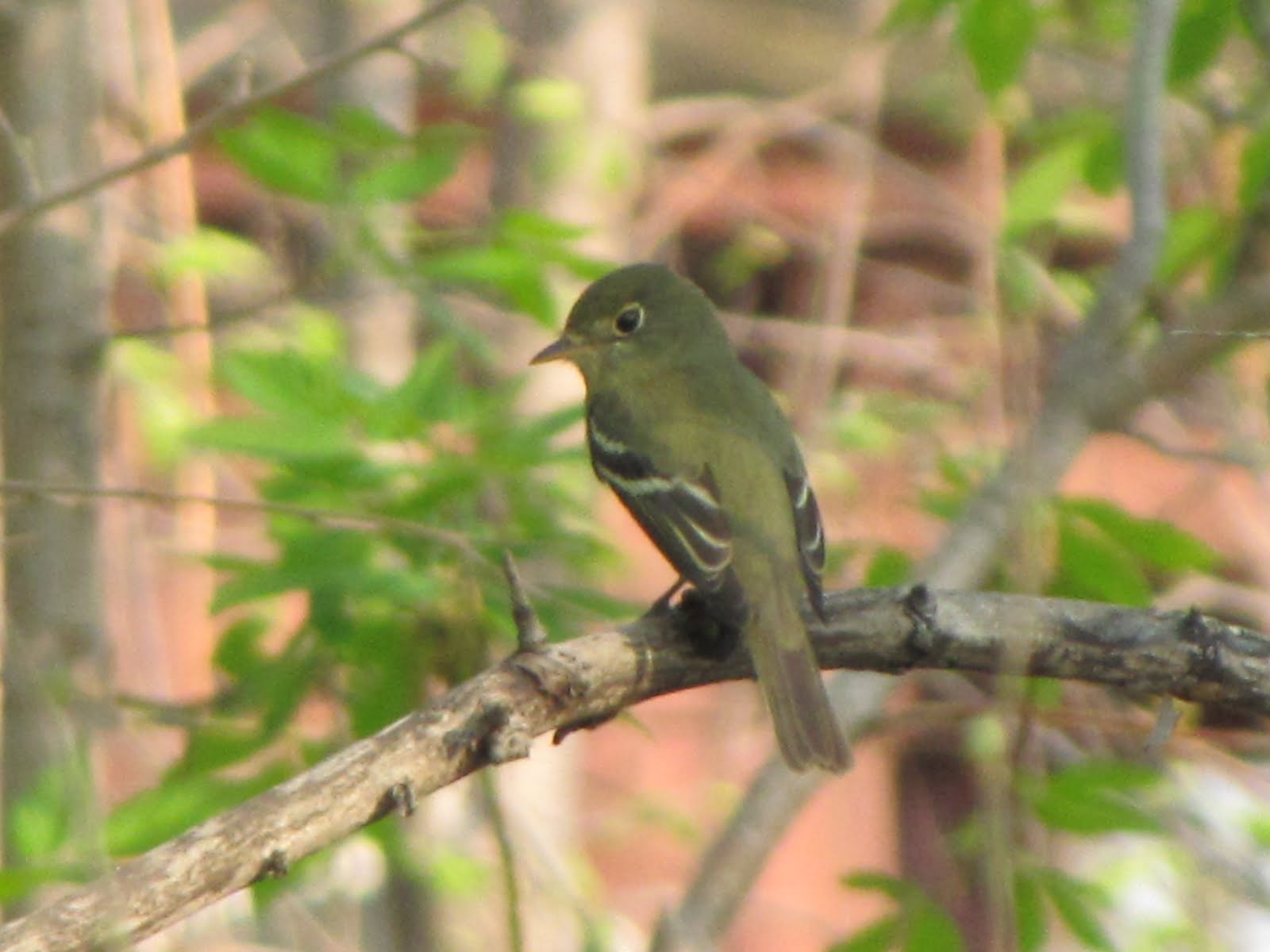
Dusky Flycatcher

Scientific Name: Empidonax oberholseri

Range / Habitat: Found in open montane forest of American and Canadian West in the summer. Winters in central Mexico. 

Field Notes: Small, dull, Empidonax flycatcher. Grey back, underparts white. Prominent eyering and wing bars. Hammond's Flycatcher and Grey Flycatcher similar. Habitat and song best ways to distinguish among these species, though Hammond's found at higher altitudes and Grey has distinctive downward wag of tail. 

Personal Notes: Seen on Deseret Ranch in Utah

24 May, 2014

Cordilleran Flycatcher

Scientific Name: Empidonax occidentalis

Range / Habitat: Found in arid forest regions, summers east of the Sierra Nevada and Cascade mountain ranges in the western US and Canada. Winters into Mexico.

Field Notes: Small flycatcher with prominent pale yellow, almond-shaped eyering. Two pale yellow wing bars. Upperparts greenish-brown, underparts yellow. Pacific-coast Flycatcher (with which it used to be considered one species, Western Flycatcher) nearly identical, separated by range.

Personal Notes: Seen on the late spring ski slopes of Park City, Utah.

09 May, 2014

Least Flycatcher

Scientific Name: Empidonax minimus

Range / Habitat: Breeds in open woodlands of northern US and most of Canada. Winters along wooded ravines, woodland edge, and brush land on both coasts of Mexico, including the Yucatan.

Field Notes: Small flycatcher with grey to olive back, darker wings with two white wingbars. Underparts white and prominent eyering. Difficult to distinguish among other members of genus with call being the best determining characteristic. That having been said, Least Flycatcher is the smallest and most grey of the Empidonax.

Personal Notes: So small we initially mistook him for a warbler.

03 February, 2014

Black Phoebe

Scientific Name: Sayornis nigricans

Population Estimate: Unknown, but Least Concern status

Range / Habitat: Year-round near water sources in coastal California, Mexico, Central America and into South America.

Field Notes: Sooty black flycatchers with white belly. Eastern Phoebe only overlaps in range in winter in Mexico, but has pale neck and chest.

Personal Notes: Richard first spotted this bird from the car near Palm Springs. We were later rewarded with photos at Salton Sea.

09 August, 2011

Hammond's Flycatcher

Scientific Name: Empidonax hammondii

Population Estimate: 13M, Least Concern status

Range / Habitat: Full migrant from montane forest in American West, Canada, and Alaska down to Mexico and Central America.

Field Notes: Olive-colored flycatcher with broad white eye ring, prominent white wing bars, bicolored bill. Similar to Dusky Flycatcher and Grey Flycatcher, but Hammond's nests at higher elevation. Best distinguished by voice.

Personal Notes: A resident bird at Barr Camp on Pike's Peak. Later seen at the higher altitudes on Deseret Ranch, Utah. 

26 May, 2011

Eastern Wood-pewee


Scientific Name: Contopus virens

Population Estimate: 6M, Least Concern status

Range / Habitat: A bird of the middle canopy, breeds throughout the eastern US in summer then migrates to northwestern South America for winter.

Field Notes: Medium-sized flycatcher, grey / olive above and pale below. Pale white wingbars. No eye ring or only a faint one. Call is distinctive. Lack of prominent eye ring distinguishes it from Empidonax flycatchers. Presence of wingbars and call differentiate from Eastern Phoebe.

Personal Notes: Spotted and heard on a bike trip from Minneapolis to Stillwater, MN.

23 May, 2011

Common Tody-Flycatcher


Scientific Name: Todirostrum cinereum

Population Estimate: 5M - 50M

Range / Habitat: Common in gardens, shady plantations, second growth and the edges and clearings of forest at a variety of elevations, although it avoids the dense interior of mature woodland and also arid areas. Found in southern Mexico to northwestern Peru, eastern Bolivia and southern Brazil.
Field Notes: Small black and yellow flycatcher with short tail, frequently held upright. Yellow eyes set in black head, which differentiates it from other tody-flycatchers. Black back though wings edged in yellow. Yellow underparts.

Personal Notes: Seen at Carara National Park, Costa Rica

Golden-bellied Flycatcher


Scientific Name: Myiodynastes hemichrysus

Population Estimate: Unknown, but Least Concern status

Range / Habitat: Endemic to the tropical montane moist forest of Costa Rica and Panama.

Field Notes: Large flycatcher with common coloration of olive back, bright yellow underparts, and black and white streaked head. This is the only one with a dark lateral throat stripe, however.

Personal Notes: Seen at Monteverde Cloud Forest Reserve, Costa Rica

Golden-crowned Spadebill

Scientific Name: Platyrinchus coronatus


Population Estimate: Unknown, but Least Concern status


Range / Habitat: Subtropical / tropical lowland moist and swamp forest areas in Central America and northern South America.


Field Notes: Small, stubby passerine with nearly absent tail and broad bill. Facial features characteristic of spadebills: dark crown with black postocular and malar stripe on otherwise white face. White eyering. Olive back and rust-colored crown distinguish it from other spadebills.


Personal Notes: Seen at Carara National Park, Costa Rica

11 May, 2011

Yellow-bellied Flycatcher

Scientific Name: Empidonax flaviventris

Population Estimate: 6M

Range / Habitat: A bird of boreal forests and bogs who breeds throughout Canada and northernmost US and winters in southern Mexico and Central America.

Field Notes: Small passerine, with typical flycatcher posture and behavior. Complete eye ring and white wing bars of the Empidonax. Olive back and yellow belly differentiate from the more grey Least Flycatcher.

Personal Notes: Part of a good day of "urban birding" on the Mississippi River.

22 November, 2010

Scissor-tailed Flycatcher

Scientific Name: Tyrannus forficatus

Population Estimate: 8M

Range / Habitat: Breeds in the southwestern US and into northeastern Mexico. Forms large premigratory roosts in late summer, with up to 1,000 birds in one flock. Winters in southern Mexico through Central America. Found on dry savanna, grassland, and moist shrubland.

Field Notes: Tyrant flycatcher, grey above and white below with salmon belly. Markedly long forked tail. Winter sympatric with Fork-tailed Flycatcher in Mexico and Central America, which has a black cap and a relatively longer tail.

Personal Notes: Seen on the Mennonite farmland in central Belize.

Fork-tailed Flycatcher

Scientific Name: Tyrannus savana

Population Estimate: 5M-50M

Range / Habitat: Breeds from central Mexico through central Argentina. Known to wander wildly, with sightings in the eastern United States up to Canada. Found on dry savanna and moist shrubland.

Field Notes: Tyrant flycatcher, grey above, white below with black cap and exceptionally long forked tail. Tail longest in males, shorter in females, and shortest in juveniles. Scissor-tailed Flycatcher, with whom it overlaps in southern Mexico and Central America in winter, lacks the black cap and has a relatively shorter tail.

Personal Notes: Seen on Mennonite farmland in central Belize.

21 November, 2010

Bright-rumped Attila

Scientific Name: Attila spadiceus

Population Estimate: 500K to 5M

Range / Habitat: Resident species throughout Mexico, Central and northern South America. Prefers lowland forest.

Field Notes: Large, bulky flycatcher with large head, prominent whiskers and hooked bill. Droopy tail while perched with prominent yellow rump.

Personal Notes: Seen at Tikal Mayan ruins in Guatemala.

25 July, 2010

Alder Flycatcher

Scientific Name: Empidonax alnorum

Population Estimate: 50M, Least Concern status

Range / Habitat: Summers in most of Alaska, Canada and New England. Winters in a swath of western South America. Favors moist shrubland habitat.

Field Notes: Medium-sized flycatcher of wet thickets. Drab olive on upper parts with two white wing bars. White underneath. Partial eye ring. Essentially identical to Willow Flycatcher, though with limited overlap in range in the northeastern United States and distinct songs.

Personal Notes:

24 May, 2010

Great Crested Flycatcher


Scientific Name: Myiarchus crinitus

Population Estimate: 7.5M, Least Concern status

Range / Habitat: Temperate forests in eastern North America in summer, from Yucatan Peninsula to northern South America in winter.Their breeding habitat is deciduous or mixed forests across eastern North America and is found over most of the eastern and mid-western portions of the continent

Field Notes: Large flycatcher with grey head, prominent crest and yellow belly. Rufous patches in wings. All adults are brownish-olive on the upperparts with yellow underparts; they have a long rusty brown tail and a bushy crest. Their throat and breast are grey.

Personal Notes: A very welcome sight in Minnesota in the spring of 2014. 

Eastern Kingbird


Scientific Name: Tyrannus tyrannus

Population Estimate: 13M

Range / Habitat: Found in generally open areas throughout most of North America in the summer, excluding the southwest portion. Winters in the interior of South America.

Field Notes: Widespread, large flycatcher with dark head, back and tail. White belly and white tip to tail.

Personal Notes: This fellow actually thrives pretty far west, and overlaps range with the Western Kingbird, though they look nothing alike.

13 May, 2010

Western Wood-Pewee


Scientific Name: Contopus Sordidulus

Population Estimate: 10M

Range / Habitat: Summers in western North America, from Alaska to Mexico. Winters in small area of northwestern South America. Habitat is open forests and riparian areas.

Field Notes: Medium-sized flycatcher, olive above, buff below. Faint white wing bars, no eye ring (to distinguish it from the Empidonax flycatchers who have distinctive wing bars and eye rings). Distinguished by voice alone from Eastern Wood-Pewee, though the ranges only overlap appreciably in winter. This species is know for returning to the same perch over and over while hawking. It does not wag its tail while perched, distinguishing it from Phoebe species.

Personal Notes: First identified by guide in San Blas, Mexico, but later seen across the Western US.

Say's Phoebe

Scientific Name: Sayornis saya

Population Estimate: 4M, Least Concern status

Range / Habitat: Year round in the southwestern US. Summers up from there into the interior of Alaska. Winters down through much of Mexico. A bird of open areas, will often nest on buildings.

Field Notes: Medium-sized flycatcher, commonly found around people. Grey above, light below with rust wash on belly on under the tail. No distinct wing bars or eye ring.

Personal Notes: Seen initially on Antelope Island, Salt Lake City and then later in the San Pedro Riparian Area in Arizona. Mistook it for an Ash-throated Flycatcher (which would have been bird #1000) at Furnace Creek Inn until we got a closer look. 

12 May, 2010

Western Kingbird


Scientific Name: Tyrannus Verticalis

Population Estimate: 19M

Range / Habitat: Conspicuous bird of open country. Summers in western US. Winters along the Pacific coast of Mexico and Central America.

Field Notes: Typical tyrant-flycatcher with grey head, grey to buffy chest, yellow belly. Tropical Kingbird nearly identical with some overlap in range.

Personal Notes: