25 July, 2011

Veery

Scientific Name: Catharus fuscescens

Population Estimate: 14M, Least Concern status

Range / Habitat: Full migrant from damp forests of northern US and southern Canada in summer to most of central northern South America in winter.

Field Notes: Medium-sized thrush, plain brown upperparts, no eye ring, minimal brown spotting on otherwise white underparts. Swainson's Thrush with distinct pale spectacles and more extensive spotting on breast.

Personal Notes: First seen in beautiful Spearfish Canyon, SD. Later found closer to home in Hok-Si-La Park in Lake City, MN.

Common Starling

Scientific Name: Sturnus vulgaris

Population Estimate: 310M, Least Concern status

Range / Habitat: Year-round in urban areas throughout the US and all but northernmost Canada, introduced from Europe. Similar habitat throughout Europe, Asia and northern Africa. Also introduced to Australia and New Zealand.

Field Notes: Stocky, medium-sized songbird with short tail. Overall glossy black, with iridescent purple and green. Pale spots on back and brownish wings.

Personal Notes: These birds are EVERYWHERE in the US and yet we waited until 3 weeks before our departure for New Zealand to get a photo for the blog.... Also known as European Starling.

19 July, 2011

Prairie Falcon

Scientific Name: Falco mexicanus

Population Estimate: 40K, Least Concern status

Range / Habitat: Year round in grasslands of the American West. Extends up some into Canada and more extensively into Mexico.

Field Notes: Large for a falcon, medium-sized for a hawk. Fairly uniform pale brown back. Whitish chest with brown spots and bars. White supercilicary, dark mustache mark on face, dark ear patch. In flight, all light underneath except for dark "armpits," no tail stripes.

Personal Notes: A surprise find while hiking Painted Rock Canyon (looking for the elusive Canyon Wren) in Wyoming, then we saw a pair the following week at Devil's Tower. The top photo was from a nesting site on Deseret Ranch in Utah. 

Black Rosy Finch

Scientific Name: Leucosticte atrata

Population Estimate: 20K

Range / Habitat: A bird of the high mountain tundra of the American West. Nests above tree-line at 3000-4300M. Often the bird on the highest elevation on a particular mountain.

Field Notes: Dark brown / black on back, breast, neck, and face. Grey patch wrapping around back of head. Black forehead, white tuft at base of bill. Pink on belly, rump, and in wings. Grey-crowned Rosy Finch with more grey on head. Brown-capped Rosy Finch without the grey on head.

Personal Notes: A wonderful surprise find while summiting an unnamed 12K foot peak in the Big Horn Mountains.

18 July, 2011

Bobolink

Scientific Name: Dolichonyx oryzivorus

Population Estimate: 11M

Range / Habitat: Full migrant found almost exclusively in grasslands. Summers / breeding in upper US and into Canada, excluding the far west. Winters in the middle of South America.

Field Notes: Typical blackbird size / shape. Male in breeding plumage has black face, bill, and underparts, white on back and wings, yellow half-hood. Female and non-breeding male with yellow underparts, brown tail and wings, black eyestripe and streak on top of head, yellow superciliary, pale bill.

Personal Notes: We finally got to see this species (with the help of the Wyoming bird list serve) on a gravel road between Fort Phil Kearney and Story, Wyoming. We were quite excited to find him later in St. Paul MN at Kaposia Landing, a former superfund site. 

11 July, 2011

Red-eyed Vireo

Scientific Name: Vireo olivaceus

Population Estimate: 140M, Least Concern status

Range / Habitat: Lowland forest of the US and Canada, excluding the far American West, in summer. Full migrant to forests of northern and eastern South America.

Field Notes: Small drab bird with olive back and white underneath. Crown grey, eyebrow white with thin black eye stripe. Eyes dark red. Song distinctive, a series of broken, slurred phrases alternating upswing and downswing.

Personal Notes: We've probably heard and even seen this common bird before our first confirmed sighting in the Spearfish, South Dakota city park. We later found this bird in migration at the El Rey ruins in Cancun, Mexico. Then, finally, at home in Minnesota. 

Upland Sandpiper

Scientific Name: Bartramia longicauda

Population Estimate: 350K

Range / Habitat: Grasslands in the upper half of US, excluding far West, up into Canada and interior Alaska in summer. Full migrant to grasslands of southeastern South America in winter.

Field Notes: Medium sized sandpiper with long neck, small head, short yellow bill, yellow legs. Greater Yellowlegs and Lesser Yellowlegs have grey, not brown backs, and longer dark bills.

Personal Notes: Seen en route to Devil's Tower National Monument in Wyoming. From then on he was known by the Spolts as "Pylon Plover." 

Pygmy Nuthatch

Scientific Name: Sitta pygmaea

Population Estimate: 2M

Range / Habitat: Year-round resident of montane forests in the American West and down into Mexico.

Field Notes: Stocky nuthatch with disproportionately large bill. Black eye stripe, grey head and back, white belly with subtle orange wash. Range does not overlap with Brown-headed Nuthatch. Red-breasted Nuthatch has white supercilium and red belly. White-breasted Nuthatch larger with plan white face.

Personal Notes: Seen while hiking at Devil's Tower National Monument.

Bullock's Oriole

Scientific Name: Icterus bullockii

Population Estimate: 3.8M

Range / Habitat: Open woodlands, summers in the American West, winters in Mexico not including Yucatan.

Field Notes: Male unmistakable in range with black cap and eye stripe on yellow / orange head and chest. Large white wing bar. Black back and throat. Female more drab without black markings on head / chest.

Personal Notes: The bloke in the photo above and his mate were seen while hiking just above the prairie dog 'town' at Devil's Tower National Monument. We saw him (and an eastern kingbird) get chased off a big dead Ponderosa pine by a red-headed woodpecker.

05 July, 2011

Buff-bellied Pipit


Scientific Name: Anthus rubescens

Population Estimate: 20M

Range / Habitat: Prefers open, rocky areas. During summer / breeding season found in tundra of northern Canada, most of Alaska, and into a portion of the most elevated regions of the American west. In winter, migrates to the southern US and all of Mexico.

Field Notes: Slender, drab bird. Appears similar to sparrows but thinner bill and longer tail. Has habit of bobbing head like a pigeon. Pale supercilium and lateral throat stripe. Light streaking on the breast. Dark legs compared to other pipits.

Personal Notes: Fortuitous sighting at Beartooth Pass (on the Wyoming / Montana border) on the Fourth of July. Seen again at Acadia NP, ME. Also known as American Pipit.

Western Tanager


Scientific Name: Piranga ludoviciana

Population Estimate: 8.9M

Range / Habitat: Summers in montane forest of western US and Canada. Winters throughout Mexico exclusive of Yucatan.

Field Notes: Breeding male (top photo) with red head, yellow belly and rump. Otherwise black with two yellow wing bars. Female or juvenile (bottom photo) drab olive yellow on head, rump, belly. Still with black back and two yellow wing bars.

Personal Notes: We first spotted the female outside our friend Patrick's window in Puerto Vallarta. We then spotted a male in classic plumage in the courtyard of the Grand American Hotel in Salt Lake City, UT. The top photo was taken en route to Rainbow Lake in the Absaroka-Beartooth Wilderness in Montana. The light was so bright that morning, the camera had a hard time with the color!

Cassin's Finch

Scientific Name: Carpodacus cassinii

Population Estimate: 1.9M, Near Threatened status

Range / Habitat: Year-round in montane pine forests of the American West. Will extend slightly into Canada in summer and throughout the mountains of Mexico in winter.

Field Notes: Somewhat large and lanky for a red American finch, the bright red crown contrasts with brownish cheeks in male. Purple Finch overlaps little but stouter with shorter beak and more uniform red. House Finch with distinct brown streaks on flanks.

Personal Notes: Seen on a lovely hike to Rainbow Lake in the Absoroka-Beartooth Wilderness near Red Lodge, Montana.

Common Nighthawk

Scientific Name: Chordeiles minor

Population Estimate: 11M

Range / Habitat: Full migrant from most of South America excluding Chile up to western Mexico, all of the US and most of Canada. Found year-round in Caribbean islands. Found in a variety of habitats, both urban and rural, but prefers grasslands for breeding.

Field Notes: Distinct nightjar shape and cryptic coloring (Sibley's phrase) as seen above. Long, dark primaries with white bar at the base (seen in flight) which distinguishes from Common Poorwill, Whip-poor-will and Chuck Will's-widow. Swift shape but larger when flying, which is primarily at dawn and dusk, catching insects.

Personal Notes: First seen feeding on bugs at dusk during a walk at Birdwing Spa in Litchfield MN. We were latter pleased to come across the above bird on a hike to Coney Lake in the Cloud Peak Wilderness in the Bighorn Mountains of Wyoming.

27 June, 2011

Ruby-crowned Kinglet


Scientific Name: Regulus calendula

Population Estimate: 70M

Range / Habitat: Temperate forest dweller. Summers throughout parts of the American West, Canada, and the interior of Alaska. Winters throughout the southern half of the US and throughout much of Mexico excluding the Yucatan.

Field Notes: Tiny, dull olive-green bird with light wing-bars and eye ring. Short tail and pin beak. Constantly in motion and continually flicking wings. Small ruby crown of the male is rarely seen. Golden-crowned Kinglet has yellow crown, white eyebrow and black eye-stripe.

Personal Notes: One of our favorite birds; we delight in seeing the crown and were fortunate to actually capture on the above photos.

Sage Sparrow

Scientific Name: Amphispiza belli

Population Estimate: 4.3M

Range / Habitat: Dry shrub land up to 3000m. Year-round along the southern US Pacific coast into Baja. Summers in the American West with winters in the American Southwest and northwestern Mexico.

Field Notes: Medium-sized sparrow, relatively long-tailed. Grey head and brown back. White eye ring and supraloral spots. White and black lateral throat stripes. Breast buffy with central dark spot. Five-striped Sparrow similar but little overlap and grey breast.

Personal Notes: First seen on a beautiful drive along the southwestern edge of the Bighorn National Forest in Wyoming and then again in the Petrified Forest NP.

20 June, 2011

Lark Bunting


Scientific Name: Calamospiza melanocorys

Population Estimate: 27M

Range / Habitat: Tall, dense grassland. Winters in northern Mexico. Summers in Great Plains of the United States.

Field Notes: Medium-sized sparrow with short, thick, bluish bill. Large white patches in wing. Breeding male all back with white wings. Female and nonbreeding male grayish brown and heavily striped.

Personal Notes: Seen at Buffalo Gap National Grasslands, South Dakota.

Grasshopper Sparrow

Scientific Name: Ammodramus savannarum

Population Estimate: 15M

Range / Habitat: Tall, dense grassland winters in southeastern US, Mexico, Central America, and into northwestern South America. Summers throughout eastern US to Rocky Mountains, parts of California and Pacific Northwest.

Field Notes: Found singly. Relatively long-billed and flat-headed sparrow with short tail. Unmarked, buffy breast. Complete eye ring. Some yellow in the face. Dark crown with pale middle stripe.

Personal Notes: Seen in the South Dakota Badlands.

11 June, 2011

American Three-toed Woodpecker

Scientific Name: Picoides dorsalis

Population Estimate: 800K

Range / Habitat: Year-round in boreal and montane coniferous forests across all of North America

Field Notes: Medium-sized black-and-white woodpecker, more black than white. Head black with a white mustache stripe and a thin white line behind eye. Yellow cap in male. Throat, breast, belly and midline of back white. Black barring on flanks. Black-backed Woodpecker with all black back. Hairy Woodpecker with more white on face, no barring on flanks, red cap in male.

Personal Notes: Seen in the Laramie Mountains (Medicine Bow National Forest).

Mountain Chickadee

Scientific Name: Poecile gambeli

Population Estimate: 12M

Range / Habitat: Year-round in dry, montane forests of the American West up to western Canada.

Field Notes: Small, active passerine with oversized round head. Striking black and white head with black neck and grey body. The white eyebrow differentiates from Black-capped Chickadee, Boreal Chickadee, and Chestnut-backed Chickadee.

Personal Notes: Chickadees are hard to photograph but we have been able to "lure" them by tapping rocks together and mimicking their call.

04 June, 2011

Green-tailed Towhee


Scientific Name: Pipilo chlorurus

Population Estimate: 4.1M, Least Concern status

Range / Habitat: Year-round in dry shrub land of montane American West. Winters extending into Mexico.

Field Notes: Small towhee but large and long-tailed for an American sparrow. Overall grey bird with striking rufous crown, white throat, and olive-green patches on wing. Ascending cat-like mew call, reminiscent of a Grey Catbird.

Personal Notes: Seen at Vedawoo outside of Laramie, then again in the Bighorn Mountains. Once again seen on Deseret Ranch in Utah.

31 May, 2011

Mountain Bluebird

Scientific Name: Sialia currucoides

Population Estimate: 5.2M

Range / Habitat: Ranch land and other open areas of the American West. Winters extending into Mexico. Summers extending into Canada.

Field Notes: Slight thrush. Male bright blue back, duller blue underneath. Bill, eye and legs black. No other markings. Female duller grey / blue. Eastern Bluebird and Western Bluebird similar but both have red on their breasts. Lazuli Bunting with short, thick bill, white wing bars, and extensive white on chest and belly. Townsend's Solitaire similar to female but with white eye ring and wing bars.

Personal Notes: Seen in various montane locations in Wyoming and Montana.

26 May, 2011

Eastern Wood-pewee


Scientific Name: Contopus virens

Population Estimate: 6M, Least Concern status

Range / Habitat: A bird of the middle canopy, breeds throughout the eastern US in summer then migrates to northwestern South America for winter.

Field Notes: Medium-sized flycatcher, grey / olive above and pale below. Pale white wingbars. No eye ring or only a faint one. Call is distinctive. Lack of prominent eye ring distinguishes it from Empidonax flycatchers. Presence of wingbars and call differentiate from Eastern Phoebe.

Personal Notes: Spotted and heard on a bike trip from Minneapolis to Stillwater, MN.

24 May, 2011

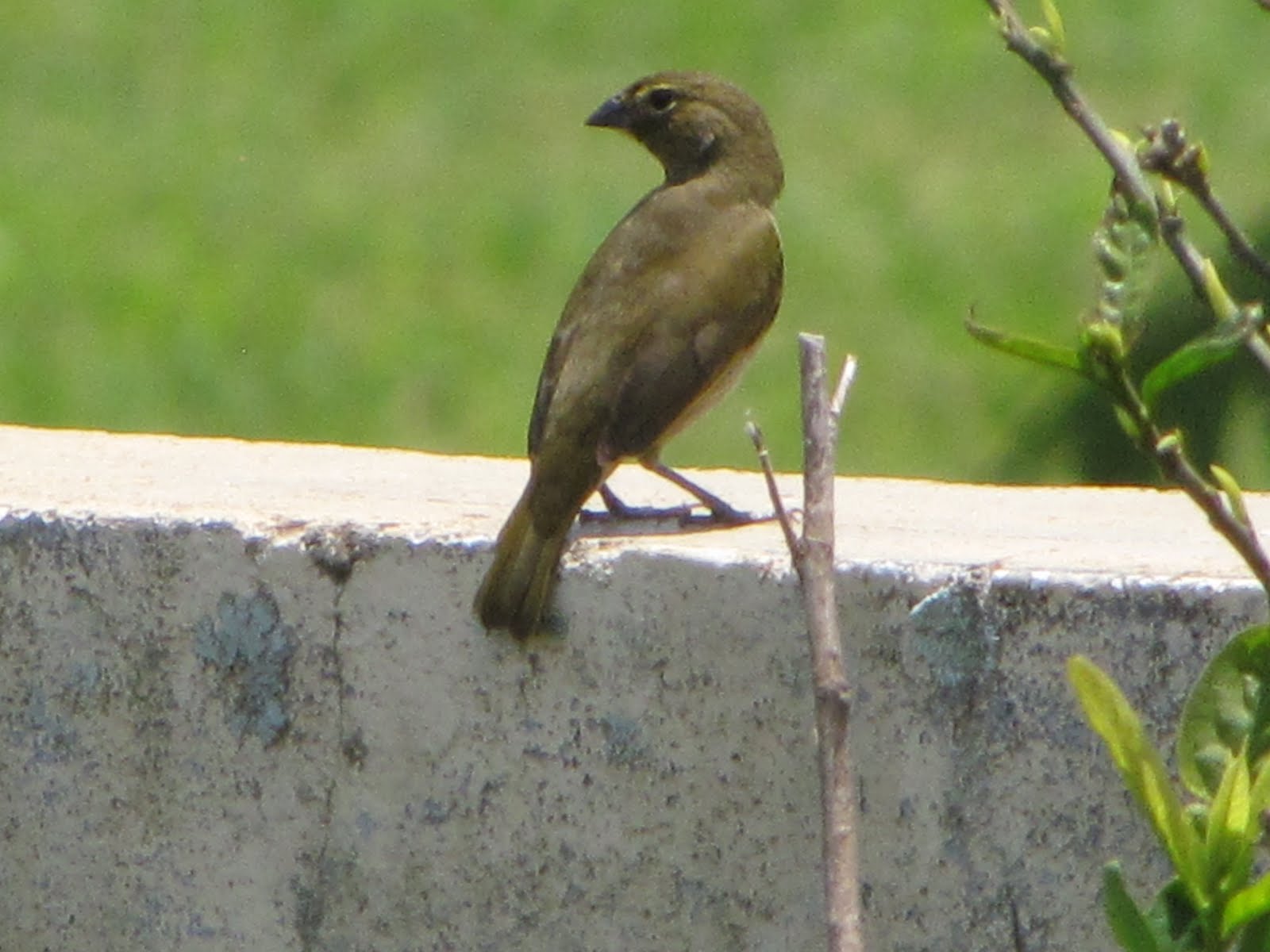
Yellow-faced Grassquit


Scientific Name: Tiaris olivaceus

Population Estimate: 500K to 5M

Range / Habitat: Subtropical / tropical lowland shrub and grass land in Mexico, Central America, northwestern South America and several Caribbean islands.

Field Notes: Small olive green passerine with thick, short bill. Males and females both with yellow throat and superciliary, though much more pronounced in males.

Personal Notes: Seen at Monteverde Lodge, Costa Rica

Northern Barred Woodcreeper


Scientific Name: Dendrocolaptes sanctithomae

Population Estimate: 50-500K

Range / Habitat: Subtropical / tropical lowland moist forest of southern Mexico, Central America, northwestern South America.

Field Notes: Large woodcreeper with straight, stout bill. Fine black barring on head, neck and chest which distinguishes it from many other woodcreepers which have white streaking. Distinctive call.

Personal Notes: Seen at Manuel Antonio, Costa Rica

23 May, 2011

Streak-headed Woodcreeper

Scientific Name: Lepidocolaptes souleyetii

Population Estimate: 500K to 5M

Range / Habitat: Subtropical / tropical dry forest throughout southern Mexico, Central America, and northern South America.

Field Notes: Large woodcreeper with streaked head (extending onto back) and chest. Rufous back and wings. Relatively thin, pinkish, decurved bill. Bill and call distinguish from Cocoa Woodcreeper and Ivory-billed Woodcreeper.

Personal Notes: Seen at Carara National Park, Costa Rica

Stripe-tailed Hummingbird

Scientific Name: Eupherusa eximia


Population Estimate: 50-500K


Range / Habitat: Subtropical / tropical montane (800-2500m) moist forest of southern Mexico and Central America.


Field Notes: Small green hummingbird with thin, straight bill. Prominent rufous wing and white outer rectrices in both sexes. Female with white throat and belly. Black-bellied Hummingbird similar but with black face and belly.


Personal Notes: Seen at Monteverde Cloud Forest Reserve

Thick-billed Seed Finch


Scientific Name: Oryzoborus funereus

Population Estimate: 500K to 5M

Range / Habitat: Found in lowland shrubby and grassy areas from southern Mexico, through Central America, and into northwestern South America.

Field Notes: Medium-sized passerine with finch beak. Male all black with white wing patch, nearly identical to Variable Seedeater but with straight culmen. Female warm brown without distinguishing marks, as in photo above. This warm color distinguishes from female of Variable Seedeater.

Personal Notes: Seen at Arenal Nayara Hotel, Costa Rica

Fiery-billed Aracari


Scientific Name: Pteroglossus frantzii

Population Estimate: Unknown, but Least Concern status

Range / Habitat: Endemic to tropical lowland moist forest in central and southern Pacific slope of Costa Rica and Panama.

Field Notes: Medium-sized toucan with bright red upper mandible. Quite similar to Collared Aracari, though range does not overlap in Costa Rica and bill readily distinguishes between the two.

Personal Notes: Seen at Manuel Antonio, Costa Rica

Black-mandibled Toucan


Scientific Name: Ramphastos ambiguus

Population Estimate: Unknown, but Least Concern status

Range / Habitat: Tropical lowland and montane moist forest in Central America and northwestern South America.

Field Notes: Large toucan with bicoloured yellow and dark bill. Easily distinguished from Keel-billed Toucan.

Personal Notes: Seen en route from Carara NP to Manuel Antonio, Costa Rica. Some sources consider this bird a distinct species, Chestnut-mandibled Toucan.

Plain Wren


Scientific Name: Cantorchilus modestus

Population Estimate: 500K - 5M

Range / Habitat: Lowland and foothill dry and moist forests, including forest edges, in southern Mexico and Central America.

Field Notes: Drab wren with only minimal banding on tail, white superciliary, black eye stripe and all white throat, chest, belly and flanks. Further distinguished by simple, piercing call.

Personal Notes: Seen at Monteverde Lodge, Costa Rica

Grey-crowned Yellowthroat

Scientific Name: Geothlypis poliocephala


Population Estimate: 500K to 5M


Range / Habitat: Lowland shrub land, grass land, degraded former forest in southern Mexico and Central America.


Field Notes: Warbler with relatively large bill, yellow underparts, olive upperparts. Grey crown and small black mask distinguish it from Olive-crowned Yellowthroat, Common Yellowthroat, and Masked Yellowthroat.


Personal Notes: Seen in Monteverde area, Costa Rica

Black-hooded Antshrike

Scientific Name: Thamnophilus bridgesi


Population Estimate: Unknown, but Least Concern status


Range / Habitat: Tropical lowland moist forest of Costa Rica and Panama.


Field Notes: Medium-sized passerine with thick, hooked bill. Overall dark grey to black, both sexes with white speckling on shoulder. Male otherwise undistinguished. Female with additional white barring over head, neck and breast.


Personal Notes: Seen at Manuel Antonio, Costa Rica

Band-tailed Pigeon


Scientific Name: Patagioenas fasciata

Population Estimate: 4M

Range / Habitat: Montane moist forest from British Columbia, down through the Rockies, Mexico and Central America and into South America.

Field Notes: Large grey pigeon with white band on nape, short yellow bill, and yellow legs which make it distinctive. Named for white terminal band on tail.

Personal Notes: Seen at Monteverde Lodge, Costa Rica

Tennessee Warbler


Scientific Name: Oreothlypis peregrina

Population Estimate: 60M

Range / Habitat: Breeds in the Canadian boreal forest. Winters in Central American through northwestern South America and many Caribbean islands.

Field Notes: Small passerine with thin, pointed bill. Olive back, white underparts, including undertail coverts. Grey head with white eyebrow, thin dark eye stripe, and white malar area.

Personal Notes: Seen at Manuel Antonio, Costa Rica

Northern Crested Caracara


Scientific Name: Caracara cheriway

Population Estimate: 2M

Range / Habitat: Subtropical / tropical lowland shrub land and open areas in Mexico, Central America and northern South America.

Field Notes: Large raptor with white head, neck and belly. Dark cap and large orange bill is distinctive. Dark back and tail. In flight, two pale patches on wrist when seen from above. They are primarily scavengers. Laughing Falcon has dark mask and yellow cap. Yellow-headed Caracara has all yellow head.

Personal Notes: Seen en route from Carara NP to Manuel Antonio, Costa Rica

Bridled Tern


Scientific Name: Onychoprion anaethetus

Population Estimate: 610K to 1.5M

Range / Habitat: Bird of the tropical oceans, breeding off the Pacific and Atlantic coast of Central America including the Carribean, off small areas of western Africa, around Arabia and eastern Africa down to South Africa, off the coast of India, and in much of south-east Asia and Australasia excluding southern Australia and New Zealand. They overwinter at sea.

Field Notes: Medium-sized but delicate tern with thin black bill. Minimal black crest and eye stripe form a "bridle" on the otherwise white head and neck. Wings and tail dark grey, underparts white. Least Tern considerably smaller with yellow bill and legs.

Personal Notes: Seen offshore from Manuel Antonio, Costa Rica

Common Tody-Flycatcher


Scientific Name: Todirostrum cinereum

Population Estimate: 5M - 50M

Range / Habitat: Common in gardens, shady plantations, second growth and the edges and clearings of forest at a variety of elevations, although it avoids the dense interior of mature woodland and also arid areas. Found in southern Mexico to northwestern Peru, eastern Bolivia and southern Brazil.
Field Notes: Small black and yellow flycatcher with short tail, frequently held upright. Yellow eyes set in black head, which differentiates it from other tody-flycatchers. Black back though wings edged in yellow. Yellow underparts.

Personal Notes: Seen at Carara National Park, Costa Rica

Great Tinamou

Scientific Name: Tinamus major

Range / Habitat: Year-round in tropical lowland, moist, mature forest throughout southern Mexico, Central America, northern South America.

Field Notes: Medium-sized plump terrestrial bird with small head and essentially no tail. Overall brownish / grey with dark barring posteriorly. Grey legs. Distinctive call.

Personal Notes: Seen at Carara National Park, Costa Rica.

Buff-rumped Warbler

Scientific Name: Phaeothlypis fulvicauda


Population Estimate: Unknown, but Least Concern status


Range / Habitat: Lowland moist forest and inland wetlands in Central America and northern South America.


Field Notes: Long-tailed warbler with with dark brown head, back and tail. Buff underparts, eyebrow, and rump. The above photo is a juvenile of the species.


Personal Notes: Seen at Arenal Hanging Bridges, Costa Rica